









Products
You can find everything you want here
Racing Car Batteries Built for Peak Performance
Designed for motorsport teams and high-performance vehicle builders, Aeson Power HyperNa delivers up to 1,600 PHCA and 660 CCA from a compact 5.0–5.5 kg design. With improved vibration resistance, 5C fast charging, maintenance-free operation, and reliable performance at temperatures up to 80°C, this lightweight racing battery delivers rapid, dependable starts under demanding track conditions—powerful cranking with minimal weight.
Frequently Asked Questions
-
Why can the Aeson Power sodium-ion battery achieve "zero hesitation, pure burst"?
Excellent Ultra-high Rate Discharge: The moment a racing car starts, an extremely strong instantaneous current is required.
The stable NFPP framework ensures that during high-rate (high-current) pulse discharge, the internal structure does not collapse and undergoes no thermal runaway, achieving instantaneous ignition. -
What is the charging voltage? What is the full charging voltage?
Charging voltage range: 14.4~14.8 V. Recommended maximum charging voltage is 14.6V (12V).
Usually the open circuit voltage is between 13~14.5V after fully charged and rest for about 30min.
-
What Is a Racing Car Battery?
A racing car battery is a specialized starting battery engineered to provide high cranking output with minimal size and weight. Unlike a conventional car battery designed mainly for everyday driving, a racing battery must support rapid engine starts while withstanding the heat, vibration, and physical demands of motorsport.
The most important characteristics include:
l High pulse-cranking output
l Strong power-to-weight performance
l Compact dimensions
l Rapid charge acceptance
l Resistance to track vibration and heat
l Sufficient reserve capacity for onboard electronics
Aeson Power HyperNa combines sodium-ion chemistry with up to 1,600 PHCA, 660 CCA, 5C fast charging, improved vibration resistance, and a compact 5.0–5.5 kg design.
-
How Do I Choose the Right Racing Battery for My Car or Motorsport Application?
Choose a racing battery by matching its case size, dimensions, terminal configuration, PHCA, CCA, reserve capacity, charging requirements, onboard electrical loads, and weight with the vehicle and racing application.
Aeson Power offers two HyperNa models:
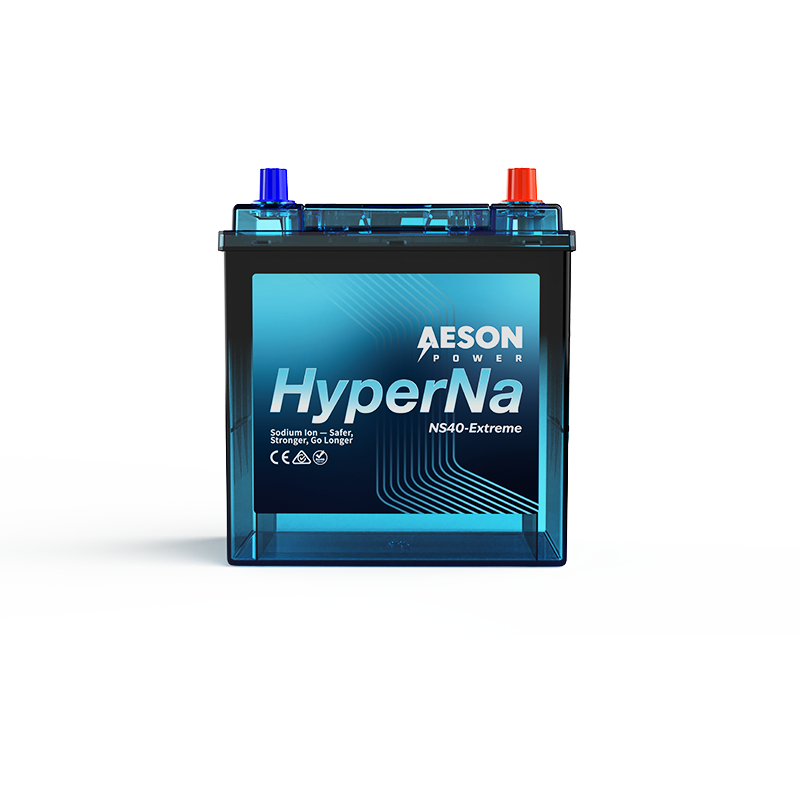
l NS40-Extreme:1,250 PHCA, 520 CCA, 312 Wh, 55-minute reserve capacity, 5.0 kg, and an NS40 case size. It is better suited to compact installations and applications where minimizing battery size and weight is the priority.
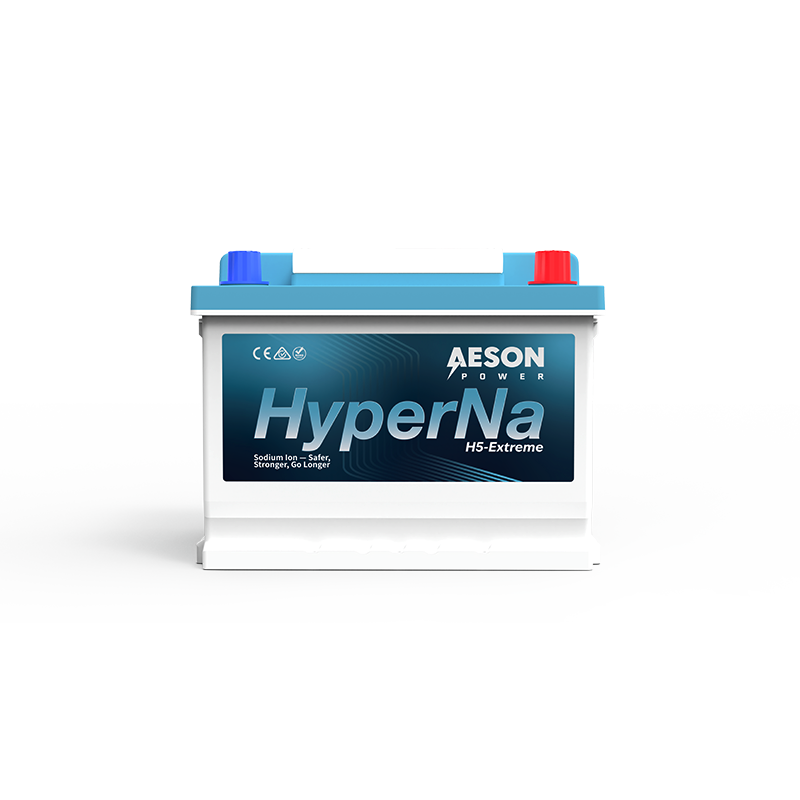
l H5-Extreme: 1,600 PHCA, 660 CCA, 396 Wh, 82-minute reserve capacity, 5.5 kg, and an L2 AGM case size. It is better suited to engines requiring greater cranking output or vehicles with higher onboard electrical demand.
The highest rating is not automatically the right choice. Confirm physical fit, terminal position, charging-system compatibility, cranking requirements, and reserve capacity before installation.
Need help choosing between NS40-Extreme and H5-Extreme? Contact us for a tailored racing battery solution.
-
What Advantages Does a Sodium-Ion Racing Battery Offer Over AGM and Lithium-Ion Batteries?
A sodium-ion racing battery offers a balanced combination of high cranking output, low weight, rapid charging, and thermal stability.
Compared with an AGM racing battery, HyperNa provides:
l Lower battery weight and a stronger power-to-weight ratio
l Rapid charge acceptance with up to 5C fast charging
l High pulse-discharge capability for immediate engine starts
l No electrolyte refilling or routine fluid maintenance
Compared with conventional lithium-ion batteries, sodium-ion chemistry can offer enhanced thermal stability in demanding motorsport environments. HyperNa supports operation at temperatures up to 80°C and improved vibration resistance, while lithium-ion batteries generally provide higher energy density.
-
How Long Does a HyperNa Racing Car Battery Last Under Motorsport Conditions?
The service life of a HyperNa racing car battery depends on the number of starts, depth of discharge, charging method, operating temperature, vibration, onboard electrical demand, and storage conditions.
HyperNa batteries are engineered for long life, rapid charge acceptance, high-temperature operation, and improved vibration resistance. However, motorsport conditions vary significantly, so service life should not be expressed as a guaranteed number of calendar years.
To maximize battery life:
l Use a compatible charging profile
l Avoid prolonged over-discharge
l Secure the battery with the correct mounting hardware
l Inspect terminals, cables, and the battery case regularly
l Monitor voltage during extended storage
l Recharge the battery according to the model-specific instructions
-
Does a Lightweight Racing Battery Sacrifice Cranking Power?
Not necessarily. Battery selection should be based on power-to-weight performance rather than weight alone.
The 5.0 kg NS40-Extreme delivers up to 1,250 PHCA and 520 CCA, while the 5.5 kg H5-Extreme delivers up to 1,600 PHCA and 660 CCA. This allows motorsport teams to reduce battery weight while maintaining strong starting output.
Always confirm that the selected model meets the engine’s cranking requirements and the vehicle’s reserve-capacity needs.
-
Can Aeson Power Customize Racing Batteries for Motorsport Teams?
Yes. Aeson Power can evaluate customized racing battery solutions for motorsport teams, performance-vehicle builders, distributors, and specialized applications.
Customization may include voltage, energy capacity, cranking output, case dimensions, terminal configuration, battery protection functions, branding, packaging, and technical documentation. Available options depend on technical feasibility, certification requirements, and order volume.
Contact us to discuss your racing application and customization requirements.
-
How Long Does an EV Auxiliary Battery Last?
A conventional 12 V auxiliary battery in an EV typically lasts three to five years. Actual service life depends on temperature, charging conditions, standby electrical loads, depth of discharge, driving frequency, and storage.
Aeson Power sodium-ion EV auxiliary batteries are engineered for extended longevity — delivering over 5,000 deep cycles with minimal degradation. Combined with maintenance-free operation and rapid charge acceptance, they provide reliable low-voltage power throughout the vehicle's lifespan, reducing replacement frequency and total cost of ownership. Actual service life will vary by vehicle model, temperature, charging conditions, and duty cycle.
-
What Are the Advantages of a Sodium-Ion EV Auxiliary Battery Over Lead-Acid and Lithium-Ion Batteries?
Compared with traditional lead-acid batteries, Aeson Power sodium-ion auxiliary batteries offer lower weight, up to 5C fast charging, maintenance-free operation, and stronger performance in extreme temperatures.
Compared with conventional lithium-ion batteries, sodium-ion chemistry can provide strong low-temperature charge acceptance and enhanced thermal stability. Aeson Power EV auxiliary batteries are designed to operate at temperatures up to 80°C. (*Actual performance depends on the battery chemistry, pack design, and vehicle operating conditions.)
-
Can a Sodium-Ion EV Auxiliary Battery Be Recharged?
Yes. A sodium-ion EV auxiliary battery is rechargeable and is normally recharged automatically while the vehicle is active. If external charging is required, use only a charger and charging profile approved for the specific sodium-ion battery. Do not assume that every lead-acid or lithium-ion charger is compatible.
-
When Should an EV Auxiliary Battery Be Replaced?
The EV auxiliary battery should be tested or replaced when the vehicle has difficulty waking up, displays low-voltage warnings, repeatedly requires a boost, or develops intermittent electronic faults. Replacement may also be necessary if testing shows poor capacity or if the battery case or terminals are damaged. Always use a replacement that matches the vehicle’s voltage, dimensions, communication requirements, and charging system.
-
Sodium battery charging time?
The charging time is related to the charging voltage and the charging current. For example, with 0.2C current and 14.6V voltage, the full charge time is about 5.5h; while with 1C high current, it isabout 1.1h. Normally, the charge voltage reach the limit value and last for 6-10min means it fully charged.
-
What is the discharge voltage (working voltage, i.e., closed circuit voltage in work) of sodium battery?
The discharge voltage is related to the size of the load and the SoC state of the battery. Thesmaller the load, the higher the voltage; the higher the SoC, the higher the voltage.
The closed-circuit voltage range of a new battery for start-stop use is between 9 and 12V, and thevoltage will gradually drop during usage.
-
Do sodium batteries require maintenance?
Sodium-ion starter batteries are a fully sealed & maintenance-free design, so these are similar to those of lead-acid AGM battery types. The original meaning of the English term MF(Maintenance Free) in the lead-acid battery terminology is that it does not require regular topping.
-
How are sodium batteries recycled?
Since sodium-ion starting batteries are a new technology and still in the stage of continuousimprovement, there is no comprehensive recycling standards and regulations yet, the relevantrecycling specifications are basically still referred to lithium-ion batteries, and it is recommended to consult the local professional organizations at present.
-
Are sodium batteries considered dangerous goods in transportation?
Yes, now basically refer to lithium-ion products regulation.
-
How to operate the sodium battery after over-discharged?
It is recommended to place it in 5~35℃ environment, and then recharge it according to therecommended method. In order to better protect the battery and avoid the damage caused byover-discharge, please recharge it if the battery voltage is less than 1ov.
-
How do I maintenance a sodium-ion battery during long time storage?
Short-term storage (1-3 months): generally no special maintenance is needed. Regularvoltage checks are recommended in higher temperatures (>35°C) to prevent excessiveself-discharge.
Medium-term storage (3-6 months): Possible 5%~20% capacity loss; check voltage every 3months. Recharge if the voltage drops to 10V per 12V.
Long-term storage (6 months or more): Possible 20%~40% capacity loss; recommendingCharge to 40%~60%soC to prevent irreversible damage for long time storage management..