










Selecting a car starting battery pack is a technical purchasing decision, especially for automotive manufacturers, fleet operators, service providers, and professional buyers. We need more than a battery that simply fits the vehicle. Starting performance, physical dimensions, charging behavior, maintenance requirements, weight, and supply reliability can all affect operational results. As sodium-ion technology develops, we also need to evaluate whether its characteristics match the intended vehicle and duty cycle.
1. Check the Required Voltage and Starting Power
We should begin with the vehicle’s electrical requirements. A battery’s nominal voltage must match the vehicle system, while cold cranking amps (CCA) indicate its ability to deliver high current for engine starting under specified test conditions.
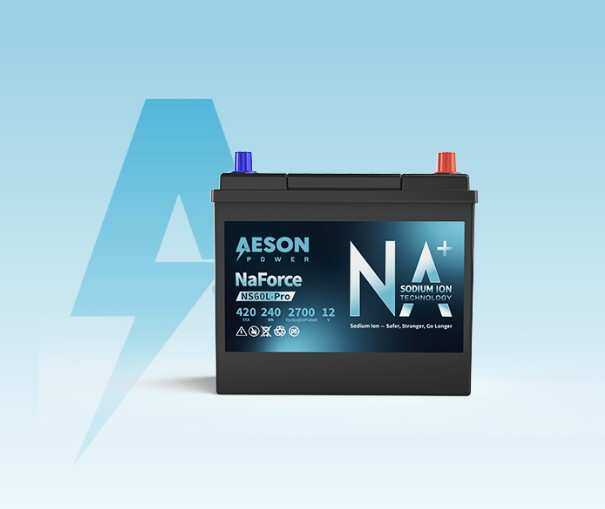
Our NS40L serves as a 12V sodium-ion starting battery with a rated 350A CCA. This rating provides business buyers with a direct benchmark for engine-starting current under demanding cold conditions.
2. Check the Battery Dimensions and Case Size
Physical compatibility is just as important as electrical performance. We should verify length, width, height, terminal arrangement, mounting requirements, and available clearance before approving a replacement battery.
The Aeson Power NS40L measures 196 × 127 × 200(220) mm and corresponds to the NS40 case size. This information helps procurement and engineering teams verify whether the battery can fit the intended vehicle platform without relying on assumptions based only on nominal voltage.
3. Check Energy Capacity Against the Application
Starting power and stored energy are different specifications. CCA describes high-current starting capability, while energy indicates how much electrical energy the battery can store. We should therefore consider both when selecting a battery for a particular vehicle.
Our NS40L provides 198Wh of nominal capacity to back its starting performance. For business applications, we recommend evaluating these values together with the vehicle’s electrical loads, operating pattern, charging system, and expected accessory usage.
4. Check Weight and Vehicle-Level Benefits
Battery weight can influence vehicle efficiency, payload, installation, and handling. This becomes increasingly relevant for commercial vehicle programs and applications where every kilogram matters.
The NS40L weighs 3.5 kg. Aeson Power also specifies its sodium-ion starting-battery platform with a light-weight design equivalent to 60% of a traditional lead battery. We should still evaluate weight together with the required electrical performance rather than treating lower mass as the only purchasing criterion.
5. Check Charging and Operating Conditions
A starting battery operates within a larger vehicle charging system, so we need to confirm charging compatibility rather than selecting a chemistry in isolation. Temperature is another consideration because engine compartments can expose batteries to demanding thermal conditions.
Our sodium-ion starting batteries feature high-temperature operation up to 80°C and 5C fast charging. The IEA also identifies strong low-temperature performance as an important characteristic of sodium-ion batteries, although application-specific testing remains essential.
6. Check Maintenance and End-of-Life Considerations
Maintenance requirements can affect fleet operating costs and service schedules. For professional buyers managing numerous vehicles, a maintenance-free battery can simplify routine battery management.
Our NS40L is specified as maintenance free and recycling friendly. We consider these characteristics valuable for businesses seeking simpler battery servicing and more responsible end-of-life planning. At the same time, recycling processes and regulations for emerging sodium-ion batteries are still developing, so buyers should follow applicable local requirements and approved recycling channels.
7. Check Sodium-Ion Battery Manufacturing Capability
The final check should extend beyond the battery itself. We should evaluate the manufacturer’s production capacity, quality systems, supply-chain security, and ability to support ongoing commercial demand. This becomes particularly important when adopting newer chemistry at scale.
Our sodium-ion battery manufacturing capabilities are backed by a vast industrial footprint featuring seven specialized production hubs, 90 automated assembly lines, and an annual capacity of 30 GWh across 1.1 million square meters. We combine manufacturing resources with secure supply chains and rigorous quality control to support consistent product delivery.
Making a Confident Battery Purchasing Decision
A suitable car starting battery pack should satisfy the complete application, not just one specification. We recommend checking electrical compatibility, case dimensions, CCA, energy, weight, charging requirements, operating temperatures, maintenance, recycling considerations, and manufacturer capability before placing a commercial order.
Sodium-ion technology gives buyers another option as battery markets diversify. The IEA reports that sodium-ion batteries are entering a scale-up phase, with particular advantages in low-temperature performance and potential supply-chain diversification, while also noting that the technology remains less mature than lithium-ion.
Our Approach to Reliable Automotive Battery Supply
At Aeson Power, we develop and supply sodium-ion, lead-acid, and lithium-ion battery solutions for automotive and other applications. Our sodium-ion starting-battery portfolio includes models designed for different vehicle requirements, while our manufacturing infrastructure supports consistent quality and factory-direct supply.
If you are sourcing a car starting battery pack for an automotive program, fleet, or replacement application, contact Aeson Power to discuss your technical requirements. We can help you evaluate the appropriate sodium-ion solution and build a reliable supply plan for your business.