









What Is Sodium-Ion Battery Technology and How Does It Work?
Battery selection is often reduced to a comparison of energy-density figures. In vehicle applications, however, the more useful question is whether a battery can deliver dependable power after long periods of inactivity, during a cold start, and across thousands of charge-discharge events.
At Aeson Power, our sodium-ion development work begins with those operating conditions. This application-first perspective explains why sodium-ion chemistry is attracting attention as a practical alternative rather than simply another laboratory technology.
What Is a Sodium-ion Battery?
A sodium-ion battery stores and releases energy by shuttling sodium ions between a positive electrode and a negative electrode. The basic architecture resembles that of a lithium-ion cell, but changing the mobile ion changes the choice of electrode materials, electrolyte formulation, voltage profile, and thermal behavior. Those differences shape the cell's power output, low-temperature response, safety characteristics, and service-life consistency.
Sodium-ion vs Lithium-ion vs Lead-acid Batteries
Each of the three chemistries solves a different engineering problem. A fair comparison therefore needs to look beyond a single headline specification and consider the duty cycle, climate, packaging limits, safety requirements, and total cost of operation.
Lithium-ion technology is especially strong when a system must store substantial energy in a small, lightweight package. Lithium's electrochemical properties support high cell voltage and high specific energy, which is valuable in portable electronics and traction batteries. The trade-off is that material cost, thermal management, cold-weather power, and high-rate aging can become important design constraints.
Lead-acid batteries remain widely used because the supply chain is established, the initial purchase price is low, and the charging requirements are familiar. Their limitations become clearer under demanding use: cold temperatures reduce reaction rates, heavy current raises polarization and voltage drop, and repeated partial-state-of-charge operation can promote sulfation and electrolyte stratification. These effects reduce available starting power and shorten useful life.
Sodium-ion cells are positioned between those two approaches. They do not aim to beat every lithium-ion cell on energy density or every lead-acid battery on purchase price. Instead, their value can come from rapid power delivery, resilient ion transport, broad-temperature operation, and the use of widely available raw materials. Because sodium ions are larger than lithium ions, the host structures and interfaces must be engineered specifically for repeated, low-stress insertion and extraction.
For an automotive starter battery, these priorities can matter more than maximum stored energy. The battery must produce a high current within seconds, recover efficiently, and repeat that response in winter and summer conditions. A chemistry that holds its resistance and voltage response more consistently may therefore provide greater real-world value even when its gravimetric energy density is not the highest.
Lead-acid Battery | Lithium-ion Battery | Sodium-ion Battery | |
Energy Density | Low | High | Medium |
Cycle Life | Short | Long | Long |
Thermal Stability | Good | Moderate | Good |
Temperature Adaptability | Moderate | Moderate | Good |
Upfront Cost | Low | High | High |
Environmental Impact | Contains toxic lead, but has a mature recycling system | Mining of lithium, cobalt, and nickel might cause environmental damage | Uses abundant materials and generally has a lower environmental impact |
Best for | When low upfront cost, mature supply chains, and simple charging systems are the main priorities | When high energy density, low weight, and compact size are the main priorities | When instant power delivery, wide temperature adaptability, and long-term consistency are the main priorities |
The Structure of a Sodium-Ion Battery
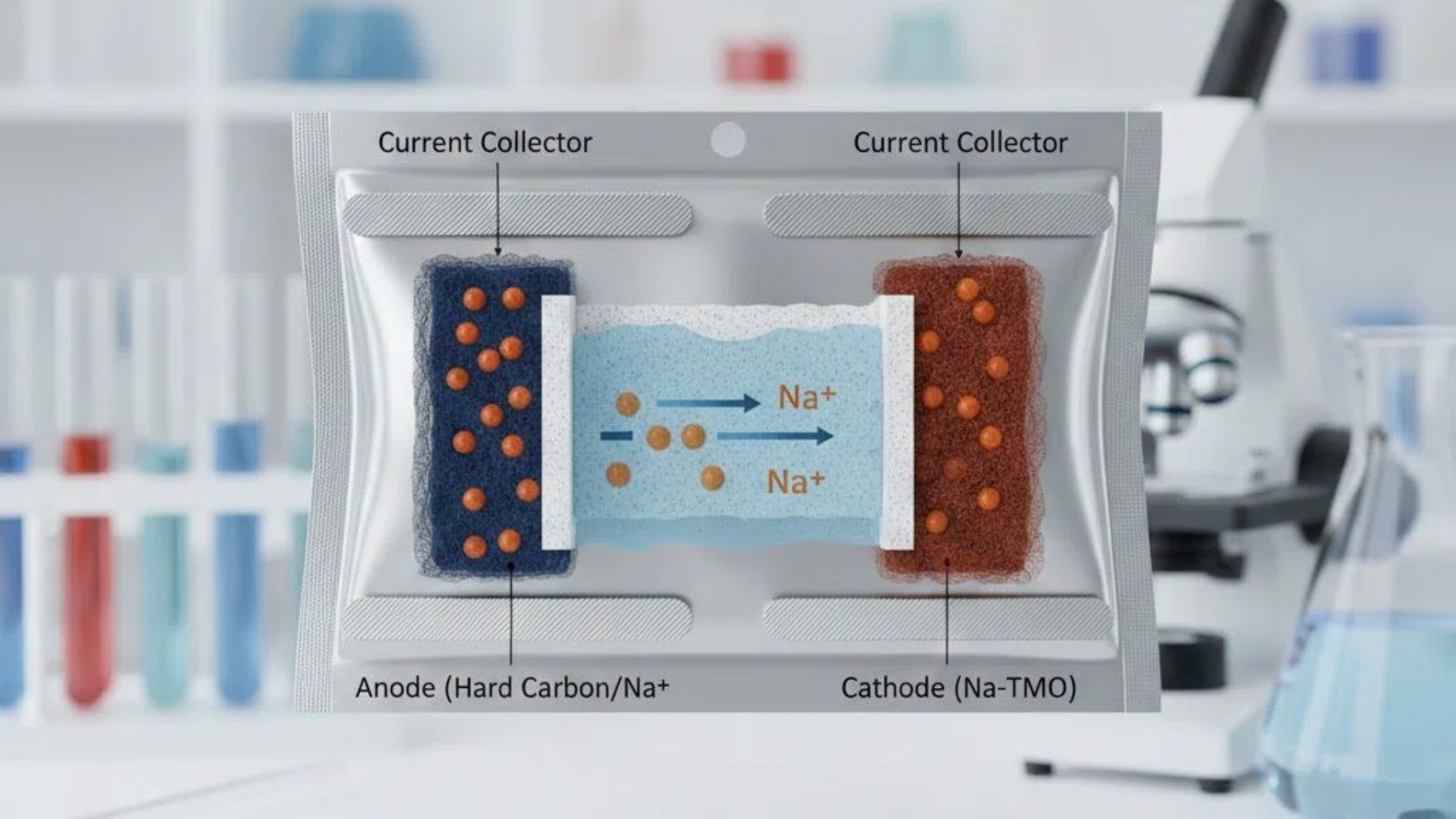
A sodium-ion cell is built around four functional elements: the cathode, anode, electrolyte, and separator. Their materials are selected as a coordinated system. The objective is to provide accessible pathways for sodium ions while limiting structural change and unwanted interfacial reactions throughout the battery's operating life.
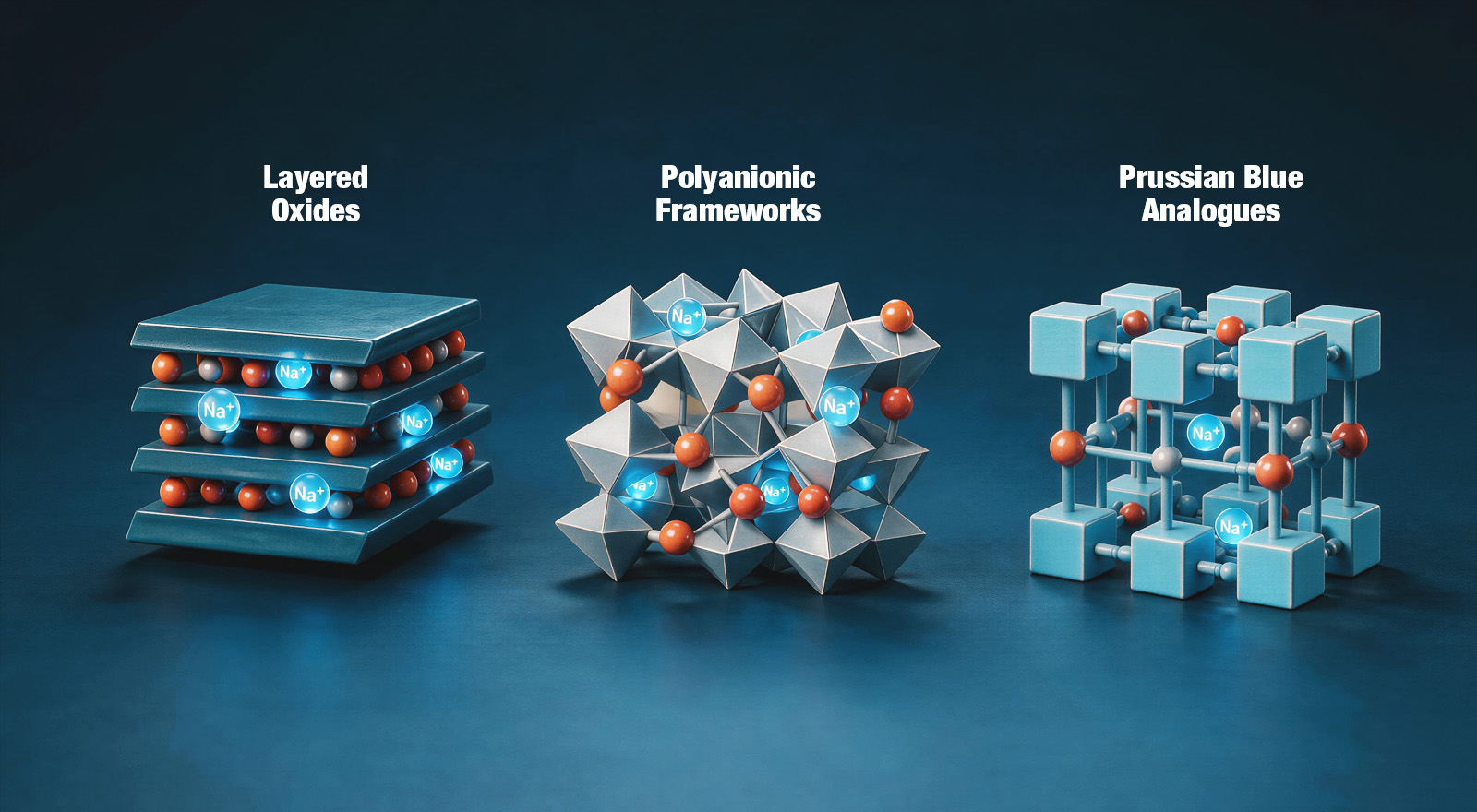
On the positive-electrode side, developers commonly evaluate Prussian blue analogues and sodium-based polyanionic compounds. Their relatively open frameworks can accommodate sodium-ion movement with manageable lattice strain. Stable host structures help preserve reaction reversibility during repeated cycling and can also support favorable thermal-safety characteristics.
The negative electrode is typically made from hard carbon. Conventional graphite, which works well in many lithium-ion cells, does not store sodium efficiently under ordinary conditions. Hard carbon contains disordered layers, pores, and varied binding sites that provide several sodium-storage pathways. Its microstructure can be tuned to balance capacity, first-cycle efficiency, rate performance, and low-temperature response.
The electrolyte carries ions between the electrodes and helps form protective interphases on their surfaces. Solvent, sodium salt, concentration, and additives must be chosen together because they influence conductivity, gas generation, interfacial resistance, and cold-temperature operation. The separator completes the internal architecture by preventing electronic contact between the electrodes while allowing ionic transport. In practice, electrolyte and interface design often determines whether promising electrode materials can perform reliably outside the laboratory.
What Happens During Charge and Discharge
When the battery charges, the external charger removes electrons from the cathode and supplies them to the anode through the outer circuit. To maintain charge balance, sodium ions leave the cathode, cross the electrolyte and separator, and enter storage sites in the hard-carbon anode. During discharge, revers route producing useful electrical power. Cell resistance, diffusion distance, and interface quality govern how efficiently this cycle occurs, especially at high current or low temperature.
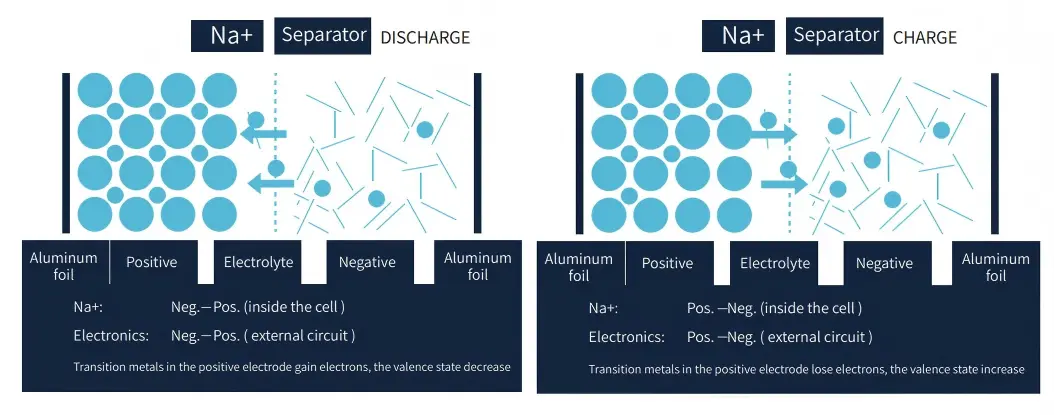
Working Principle of Sodium-ion Battery
Key Features of Aeson Power’s Sodium-Ion Batteries
At Aeson Power, we work on designing and optimizing sodium-ion batteries. Our development priorities are instant power, generous safety margins, and stable operation over a broad temperature range. Those attributes are particularly relevant to starting, lighting, and ignition systems, where a short burst of dependable power is more important than storing the maximum possible energy in the smallest volume.
For modern vehicles, the engineering advantages can be summarized in three practical outcomes:
Immediate starting power: A low-resistance cell design can supply the short, high-current pulse needed to crank an engine. The aim is consistent starting response after overnight cold soak, during repeated starts, and when vehicle electrical loads are high.
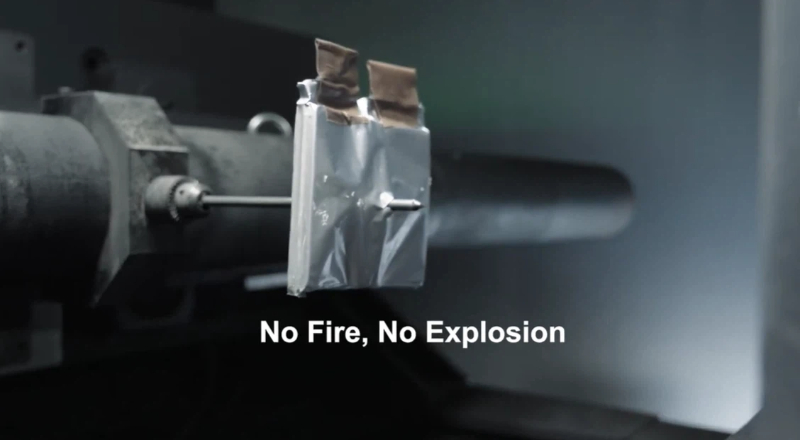
A safety-oriented material system: Thermally stable cathode frameworks improve tolerance to elevated temperature and electrical abuse. Safety still depends on cell design, manufacturing quality, controls, and system integration; it is not a property of the active material alone.
Performance across climates: Electrode porosity, electrolyte conductivity, and interface stability are optimized together to limit the rise in internal resistance at low temperature while maintaining durability in hot conditions. This supports a more predictable power response across seasonal and regional temperature changes.
Sodium-ion technology is not a universal replacement for every battery chemistry. Its strongest opportunities are applications whose requirements align with its power, temperature, safety, and material-availability profile. As cell materials and manufacturing processes continue to mature, sodium-ion batteries can become an important option for robust automotive power systems and other high-rate uses.