










Vehicle starting requirements vary across passenger cars, commercial vehicles, performance vehicles, and electrified platforms. For business buyers, choosing an automotive starting battery is not simply about matching voltage. We need to consider cold cranking performance, physical dimensions, operating temperature, charging behavior, weight, and the vehicle’s duty cycle. As a sodium-ion battery manufacturer, we see these factors shaping battery selection.
Match Battery Size and Electrical Requirements First
The first step is confirming the vehicle manufacturer’s required battery size, terminal configuration, voltage, and starting performance. Dimensions must fit the available tray and hold-down system, while electrical specifications must support the vehicle’s starter and onboard systems. We should never select a replacement solely because its voltage matches; physical compatibility and cranking performance are equally important.
CCA, or cold cranking amps, is particularly relevant for engine starting. It indicates how much current a battery can deliver under standardized cold-start conditions. A battery with inadequate CCA may struggle to provide dependable starts, especially in cold environments. For fleet operators and automotive suppliers, matching CCA helps balance starting reliability with battery size and cost.
Passenger Cars Need a Balanced Starting Solution
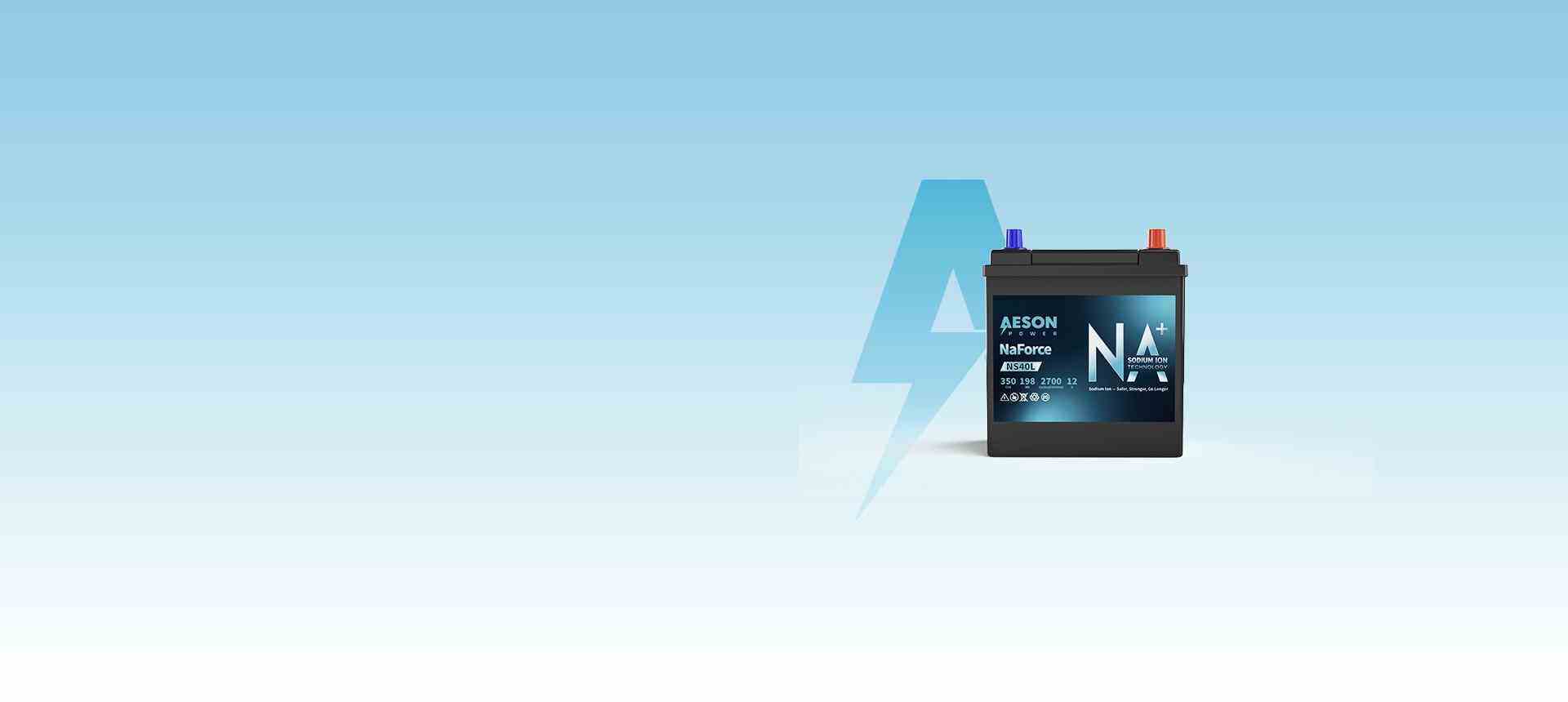
Passenger vehicles generally require a compact battery that can provide reliable starting power without adding unnecessary mass. We should evaluate the original battery size, terminal arrangement, CCA requirement, and charging system before selecting a replacement. Aeson Power’s NaForce range includes sodium-ion starting batteries designed to replace several common passenger-car formats, including L1, L2, NS40, NS60, D23, and D26 sizes.
For compact passenger cars using the L1 case format, our H4/LN1 is an example. It provides 12V voltage, 360A CCA, and 198Wh nominal energy. Its dimensions are 207 × 175 × 190 mm, with a 3.5 kg weight. It also features long life, operation up to 80°C, 5C fast charging, maintenance-free operation, recycling-friendly design, and weight approximately 60% lower than a traditional lead battery.
Start-Stop Vehicles Require More Cycling Capability
Vehicles equipped with automatic start-stop systems place different demands on batteries because the engine may shut down and restart repeatedly during traffic. We should therefore prioritize cycle performance, charge acceptance, and reliable high-current delivery rather than focusing only on one-time starting power.
Aeson Power offers a dedicated NaForce SS range for passenger-car start-stop applications. We state that these batteries can provide up to 180,000 start-stop cycles, making them suited to frequent engine-off and engine-on events. For business customers, matching chemistry and cycling capability to the operating pattern can support reliability.
Commercial Vehicles Need Higher Starting Performance
Commercial vehicles often have larger engines and more demanding operating schedules. Trucks, vans, and other commercial platforms may therefore require higher CCA and greater electrical capability than compact passenger cars. We should also consider ambient temperature, daily operating hours, accessory loads, and the physical battery compartment when specifying a starting battery.
Our NaForce portfolio extends beyond compact formats. The L2-400L-Pro, for example, is rated at 12V, 520A CCA, and 312Wh, with dimensions of 242 × 175 × 190 mm and a listed weight of 4.8 kg. Larger models reach higher CCA ratings and energy levels, allowing buyers to select specifications according to the vehicle rather than applying one battery to every application.
Performance Vehicles Demand Fast, Reliable Power
Racing and performance vehicles create another set of priorities. Battery weight can affect vehicle dynamics, while strong cranking performance remains essential. A lightweight battery can reduce mass without sacrificing starting capability, but buyers still need to verify dimensions, terminals, CCA, and compatibility with the vehicle’s electrical architecture.
Aeson Power addresses this market through its HyperNa racing-car starting battery line. More broadly, our sodium-ion technology emphasizes high-rate performance, thermal stability, and long service life. These characteristics can be valuable when a vehicle operates under demanding conditions and when reducing battery mass is an important engineering consideration.
Why Sodium-Ion Is Worth Considering
Sodium-ion starting batteries are gaining attention because they can combine high-rate performance with low weight and strong thermal stability. Our NFPP-based technology uses a polyanionic cathode structure designed for safety, structural stability, and high-power applications. We also design starting batteries for demanding temperature conditions, with relevant NaForce products specified for operation up to 80°C.
For procurement teams, sodium-ion should be selected according to application requirements rather than technology trends alone. We recommend comparing required CCA, case size, energy, temperature conditions, charging profile, cycle demand, and weight. This structured approach makes it easier to identify the battery chemistry and specification that optimally fits the vehicle fleet.
Aeson Power Helps Businesses Specify the Right Starting Battery
At Aeson Power, we are a sodium-ion battery manufacturer focused on practical battery solutions for transportation and demanding applications. Our portfolio includes sodium-ion automotive start-stop and starting batteries, commercial starting batteries, racing-car starting batteries, EV auxiliary batteries, and UPS batteries, alongside other energy-storage technologies.
We combine sodium-ion development with application-focused engineering to help business customers select suitable battery specifications for different vehicles. If you are sourcing automotive starting batteries, developing a new vehicle platform, or evaluating a lighter alternative to traditional lead batteries, contact Aeson Power to discuss your requirements and find the right starting-battery solution.