










Vehicle starting systems demand more than a battery that simply delivers power at ignition. Fleet operators, automotive manufacturers, and service businesses increasingly evaluate starting batteries by weight, recharge speed, operating temperature, service life, and maintenance requirements. As battery technology evolves, sodium-ion is emerging as a practical alternative to lead acid car battery designs for selected automotive applications. We believe the shift is driven by measurable operating advantages rather than novelty alone.
Why Lead-Acid Is No Longer the Only Starting-Battery Choice
Lead-acid batteries remain widely used because they are proven, established, and well suited to conventional starting, lighting, and ignition duties. However, procurement teams now have broader performance priorities. Battery mass affects vehicle efficiency and handling, while frequent replacement, charging downtime, and demanding temperature conditions can increase the total cost of ownership.
This is where sodium-ion technology deserves closer consideration. The International Energy Agency notes that sodium-ion batteries can perform particularly well at low temperatures, while the Battery Council International highlights sodium’s abundance, reduced overheating risk, and practical safety advantages. These characteristics make sodium-ion technology attractive for applications where operating resilience matters.
The Business Case for a Lighter, Faster-Charging Battery
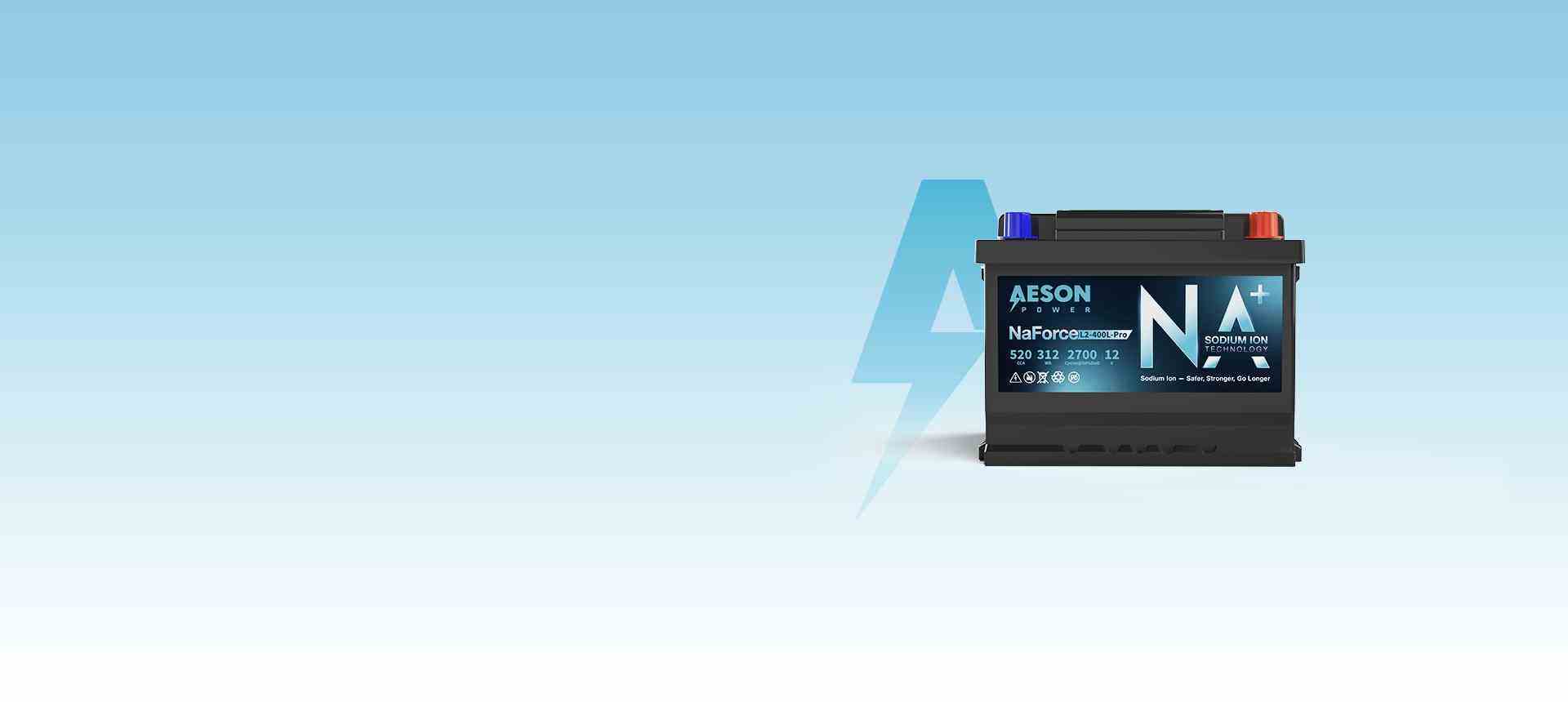
For commercial fleets and equipment operators, battery weight is not merely a specification. It can influence system design, installation, transportation, and overall vehicle efficiency. Aeson Power’s L2-400L-Pro, for example, is designed as a 12V starting battery with 520A CCA and 312Wh nominal energy. Its official product specification lists dimensions of 242 × 175 × 190(190) mm and a weight of 4.8 kg.
The same model is specified with 5C fast charging, maintenance-free operation, long life, and recycling-friendly characteristics. Aeson Power also states that it is 60% lighter than a traditional lead battery and can operate at temperatures up to 80°C. For professional buyers, these features can translate into easier handling and greater flexibility when selecting batteries for demanding environments.
Reducing Maintenance Burden Across Vehicle Operations
Maintenance requirements also matter when batteries are deployed across fleets, workshops, commercial vehicles, or other professional equipment. Every inspection, service intervention, or charging delay can add operational friction. A maintenance-free design can therefore simplify routine battery management, especially when many vehicles need to remain available.
Recycling considerations are becoming increasingly relevant as procurement teams look beyond initial purchase price. A battery with a more practical end-of-life pathway can support broader sustainability objectives. We should still assess recycling arrangements according to local regulations and infrastructure, but recycling-friendly design is a useful consideration during supplier evaluation.
Why Temperature Performance Matters for Professional Vehicles
Temperature is a critical consideration in automotive battery selection. Vehicles may operate outdoors, in hot engine compartments, or across seasonal temperature extremes. A battery that maintains dependable performance across a broader operating window can help reduce concerns related to harsh conditions.
Sodium-ion chemistry is gaining attention partly because of its temperature resilience. The IEA reports that newer sodium-ion batteries can operate at temperatures as high as 70°C, while research reviewed by the Royal Society of Chemistry describes stronger low-temperature capacity retention than conventional lithium-ion batteries in certain engineered configurations.
For buyers, the lesson is not that one chemistry is universally superior. Instead, we should match the battery chemistry to the operating profile, starting requirements, charging system, installation space, and environmental conditions of the vehicle.
Sodium Battery Manufacturer Support for Automotive Procurement
Technology is only one part of a successful battery sourcing strategy. Business customers also need consistent quality, dependable supply, and product coverage across different applications. Aeson Power currently supports automotive start-stop, automotive starting, commercial starting, racing car starting, EV auxiliary, and UPS applications. The company also provides customized sodium battery, transportation, and reserve solutions.
Aeson Power describes its manufacturing network as seven manufacturing centers with 90 production lines and 30 GWh of annual production capacity. Its company profile also emphasizes rigorous quality control and secure supply chains. For procurement teams, this manufacturing foundation matters because battery performance must be supported by repeatable production and reliable supply.
Making the Transition with the Right Application Fit
Moving beyond lead-acid does not mean replacing every battery immediately. Professional buyers should evaluate CCA, nominal energy, dimensions, charging compatibility, temperature exposure, expected service conditions, and maintenance requirements before making a change.
For suitable starting applications, sodium-ion can offer a compelling combination of lightweight construction, fast charging, high-temperature operation, and maintenance-free use.
Building the Next Generation of Automotive Power
We are Aeson Power, a sodium battery manufacturer focused on bringing safer, high-quality battery technology to practical applications. We deliver factory-direct supply of sodium-ion, lead-acid, and lithium-ion batteries, supporting transportation and other demanding energy needs through a broad product portfolio and global manufacturing capabilities.
As automotive requirements continue to evolve, we believe battery selection should be based on verified performance, application fit, and long-term supply confidence. If you are evaluating an alternative to lead acid car battery technology for starting or fleet applications, contact Aeson Power to discuss the right sodium-ion solution for your requirements.