










When we look at an electric vehicle, it is easy to think that one large traction battery does everything. In practice, we rely on two electrical layers: a high-voltage traction battery for propulsion and a low-voltage auxiliary battery for controls and everyday electronics. Understanding these roles explains why an EV can have plenty of driving range yet still fail to wake up when its auxiliary battery is depleted.
Why Do We Use Two Batteries in One EV?
We use the high-voltage traction battery as the vehicle’s main energy store. It supplies the energy needed for the electric motor and other high-voltage loads. The high-voltage traction battery provides propulsion power, while the auxiliary battery supports the vehicle’s low-voltage electrical and control systems.
We keep the auxiliary battery separate because many control units and conventional vehicle electronics operate on a low-voltage architecture. The 12V system can support lights, wipers, audio, locks, displays, controllers, and related functions without placing those circuits directly on the high-voltage bus. We also use this low-voltage layer during vehicle startup and high-voltage system activation.
What Is the Auxiliary Battery in an EV?
When we answer “what is the auxiliary battery,” we mean a rechargeable low-voltage battery, typically 12V in electric passenger cars, that supplies the vehicle’s low-voltage electrical and control systems. We may also use 24V auxiliary systems in some electric commercial vehicles. We do not use the auxiliary battery to drive the traction motor; it serves a different layer of vehicle operation.
One of its most important jobs appears before propulsion begins. We use low-voltage power to operate the controls that allow the high-voltage battery to connect safely to the vehicle. Our low-voltage auxiliary battery powers the contactors that connect the high-voltage traction battery, so the vehicle may not enter its normal ready state if the auxiliary battery is depleted.
This is why we should not judge an EV only by the state of charge shown for the traction battery. Even with substantial energy in the high-voltage pack, we may be unable to bring the vehicle into its normal ready state when the auxiliary battery cannot support the necessary low-voltage functions.
How Do the Traction and Auxiliary Batteries Work Together?
Once we activate the high-voltage system, we can use a DC-DC converter to step high voltage down to the low-voltage level. We then use that converted power to support low-voltage loads and, depending on the vehicle design, recharge or maintain the auxiliary battery.
The auxiliary battery supports low-voltage controls and electronics, while the high-voltage traction battery serves the vehicle’s propulsion system. We therefore use both batteries as coordinated parts of one electrical architecture.
Because the exact architecture differs between vehicle manufacturers, we always need to match an auxiliary battery to the original vehicle requirements. We consider voltage, physical dimensions, energy capacity, communication requirements, charging strategy, and battery-management compatibility. We should not assume that every battery labeled “12V” is automatically interchangeable in an EV.
Why Are We Exploring Sodium-Ion Auxiliary Batteries?
For EV auxiliary applications, we focus on reliable low-voltage power, charging capability, temperature performance, vehicle communication where required, and compatibility with the original electrical architecture. These requirements give us opportunities to develop alternatives to conventional lead-acid and lithium-ion auxiliary battery designs.
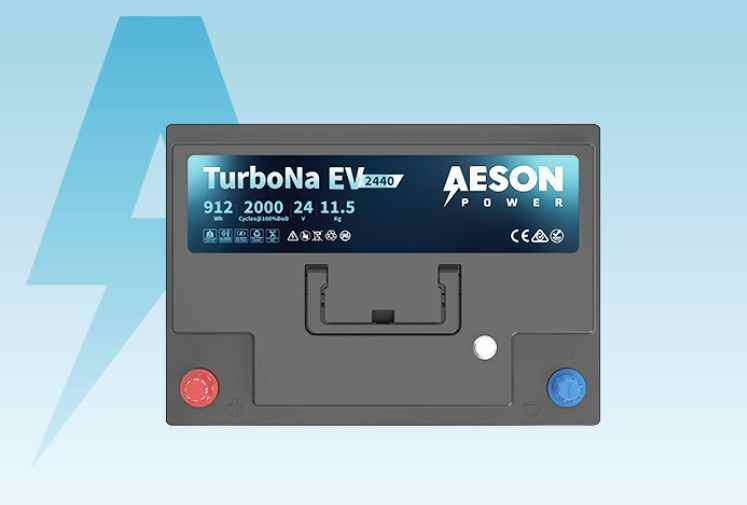
At Aeson Power, we apply sodium-ion technology to both 12V and 24V EV auxiliary batteries. Our EV range includes the NaForce EV 1215 for electric passenger cars and TurboNa EV models for electric commercial vehicles. We develop these products around low-voltage vehicle requirements rather than treating them as smaller versions of traction batteries.
Our NaForce EV 1215 is rated at 12V and 180Wh, weighs 3.2 kg, measures 265 × 180 × 75 mm, and supports CAN/CANFD communication. For commercial EVs, our TurboNa EV 1220 is a 12V, 228Wh model weighing 3.5 kg, while our 2440 provides 24V and 912Wh with a listed weight of 11.5 kg.
These specifications show why we recommend matching by vehicle requirements rather than voltage alone. We work with vehicle OEM requirements and support customized 12V and 24V low-voltage solutions. We ask customers to provide the vehicle model or original battery specifications so we can evaluate an appropriate configuration.
What Should We Check When Selecting an Auxiliary Battery?
We start with the original low-voltage system voltage, then verify dimensions, connection layout, charging requirements, energy needs, communication protocol, and battery-management integration. We also consider the operating environment and duty cycle, especially for commercial vehicles that may face longer operating hours or more demanding temperature conditions.
We also follow the vehicle manufacturer’s service and replacement procedures. Because auxiliary batteries can participate in high-voltage system activation, we do not view replacement as simply choosing a battery with a similar case size. Correct electrical and system compatibility remains essential for dependable operation.
Work With Aeson Power on EV Auxiliary Battery Solutions
At Aeson Power, we focuse on bringing sodium-ion technology into automotive, backup-power, and customized applications. We offer automotive start-stop, starting, commercial starting, racing, EV auxiliary, and UPS battery lines. Our company profile lists seven manufacturing centers, 90 production lines, and 30 GWh of annual production capacity.
As a sodium ion batteries manufacturer and solution partner, we combine sodium-ion product development with 12V and 24V EV auxiliary options, OEM-oriented matching, and customized battery support. If you are evaluating an auxiliary battery for an electric passenger car, commercial EV, or new vehicle program, contact us with your vehicle model or low-voltage battery requirements. We can help identify a suitable Aeson Power configuration for your application.