










Battery buyers are looking beyond lithium-ion and lead-acid as application requirements become more demanding. We see sodium-ion batteries attracting greater attention because they combine material availability, strong temperature performance, safety potential, and high-rate capability. For companies making sodium-ion batteries, the opportunity is no longer only about developing a new chemistry. It is about solving practical problems in transportation, backup power, and other commercial applications where reliability matters.
Why Sodium-Ion Batteries Are Drawing More Industry Attention
Sodium-ion batteries operate on a principle similar to lithium-ion systems: sodium ions move between the positive and negative electrodes during charge and discharge. The key difference is the active ion and the materials used to host it. Sodium is abundant, which can help diversify battery supply chains and reduce exposure to lithium price volatility. The International Energy Agency identifies sodium-ion technology as an emerging chemistry entering the scale-up phase, while also noting that its manufacturing ecosystem remains much smaller than lithium-ion’s.
For business buyers, this combination creates a practical reason to watch the technology. A battery chemistry does not need to replace lithium-ion everywhere to be valuable. It can become particularly attractive where temperature tolerance, high power, safety, or supply-chain diversification matter more than maximum energy density. That makes sodium-ion an increasingly relevant option for specialized commercial and industrial applications.
NFPP Chemistry Supports High Safety and Long Life
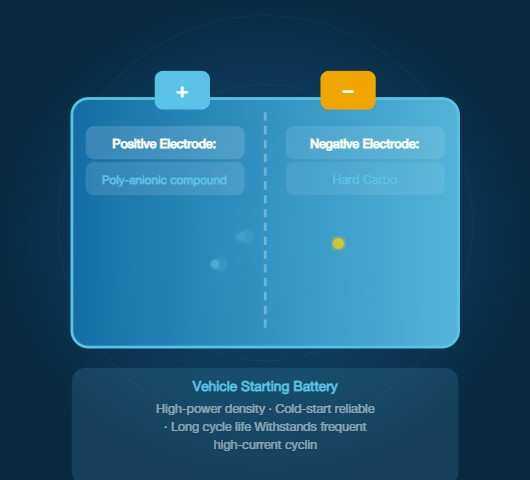
Not all sodium-ion batteries use the same cathode chemistry. Current development includes layered metal oxides, Prussian blue analogues, and polyanion compounds. We have selected NFPP, Na₄Fe₃(PO₄)₂(P₂O₇), because its polyanionic framework provides structural stability and supports sodium-ion transport. Our technology platform emphasizes long life, high safety, thermal stability, and sustainable material selection.
NFPP is especially relevant when batteries face repeated cycling and demanding operating conditions. A stable crystal framework can help limit structural changes during cycling, while strong bonding within the polyanion structure contributes to thermal stability. For procurement teams and system designers, these characteristics can translate into greater confidence when evaluating battery performance over the intended service life.
Low-Temperature Performance Creates Practical Value
Temperature is one of the most important variables in battery performance. The IEA reports that the latest sodium-ion batteries can retain around 90% of nominal capacity at temperatures as low as -40°C and operate at temperatures up to 70°C. These figures are technology-level observations, not specifications for every sodium-ion product, but they illustrate why the chemistry is attracting attention for cold-climate applications.
We see this advantage clearly in vehicle starting and start-stop systems. Starting batteries need to deliver high current quickly, often after exposure to low temperatures. Our NFPP-based approach uses a stable voltage platform and favorable low-temperature kinetics to support consistent starting performance. This makes sodium-ion particularly interesting for passenger vehicles, commercial vehicles, and other equipment where dependable power delivery is essential.
Companies Making Sodium-Ion Batteries Are Expanding Applications
The market is moving beyond laboratory research. The IEA reports that sodium-ion batteries are entering the scale-up phase, with major battery producers increasing their involvement. At the same time, companies making sodium-ion batteries are developing products for automotive, energy storage, UPS, and auxiliary power applications.
We have developed a portfolio that reflects this broader commercial direction. Our sodium-ion products include automotive start-stop batteries, automotive starting batteries, commercial starting batteries, racing-car starting batteries, EV auxiliary batteries, and UPS batteries. We also supply lead-acid and lithium-ion solutions, allowing business customers to evaluate battery chemistry according to application requirements rather than forcing every project into one technology.
Where Sodium-Ion Batteries Make Business Sense
For commercial buyers, technology selection should start with the duty cycle and operating environment. Sodium-ion can be compelling when frequent high-current operation, wide temperature exposure, safety, or reduced dependence on lithium-based supply chains is important. Vehicle starting and start-stop systems are a strong example because they require rapid power delivery, repeated cycling, and reliable operation across changing temperatures.
Sodium-ion is not automatically the optimal choice for every project. The IEA notes that current sodium-ion batteries generally have lower energy density than lithium-ion, while their supply chains and manufacturing capacity are still developing. We therefore recommend evaluating cycle requirements, power demand, temperature range, installation constraints, total cost of ownership, and supply continuity before selecting a chemistry.
Aeson Power: Building Practical Sodium-Ion Solutions
At Aeson Power, we are a sodium-ion battery manufacturer focused on turning emerging battery technology into dependable commercial products. We provide factory-direct supply of sodium-ion, lead-acid, and lithium-ion batteries for diverse applications, supported by seven manufacturing centers, secure supply chains, and rigorous quality control.
Our NFPP polyanion technology is particularly focused on vehicle starting applications, where high power, thermal resilience, long life, and low-temperature performance are critical. As sodium-ion technology continues to scale, we will keep developing battery solutions around real operating requirements rather than technology hype. If you are evaluating sodium-ion batteries for automotive, UPS, or other commercial applications, contact Aeson Power to discuss your requirements and identify the right solution for your project.