









By Chris Taylor
About the Author
Chris Taylor is a Senior Engineer at Aeson Power, specializing in sodium-ion cell design and performance optimization. His research focuses on high-rate discharge behavior, thermal stability at extreme high temperatures, low-temperature adaptability, and real-world operational performance of sodium-ion batteries.
After working in sodium-ion batteries for so many years, I am often asked the same question: are sodium-ion batteries actually good?My answer is usually: it depends on which technical pathway is being used.
The answers to questions such as a battery’s performance, service life, and whether it remains safe under extreme operating conditions are, to a large extent, determined by the cathode material—that is, the technology route.
The cathode is the “home base” of sodium ions. During charging, sodium ions leave the cathode, pass through the electrolyte, and intercalate into the anode; during discharge, they return along the same path. The crystal structure of the cathode determines how fast this journey can be made, how many times it can be repeated, and whether the battery can still operate in a -30°C winter or in a parking lot exposed to intense summer heat.
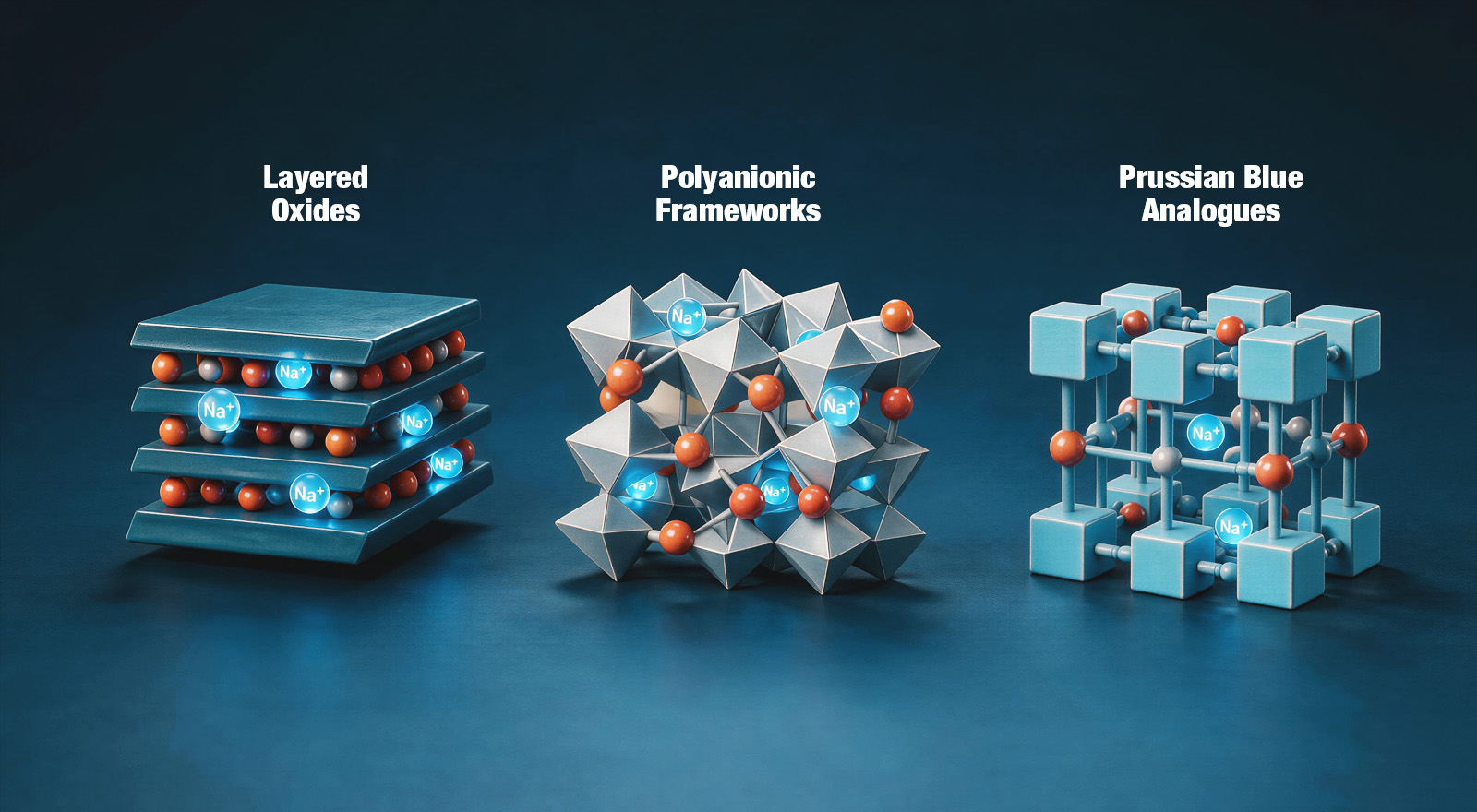
At present, sodium-ion cathodes mainly follow three technical routes: layered metal oxides (NMO), Prussian blue analogues (PBA), and polyanion compounds (NFPP). Each route has its own strengths—but in different applications, those differences become highly visible. This article walks through all three pathways and focuses in particular on NFPPNa4Fe3(PO4)2P2O7, a core material in the polyanion family—the route chosen by Aeson Power—and explains why it is especially suitable for automotive start-stop battery applications.
Understanding the Alternatives First
The general chemical formula of layered metal oxides (Layered Metal Oxides, NMO) is NaMeO2, where Me represents transition metals such as manganese, iron, nickel, or copper. Sodium ions shuttle up and down between the layers of metal oxides during charge and discharge—like repeatedly taking the elevator in a high-rise apartment building. High energy density is its biggest selling point, which is why the industry placed early bets on this route. But after a large number of cycle tests in the lab, I developed a very intuitive understanding of its limitations: structural degradation does not happen all at once. It accumulates gradually over repeated charge-discharge cycles, like a stack of playing cards that starts to shift out of alignment after being flipped too many times. As a result, cycle performance is poor. In addition, these materials are extremely sensitive to air and moisture. A slight lapse in the production environment can create an insulating surface layer, significantly degrading electrochemical performance. It offers the highest energy density, but structural stability is its weak point, and both safety and cycle life are relatively poor.
Prussian blue analogues (Prussian Blue Analogues, PBA) have an open three-dimensional framework through which sodium ions can move freely—like living in a spacious, subsidized apartment. Their raw materials are simple, and synthesis costs are very low. But based on my understanding, batch-to-batch consistency in industrial-grade products remains a challenge. Control over lattice defects and crystal water is highly dependent on manufacturing capability. If crystal water is not removed thoroughly, coulombic efficiency and battery life drop sharply, and this is precisely one of the hardest variables to stabilize in large-scale mass production. PBA has the lowest raw-material cost, but manufacturing consistency remains a major obstacle, along with toxicity concerns in raw-material preparation. For example, precursors such as Na4[Fe(CN)6] involve the use of highly toxic sodium cyanide (NaCN), which increases production safety-control costs.
NFPP—The Preferred Answer Within the Polyanion Family
What is NFPP, and why choose it?
If the first two routes each have obvious shortcomings, then the polyanion route is a more “straightforward” but more solid path—and NFPP is currently the most stable and mature representative on that path.
The polyanion family includes many members, such as NaFePO4, NVP, and NVPF. At Aeson Power, after a systematic evaluation, we ultimately selected NFPP (Na4Fe3(PO4)2P2O7, sodium iron phosphate-pyrophosphate) as the cathode material.
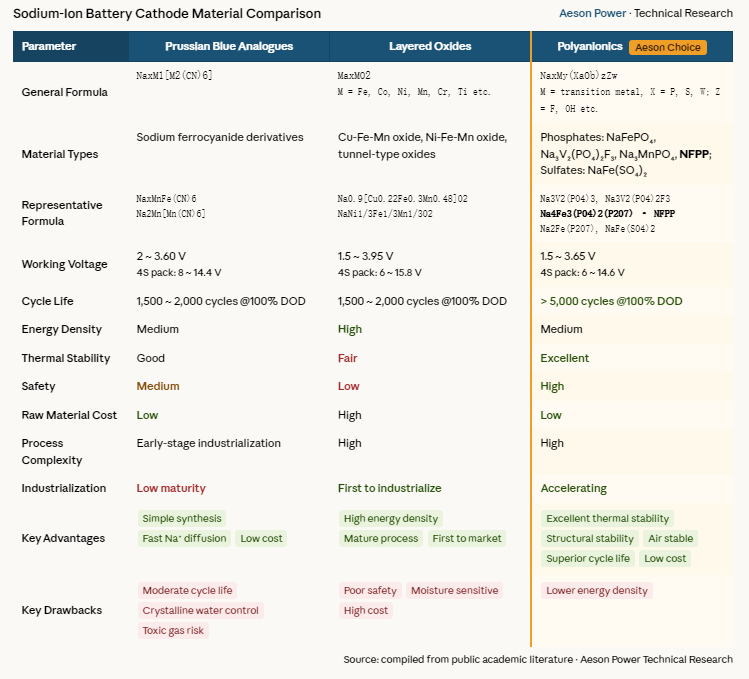
Before going deeper into NFPP, let us first look at the overall landscape of the three pathways.
[Chart Placeholder: Comparative Table of Cathode Material Systems]
As the table makes clear, the polyanion route leads across cycle life, thermal stability, and safety. Its only shortcoming is relatively lower energy density—but for start-stop applications, it is already more than sufficient and is not really a disadvantage in practice. Therefore, we believe NFPP is currently the best overall choice for start-stop applications.
NFPP is a mixed phosphate structure: its molecule contains both PO4 (phosphate) and P2O7 (pyrophosphate) polyanion groups, which together build a three-dimensional interconnected NASICON-type framework. A 2026 paper published in Energy Storage Materials, “Na4Fe3(PO4)2P2O7 Cathode Materials: From Fundamental Research to Commercialization Challenges,” points out that NFPP, thanks to its low cost, ultra-long cycle life, and high theoretical capacity, has shown great potential as a sodium-ion battery cathode material. In 2025, NFPP-type products accounted for more than 70% of sodium-ion battery shipments produced in China, already demonstrating a major advantage.
I like to describe it as reinforced concrete with double rebar: ordinary polyanion materials are like concrete reinforced in one direction, while NFPP is reinforced in both longitudinal and transverse directions. The PO4 and P2O7 groups lock one another in place, further enhancing framework stability. Sodium ions migrate through it while the framework remains almost motionless. This matches exactly what we have observed in our actual cycle testing. This structural stability is not just a theoretical prediction—it is clearly reflected in real data.
The same Energy Storage Materials paper also states that NFPP has a theoretical specific capacity of 129 mAh/g, making it one of the highest-capacity iron-based polyanion systems currently known. More importantly, it is composed entirely of extremely abundant crustal elements such as iron, sodium, and phosphorus. It contains no lithium, cobalt, nickel, or vanadium, giving it an inherent advantage in cost controllability and supply-chain security.
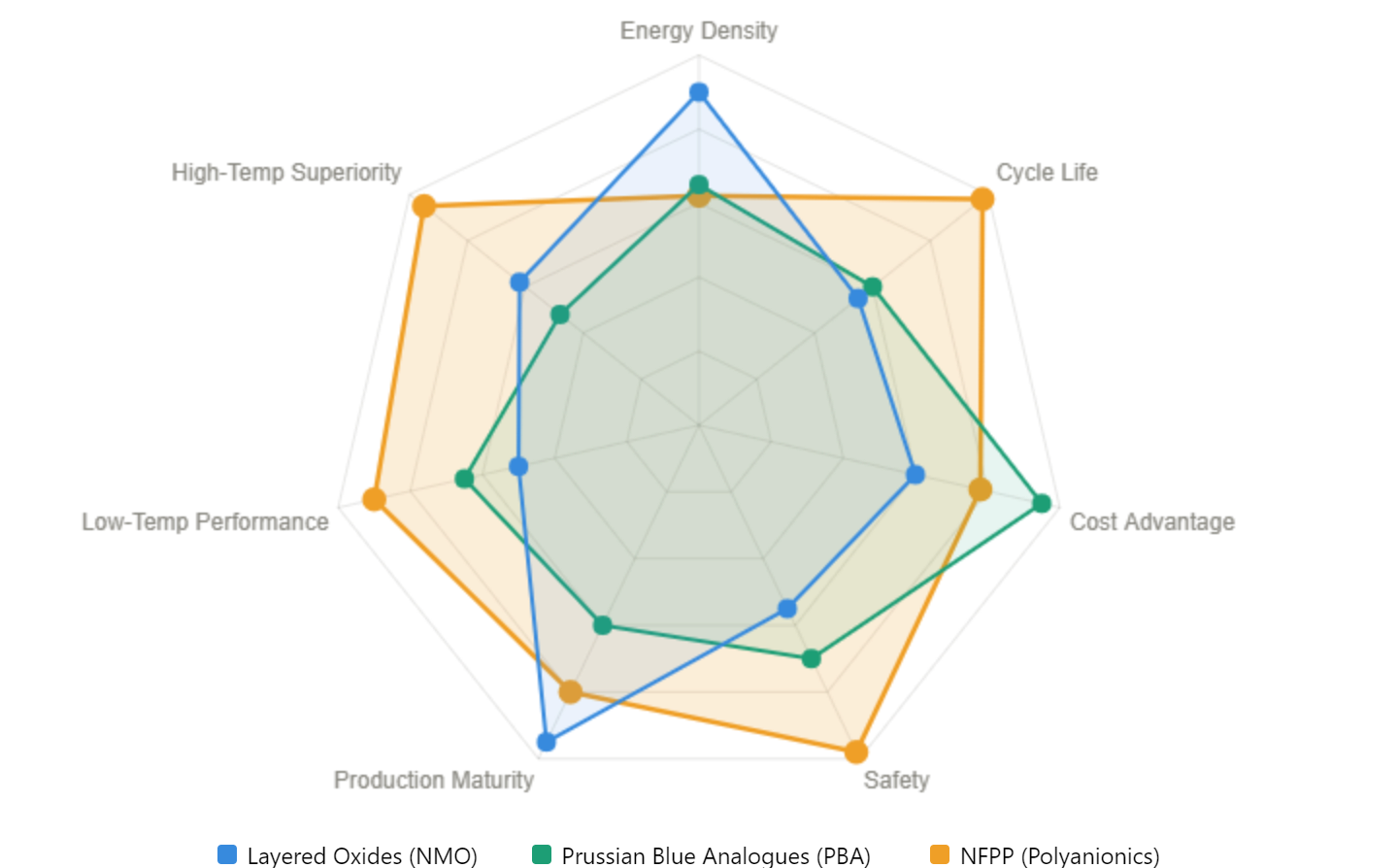
The chart below compares the overall performance of the three major cathode pathways. NFPP’s leading advantages in safety, longevity, low-temperature performance, and ultra-high-temperature performance are immediately clear.
[Chart Placeholder: Overall Performance Radar Chart]
Core Advantages of NFPP
Ultra-Long Cycle Life: Structural Stability Is Written Into Its DNA
Among the iron-based materials I have seen, NFPP’s cycle-life data is in the top tier. A 2024 paper published in ACS Applied Materials & Interfaces, “Solid-State Synthesis of Ti-Doped Na4Fe3(PO4)2P2O7 with Enhanced Structural Reversibility,” reported that after Ti-doping optimization, NFPP retained 97.2 mAh/g after 5,000 cycles at a 10C rate, while crystal volume change during charge and discharge was only 2.98%. Small volume change means the framework undergoes almost no deformation as sodium ions repeatedly leave and re-enter it—and that is the fundamental reason for long service life.
A 2025 paper in Advanced Functional Materials, “Synergistic Optimization of Electronic/Ionic Transport in Hybrid Phosphate Cathodes,” reported that a W-doped NFPP system can exceed 10,000 cycles in stability and still deliver 72 mAh/g discharge capacity at an ultra-high 50C rate. A vehicle started several times a day can easily achieve 3–5 years of use with 10,000 cycles.
Thermal Stability: Building a Safety Baseline at the Material-Structure Level
This is the area where I have invested the most personal research effort. A 2024 study published in Journal of Materials Chemistry A, “Synthesis and Characterization of Na4Fe3(PO4)2(P2O7) Cathode Material,” shows that NFPP has excellent structural stability, very small volume change, low cost, and non-toxicity. The strong covalent bonds in its PO4 and P2O7 framework tightly lock oxygen atoms in place, fundamentally suppressing oxygen release at high temperatures. Oxygen release is precisely the core mechanism behind thermal runaway and severe fire in layered oxide systems. In our own extreme high-temperature abuse testing, the thermal-runaway trigger temperature of NFPP cells was significantly higher than that of layered oxide systems. This is a physical law written into the material structure, not a statistical coincidence.
Tests show that NFPP can still operate safely even under harsh operating conditions at an extreme temperature of 80°C. This is almost unimaginable for layered oxides and conventional lithium batteries, which are extremely sensitive to temperatures above 60°C.
Completely Non-Toxic, Fully Iron-Based: The Real Foundation of Supply-Chain Security
A 2025 review paper published in Journal of Energy Storage, “Commercialization Progress of Sodium-Ion Batteries: Phosphate- and Sulfate-Based Polyanion Cathodes,” clearly points out that NFPP is known for its low cost, environmental friendliness, and high structural stability. Iron is one of the most abundant transition metals on Earth, and phosphorus and sodium are also widely available. The entire material system does not depend on any scarce or controversial mineral resources. In a world where mineral resources are increasingly becoming geopolitical bargaining chips, the value of this goes far beyond cost.
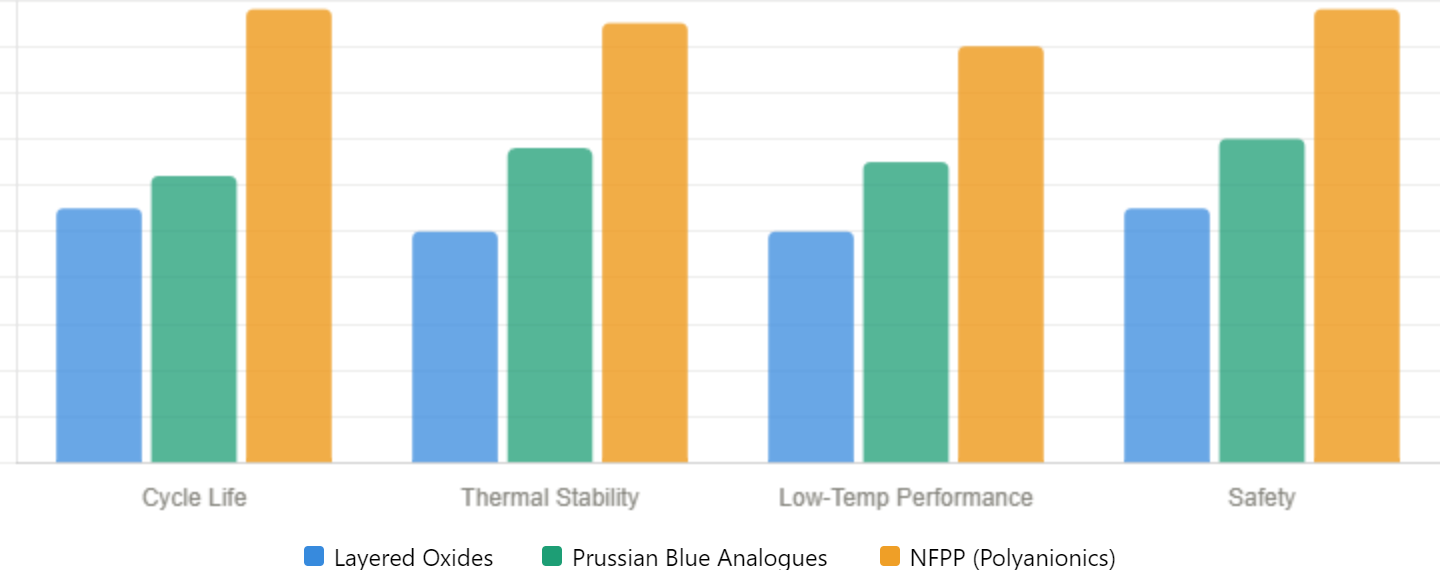
The chart below presents a quantitative comparison between NFPP and other routes across key performance dimensions.
[Chart Placeholder: Key Performance Bar Comparison]
Challenges of NFPP
At Aeson Power, we never avoid NFPP’s limitations. Only by understanding where its boundaries lie can we build a truly solid product.
Its relatively low energy density is NFPP’s most obvious shortcoming, and this cannot be ignored. A theoretical specific capacity of 129 mAh/g is already a relatively high level among iron-based materials, but it still trails layered oxides. However, this gap is narrowing. A 2024 paper published in MDPI Materials, “Mo-Doped Na4Fe3(PO4)2P2O7/C Composite for High-Rate, Long-Life Sodium-Ion Batteries,” reports that Mo-doped NFPP has already achieved an initial discharge specific capacity of 123.9 mAh/g at 0.1C. Combined with ongoing optimization in battery-pack structural design, practical energy density is steadily improving, and this is one of the directions our team continues to advance.
The Value of NFPP in Automotive Applications
Cold-Climate Markets Worldwide: Low-Temperature Performance Is the Real Moat
NFPP’s low-temperature advantage comes from two sources. First, sodium ions bind more weakly to the electrolyte than lithium ions do, making desolvation easier at low temperatures. Second, NFPP’s open three-dimensional framework provides wide ion-transport channels, allowing sodium ions to continue moving relatively smoothly even when low temperatures increase electrolyte viscosity.
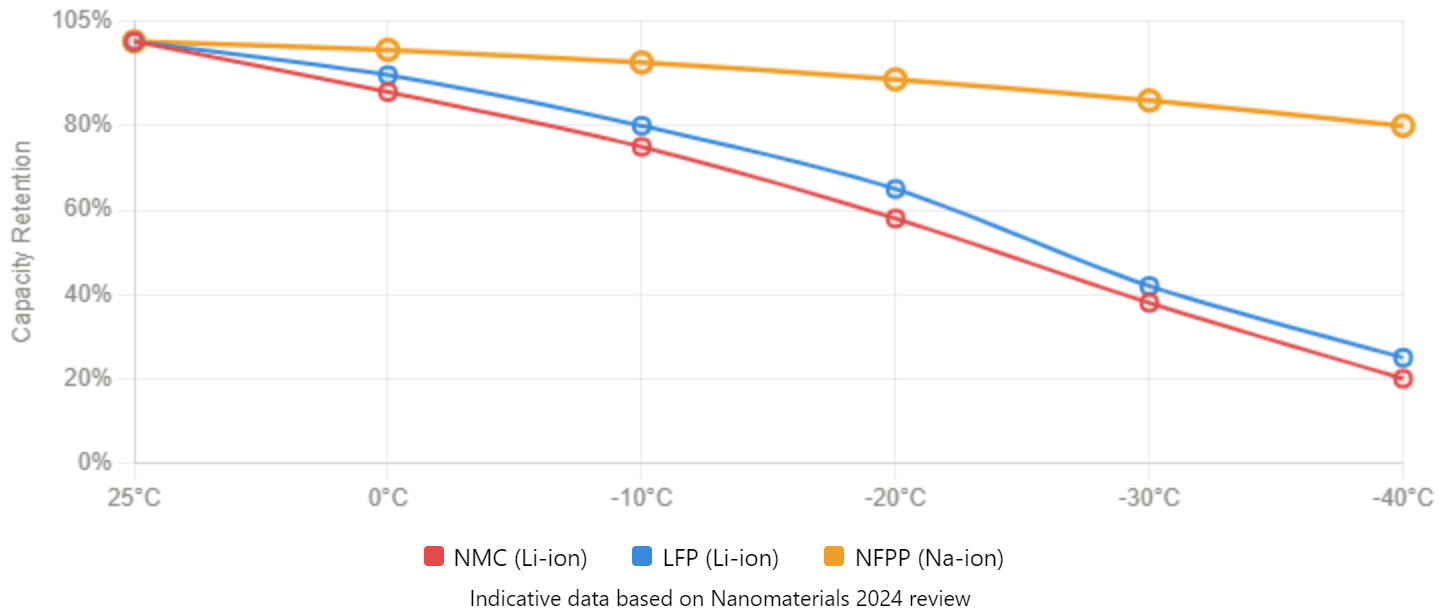
A 2024 review in Nanomaterials, “Low-Temperature Sodium-Ion Batteries: Challenges and Strategies,” documents this mechanism. In the extremely low-temperature range of -20°C to -40°C, lithium-ion batteries experience major declines in capacity, voltage, power, and service life and may even fail to operate, while sodium-ion batteries show strong adaptability under low-temperature conditions because of their unique ionic chemistry. In our own low-temperature testing, NFPP cells showed advantages on the same order of magnitude. In high-latitude markets such as Northern Europe, Canada, Russia, and Central Asia, low-temperature performance is shifting from a “bonus point” to a true “market-entry requirement.” This is a structural opportunity Aeson Power must seize in its global expansion.
The chart below compares capacity retention under low-temperature conditions across different battery routes.
[Chart Placeholder: Low-Temperature Capacity Retention Comparison]
Long Service Life = A Real, Measurable Cost Advantage
For starter-battery users, the value of NFPP is reflected not only in laboratory data, but also in real-world vehicle use. Traditional lead-acid starter batteries are especially vulnerable to two things. First, prolonged low-charge parking causes sulfation of the plates, and once sulfation occurs, it cannot be reversed. Second, internal resistance rises sharply at low temperatures, causing cold-cranking current to fall significantly. Many drivers share the experience of being unable to start the car in winter.
NFPP sodium starter batteries have structural advantages in both respects. Their framework is stable, they do not suffer from sulfation, and they recover better after deep discharge. At low temperatures, ion-migration resistance is also far lower than in lead-acid systems, enabling stable cold-cranking current even at -20°C or even -40°C in severe cold environments. For drivers in cold regions and for commercial fleets with extremely high reliability requirements, this is a tangible difference in user experience—not just a numbers game on a specification sheet.
Environmental Benefits: Carbon Reduction Across the Entire Value Chain, From Materials to Use
NFPP’s environmental advantages run throughout the entire battery life cycle. On the materials side, NFPP is composed entirely of non-toxic elements such as iron, sodium, and phosphorus, and its production does not involve environmentally risky heavy metals such as cobalt, nickel, or vanadium. The 2025 Journal of Energy Storage review, “Commercialization Progress of Sodium-Ion Batteries: Phosphate- and Sulfate-Based Polyanion Cathodes,” explicitly states that iron-based polyanion materials are known for low cost, environmental friendliness, and high structural stability. As a result, end-of-life battery recycling is safer and cleaner, with far lower risks of soil and water contamination than traditional lithium-ion and lead-acid battery systems.
On the user side, Aeson Power’s sodium start-stop battery can provide long-term, stable support for start-stop system operation. The core logic of a start-stop system is simple: the engine automatically shuts off during brief stops such as red lights or traffic jams, then restarts quickly when the vehicle moves again, reducing idling fuel consumption. Traditional lead-acid batteries degrade relatively quickly under the high-frequency, high-current conditions of start-stop systems, and after some time the system often disables the start-stop function, greatly reducing fuel-saving performance. With excellent high-current discharge capability, faster charging, and ultra-long cycle life, NFPP sodium batteries turn start-stop fuel saving from “available only part of the time” into “available all the time.” Lower fuel consumption directly corresponds to lower carbon emissions. Under typical operating conditions, sodium batteries can reduce fuel consumption by about 5–8%.
For vehicle manufacturers and fleet operators that include sustainability in procurement standards, NFPP starter batteries offer not only a performance upgrade, but also a measurable green value proposition that can be passed all the way to end users.
Safety: Non-Negotiable at the Material Level
Over the years I have focused on thermal-stability research, one conclusion has become increasingly clear: safety is not a marketing slogan; it is a physical law determined by material structure. NFPP’s dual PO4 and P2O7 framework locks oxygen atoms tightly in place, raising the threshold for thermal runaway at the material level. In February 2026, MIT Technology Review stated in its “10 Breakthrough Technologies of 2026” report that sodium-ion batteries, with their higher thermal stability and longer cycle life, are strong candidates to replace lithium-ion batteries, and that their energy density is already sufficient for small passenger cars and low-speed utility vehicles. This judgment fully aligns with my engineering experience. In addition to excelling in the starting-battery market, NFPP will also steadily increase its market share in important sectors such as low-end electric vehicles and energy storage.
Why Did Aeson Power Choose NFPP?
Each of the three routes has its place. Layered oxides pursue the limit of energy density. Prussian blue pursues the limit of cost. NFPP pursues the dual limit of reliability and sustainability, with broader scenario adaptability and more obvious overall advantages.
As an engineer who works with battery cells every day, my judgment is this: consumers will not remember the specific capacity of a cathode material, but they will remember a car that would not start in winter. They will remember a battery that needed replacement after only two years. They will also remember the frightening news of lithium-battery fires. For an automotive starter battery aimed at global cold-climate markets and expected to endure years of intensive use, safety and full-lifecycle reliability matter far more than the energy-density number on paper.
NFPP gives us one more layer of confidence: it contains no scarce or controversial elements, and its supply chain is fully controllable. In a world where mineral resources are increasingly becoming geopolitical leverage, the value of this goes far beyond cost. That is Aeson Power’s starting point in choosing NFPP—not because it looks best on a parameter sheet, but because in real application scenarios and the real industrial environment, it is the most trustworthy choice.