










A racing vehicle places very different demands on its starting battery than an ordinary passenger car. Weight reduction, instantaneous starting current, thermal exposure, and fast energy recovery can all influence vehicle performance. We approach these requirements differently from conventional battery design. As we develop sodium-ion solutions for automotive applications, we focus on delivering high-rate power without adding unnecessary mass, making a purpose-built racing battery an important option for motorsport applications.
Why Racing Cars Need More Than a Standard Car Battery
A standard car battery is generally designed around dependable engine starting and everyday electrical requirements. For a passenger vehicle, that balance may be sufficient for commuting, highway driving, and normal ambient conditions.
Racing applications create a different operating profile. A competition engine may require a strong burst of current at startup, while the vehicle may be optimized aggressively for weight. Battery placement, thermal exposure, vibration, and rapid turnaround between sessions can also influence the selection process. We therefore evaluate a racing battery according to the complete motorsport duty cycle rather than capacity alone.
High-Rate Starting Power Matters on the Track
The most immediate difference is the demand for instantaneous current. A racing engine needs a powerful electrical pulse to turn the starter motor and establish combustion quickly. A battery that can deliver strong short-duration output can therefore be valuable when fast, consistent starts matter.
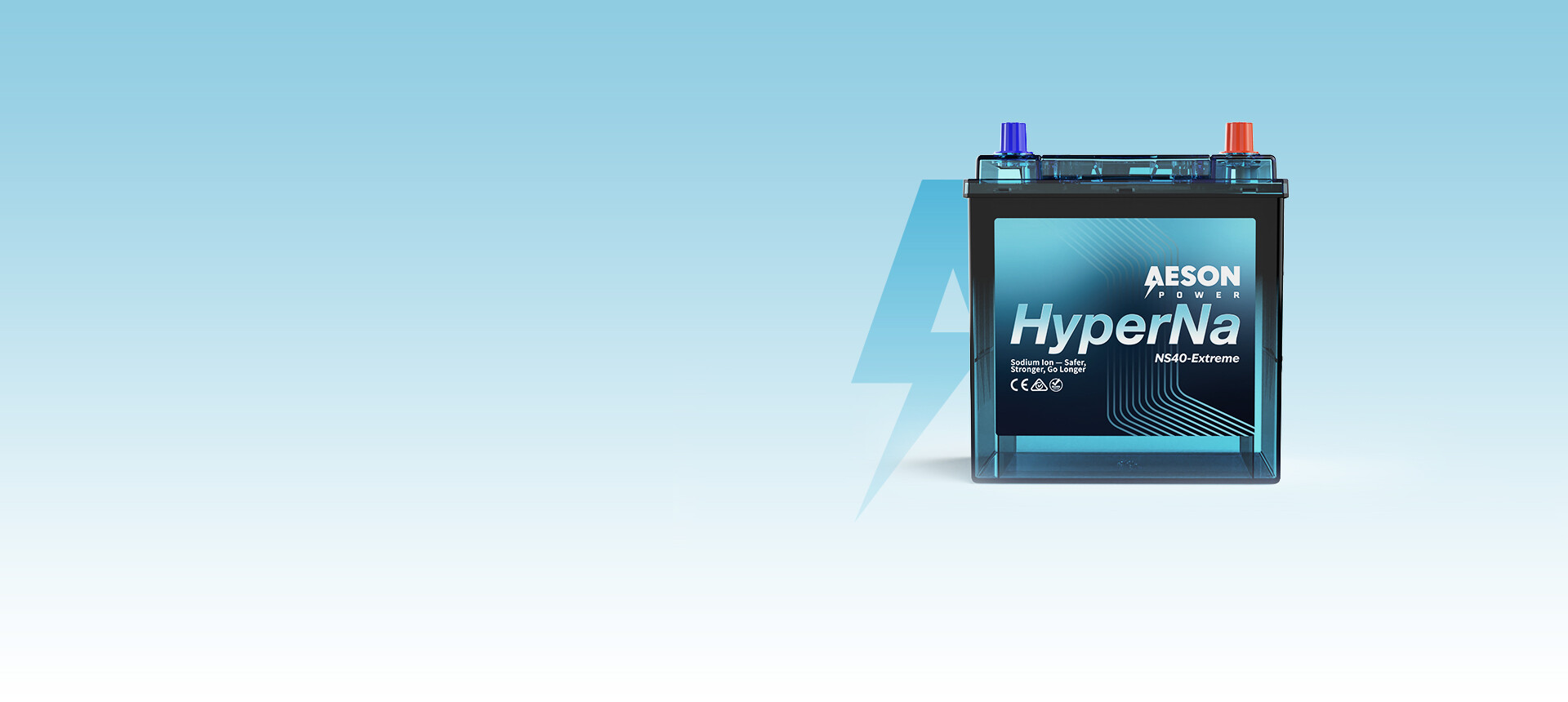
Our HyperNa series is specifically developed for racing-car starting. We use an NFPP-based sodium-ion framework designed to remain structurally stable during high-rate, high-current pulse discharge. This approach supports the rapid current delivery required for racing starts while addressing thermal stability within the battery architecture.
A Racing Battery Can Reduce Unnecessary Weight
Weight is a strategic consideration in motorsport. Engineers continually examine components that can be made lighter without compromising essential performance, because reducing mass can support vehicle balance and handling objectives.
Compared to conventional lead-acid automotive batteries, sodium-ion racing batteries offer substantial weight savings. A lighter battery can give race teams greater flexibility when managing overall vehicle mass and component placement, although the final benefit depends on the vehicle design and the battery specification selected.
NS40-Extreme: Built for Racing Applications
We designed the NS40-Extreme as a starting battery for racing cars, with specifications focused on high-current performance and compact packaging. It provides a PHCA rating of 1,250A, 520A CCA, and 312Wh of energy.
The battery has a rated reserve capacity of 55 minutes and weighs 5.0 kg. These figures give racing teams concrete parameters for evaluating starting performance, energy availability, and weight against their existing battery setup. The product belongs to Aeson Power’s HyperNa racing-car starting portfolio, alongside the H5-Extreme.
High-Temperature Operation Supports Motorsport Demands
Heat management is another important consideration. Racing environments can expose batteries to elevated temperatures around the engine bay, while repeated operation can create additional thermal stress.
Our sodium-ion starting battery platform is designed for high-temperature operation up to 80°C. We combine this capability with an NFPP polyanion framework and high-rate discharge characteristics. This gives us a technology foundation suited to demanding automotive environments where thermal stability and reliable starting performance are both priorities.
Fast Charging Helps Between Racing Sessions
A competition vehicle may have limited time to recover battery energy between starts, testing runs, or race sessions. Fast charge acceptance can therefore be useful when turnaround time is important.
The NS40-Extreme features 5C fast-charge capability. We see this as a practical advantage for racing teams that need efficient energy recovery during short service intervals. Rather than treating charging as a secondary specification, we consider it part of the overall battery system, alongside starting current, weight, thermal performance, and energy capacity.
Choosing the Right Battery for Motorsport
We do not suggest that a racing battery is automatically the best choice for every vehicle. Standard automotive batteries remain appropriate for many road-going applications where everyday starting, electrical loads, packaging, and cost are the primary considerations.
For racing teams, however, the priorities can change significantly. When high instantaneous current, low battery weight, high-temperature operation, and fast charging are important, a dedicated sodium-ion racing battery can provide a more application-focused solution. The correct choice should always match the vehicle’s electrical architecture and competition requirements.
Aeson Power: Engineering Batteries for High-Performance Starting
We believe racing batteries should be engineered around the realities of motorsport rather than adapted from conventional passenger-car requirements. Purpose-built platforms like our NS40-Extreme demonstrate how sodium-ion technology brings high pulse cranking power, elevated thermal stability, and rapid charge recovery into a race-ready format.
At Aeson Power, we develop sodium-ion battery solutions for automotive starting, start-stop, commercial, racing, and EV auxiliary applications. Our HyperNa range reflects our focus on high-rate performance and advanced sodium-ion technology. Contact Aeson Power to discuss your racing vehicle requirements and identify the right starting battery for your program.