










Modern electric vehicles rely on more than their high-voltage traction battery. A separate low-voltage system keeps essential electronics operating, manages vehicle control functions, and supports communication between critical components. We see the auxiliary battery as a small but strategically important part of EV architecture. Understanding car aux battery functions helps vehicle manufacturers, fleet operators, and system integrators evaluate the right low-voltage solution for reliability, thermal performance, and long-term operation.
What Is a Car Aux Battery?
A car aux battery, or auxiliary battery, is a low-voltage battery used to power a vehicle’s electrical systems. In electric passenger cars, it typically supports the 12V network rather than supplying traction power. This distinction is important: the auxiliary battery and high-voltage traction battery perform different jobs, and the vehicle depends on both.
We design our sodium-ion auxiliary batteries around this low-voltage role. Aeson Power offers 12V and 24V sodium-ion auxiliary batteries for electric passenger cars and commercial vehicles. This product category is intended to provide stable low-voltage power for vehicle electronics and related control functions.
Powering Essential Vehicle Electronics
One of the most important car aux battery functions is maintaining power for the vehicle’s “house” systems. These can include electronic control units, lighting, infotainment, safety-related electronics, and other low-voltage loads. The auxiliary battery helps keep these systems supplied when the main traction battery is not directly powering the low-voltage network.
For EV manufacturers, stable low-voltage power is essential to vehicle availability. A fully charged traction battery does not necessarily solve an auxiliary-battery failure. If the low-voltage system cannot operate correctly, the vehicle may be unable to start its normal operating sequence.
Supporting High-Voltage System Control
The auxiliary battery also plays a critical control role. Aeson Power explains that its 12V sodium-ion auxiliary battery supplies stable low-voltage power and controls the high-voltage contactors that connect or disconnect the main traction battery.
This means the auxiliary battery is part of the EV’s power-management architecture rather than simply an additional energy source. When the vehicle needs to activate or isolate its high-voltage system, the low-voltage side must remain dependable. For vehicle engineers, this makes auxiliary-battery reliability a system-level consideration.
Why Temperature and Charging Performance Matter
Electric vehicles may operate in environments ranging from winter cold to high-temperature parking or demanding operating conditions. Low-voltage battery performance can therefore affect vehicle readiness. We focus on sodium-ion technology because it offers characteristics that are relevant to demanding temperature conditions.
Aeson Power states that its sodium-ion auxiliary batteries can maintain strong discharge and charge acceptance in extremely cold conditions, while the product range is also designed for high-temperature operation. Our sodium-ion auxiliary platform is engineered for high thermal resilience, ensuring steady power supply near hot vehicle electronics.
Fast charging is another practical consideration. When the vehicle’s operating cycle requires rapid recovery of auxiliary-battery energy, charging capability can influence system availability. In addition, rapid charge acceptance allows the battery to quickly recover energy during short driving or active DC/DC charge cycles.
A Closer Look at the Aeson Power 1215
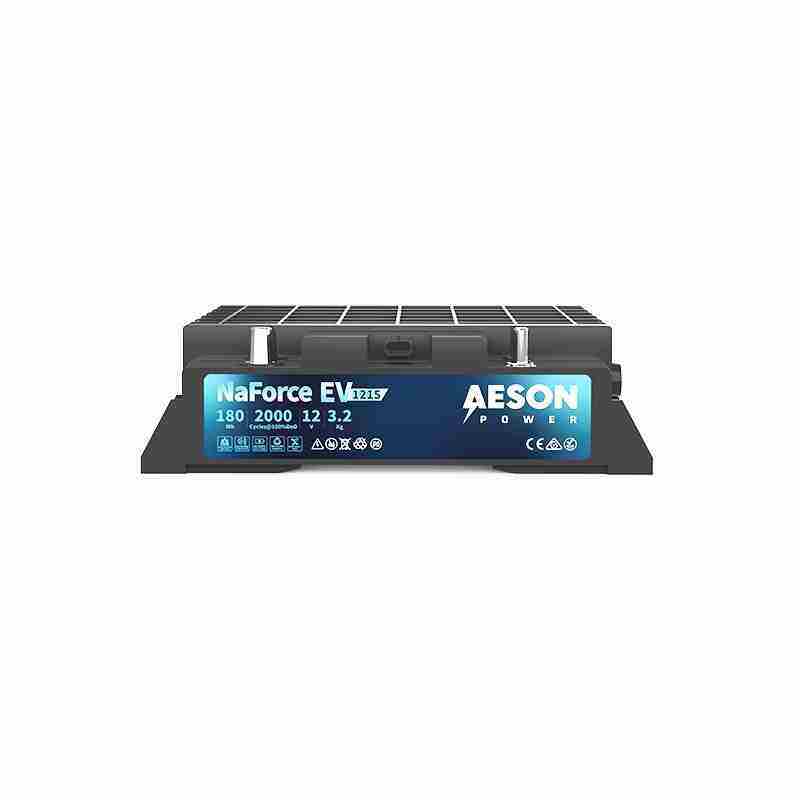
Our 1215 is an auxiliary battery for electric passenger cars. It has a nominal voltage of 12V and an energy rating of 180Wh. Its published dimensions are 265 × 180 × 75 mm, while its weight is 3.2 kg. The battery supports CAN/CANFD communication protocols for integration with vehicle electronic architectures.
We also specify the 1215 with long-life performance, high-temperature operation up to 80°C, and 5C fast charging. These characteristics are important for business customers because an auxiliary battery must fit both the physical packaging requirements and the electrical communication architecture of the vehicle.
Why Sodium-Ion Is Worth Considering
As a sodium-ion batteries manufacturer, we see sodium-ion technology as a complementary option for low-voltage EV systems. Its value is not simply that it uses sodium instead of lithium. The relevant question is whether the complete battery can provide the temperature behavior, charging performance, reliability, communication capability, and physical integration required by the vehicle.
For procurement teams and automotive engineers, this means comparing complete specifications rather than chemistry alone. A suitable auxiliary battery should match the vehicle’s voltage architecture, power demand, installation space, charging strategy, communication requirements, and expected operating environment.
Making the Auxiliary Battery Part of EV Reliability
The auxiliary battery may be smaller than the main traction battery, but its responsibilities are significant. It powers low-voltage vehicle systems and helps control the connection of the high-voltage battery. Its performance can therefore influence whether an EV successfully wakes, operates, and maintains its electronic functions.
At Aeson Power, we develop sodium-ion, lead-acid, and lithium-ion battery solutions for different applications, with our sodium-ion portfolio covering automotive starting, start-stop, commercial starting, racing, EV auxiliary, and UPS applications. We combine application-focused engineering with factory-direct supply for business customers. If you are sourcing a car aux battery for an electric passenger vehicle, contact Aeson Power to discuss the 1215 and identify the right low-voltage battery solution for your platform.