










Electric vehicles have high-voltage traction batteries that power the motor, so it is reasonable to ask why they still need a much smaller 12V battery. The answer is system architecture. We rely on the low-voltage network for essential electronic functions, control systems, safety-related equipment, and vehicle wake-up procedures. For automotive engineers and procurement teams, selecting the right auxiliary battery is therefore a critical part of EV reliability, not an outdated leftover from internal-combustion vehicles.
What Does an Auxiliary Battery for Electric Car Actually Do?
The auxiliary battery supplies stable low-voltage power to the vehicle’s electronic “house” systems. These can include control units, lighting, infotainment, communications, locks, sensors, and other electrical equipment. More importantly, the 12V system helps control the high-voltage contactors that connect or isolate the traction battery.
This separation provides an important safety function. Toyota Industries explains that a DC-DC converter steps the high-voltage battery down to 12V for the auxiliary battery, ECUs, navigation, lights, and other devices. The auxiliary battery consequently remains part of the vehicle’s low-voltage architecture even though the main propulsion system operates at much higher voltage.
Why the High-Voltage Battery Cannot Simply Replace It
The traction battery and auxiliary battery serve different electrical roles. The high-voltage pack is optimized for propulsion and energy storage, whereas the low-voltage battery provides an independent energy reserve for vehicle electronics. This reserve is particularly valuable when the high-voltage system is disconnected or inactive.
We also need to consider transient response. Automotive power systems can experience sudden load changes, and a dedicated battery can provide immediate energy while the DC-DC converter responds. This is especially relevant for safety-critical electronics that need stable power during transitions. Removing the low-voltage battery would therefore require a more complex electrical architecture rather than simply eliminating one component.
For vehicle manufacturers, this architecture also supports predictable component qualification. Low-voltage electronics can continue using familiar voltage classes and interfaces while the traction system evolves from one platform generation to another. That means the auxiliary battery remains a practical engineering interface between the high-voltage propulsion system and the vehicle’s established electronic subsystems, making its reliability important for both new development and long-term platform support.
Why Sodium-Ion Is Gaining Attention for EV Auxiliary Power
The auxiliary battery does not need to deliver the same energy as the traction pack, but it must provide dependable low-voltage power in a wide range of operating conditions. Weight, maintenance, thermal behavior, service life, and integration with vehicle electronics all matter.
This is where sodium-ion technology can offer a compelling alternative. Through our sodium-ion battery manufacturing work, we focus on a chemistry that can support low-voltage automotive applications while reducing reliance on conventional lead-acid batteries. Aeson Power specifically develops sodium-ion 12V and 24V auxiliary batteries for electric passenger cars and commercial vehicles.
Aeson Power 1215: A Compact 12V Solution
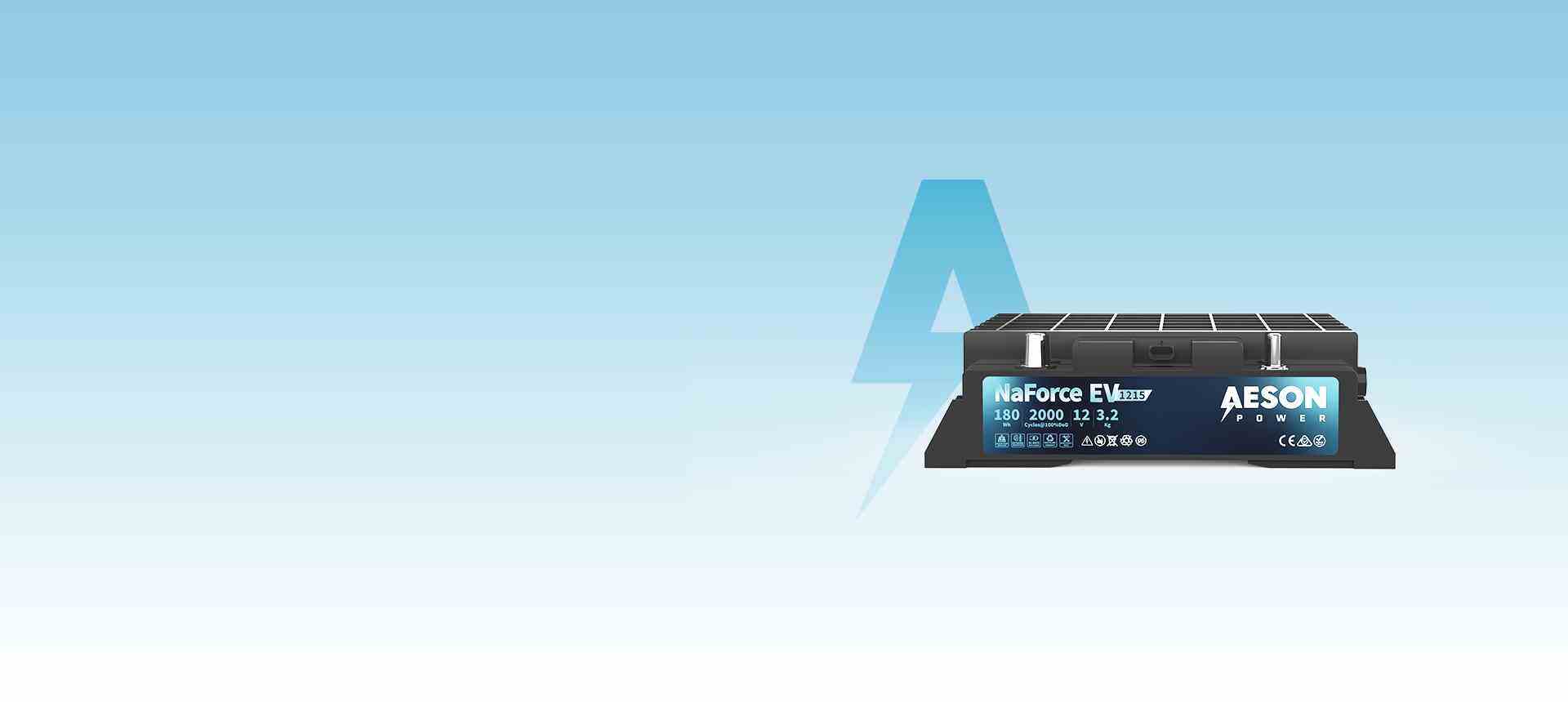
Our 1215 auxiliary battery is designed for electric passenger cars and provides 12V nominal voltage with 180Wh of energy. Its specified dimensions are 265 × 180 × 75(75) mm, while its weight is 3.2 kg. These figures give vehicle manufacturers and system integrators concrete parameters for packaging and electrical design.
The model also supports CAN/CANFD communication, enabling integration with modern vehicle electronic architectures. We specify it as maintenance free and recycling friendly. For OEM engineering teams, the combination of compact packaging, communication capability, and reduced mass can simplify evaluation against existing auxiliary-battery requirements.
What business Buyers Should Evaluate Before Switching Chemistry
We recommend evaluating more than nominal voltage and physical dimensions. Engineers should verify charging voltage, discharge behavior, communication requirements, thermal operating limits, protection strategy, and compatibility with the vehicle’s DC-DC converter and low-voltage control architecture.
For fleet operators and OEM procurement teams, lifecycle considerations also deserve attention. A lighter battery can make handling and installation easier, while a maintenance-free design can reduce routine service requirements. At the same time, sodium-ion technology is still developing, so qualification should be based on validated product specifications and application testing rather than broad technology claims.
Sodium-Ion Technology for the Next Generation of EVs
We see the 12V auxiliary battery as an important bridge between established automotive electrical architecture and next-generation vehicle technology. The continued need for low-voltage power creates an opportunity to improve weight, maintenance, thermal performance, and sustainability without changing the fundamental role of the auxiliary system.
Aeson Power develops sodium-ion solutions across automotive start-stop, automotive starting, commercial starting, racing, EV auxiliary, and UPS applications. Our factory-direct portfolio also includes lead-acid and lithium-ion batteries, allowing us to approach different projects according to their technical requirements.
As an experienced sodium-ion battery manufacturer, we combine application-focused product development with our understanding of low-voltage automotive systems. If you are evaluating an auxiliary battery for electric car platforms, contact Aeson Power to discuss the 1215 and determine whether its specifications, CAN/CANFD communication, dimensions, and weight meet your vehicle integration requirements.