










Extreme temperatures can expose the limitations of battery chemistry faster than ordinary operating conditions. For businesses deploying batteries in vehicles, data centers, telecom infrastructure, or energy storage systems, temperature tolerance directly affects reliability, safety, and service life. We believe sodium-ion batteries deserve serious consideration in these environments. As a sodium-ion battery manufacturer, we use NFPP polyanion technology to develop solutions designed for stable performance across demanding temperature conditions.
Sodium Battery Technology and the Challenge of Extreme Temperatures
Temperature affects electrochemical reactions, internal resistance, charging behavior, and available capacity. At low temperatures, ion transport becomes more difficult, while high temperatures can accelerate degradation and increase safety concerns. Therefore, comparing sodium-ion and lithium-ion batteries requires more than looking at nominal capacity or energy density.
The IEA reports that the latest sodium-ion batteries can retain around 90% of nominal capacity at temperatures as low as -40°C and operate at temperatures as high as 70°C. It also notes that sodium-ion batteries generally perform better at low temperatures than lithium-ion batteries, particularly lithium iron phosphate (LFP) chemistry.
Why Our NFPP Sodium Battery Technology Supports Thermal Stability
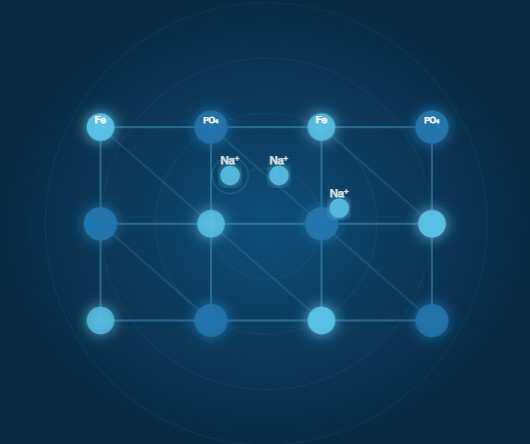
We develop our sodium-ion solutions around NFPP, or Na₄Fe₃(PO₄)₂(P₂O₇), a polyanion cathode system. Its phosphate and pyrophosphate groups form a robust three-dimensional framework. This structural design supports sodium-ion migration while limiting crystal-volume changes during repeated cycling.
We consider this structural stability particularly valuable for demanding applications. Aeson Power reports that its NFPP material retains 97.2 mAh/g after 5,000 cycles at a 10C rate following Ti-doping optimization, with only 2.98% crystal volume change during cycling. These characteristics contribute to long cycle life and thermal stability.
How Sodium-Ion and Lithium-Ion Compare in Real Applications
Lithium-ion remains highly competitive, particularly where energy density, compact packaging, and mature system integration are priorities. Our own LIBLFP APS5000, for example, offers a nominal voltage of 51.2V, 100Ah capacity, more than 6,000 cycles under its specified test conditions, and a discharge operating range of -20°C to 50°C. Its specified charging range is 0°C to 60°C
Our sodium-ion products demonstrate a broader temperature specification in several applications. The SIBPOM-4850, designed for telecom, data center, UPS, and emergency backup applications, supports charging from -10°C to 50°C and discharging from -45°C to 65°C. This makes the technology particularly attractive where both cold-start capability and high-temperature operation are important.
Where Sodium-Ion Can Gain an Advantage
We see sodium-ion technology as especially relevant to applications exposed to severe seasonal or operational temperature changes. Telecom base stations, data centers, emergency backup systems, commercial vehicles, and automotive starting systems can all experience conditions outside the comfort zone of conventional battery chemistries.
For automotive applications, our NaForce H7/LN4 sodium-ion start-stop battery provides 12V voltage, 800A CCA, 480Wh energy, and 180,000 start-stop cycles. The product is specified for high-temperature operation up to 80°C and uses a 5C fast-charge capability. These characteristics make it suitable for applications where high current and thermal resilience are important.
Temperature Performance Is Only One Selection Factor
We do not recommend choosing a battery solely because it has a wider temperature range. Project requirements also include energy density, peak current, charging infrastructure, cycle frequency, installation space, BMS strategy, safety requirements, and lifecycle economics.
Lithium-ion remains the better choice for many applications where high energy density and established system architecture are critical. Sodium-ion can become more compelling when low-temperature capability, high-temperature resilience, safety, and material diversification receive greater weight. The most suitable chemistry depends on the operating profile rather than a universal technology ranking.
Choosing a Sodium-Ion Battery Manufacturer for Extreme Environments
For business buyers, battery chemistry is only one part of the procurement decision. We also need to consider cell design, manufacturing consistency, quality control, application engineering, and supply continuity. These factors determine whether laboratory-level performance can translate into dependable field operation.
At Aeson Power, we combine sodium-ion innovation with manufacturing capabilities across sodium-ion, lead-acid, and lithium-ion battery technologies. Our NFPP-based sodium-ion portfolio covers automotive starting, start-stop, UPS, telecom, data center, and emergency backup applications. We focus on safe, high-quality products that address the evolving requirements of demanding energy systems.
Aeson Power: Building Batteries for Wider Temperature Windows
When extreme temperatures are part of the operating environment, we believe sodium-ion technology deserves a place alongside lithium-ion in the selection process. NFPP polyanion chemistry gives us a strong foundation for long life, thermal stability, safety, and wide-temperature performance, while lithium-ion continues to offer advantages in energy density and mature system integration.
At Aeson Power, we are a sodium-ion battery manufacturer delivering factory-direct sodium-ion, lead-acid, and lithium-ion battery solutions for diverse applications. If your project faces extreme cold, high heat, frequent cycling, or demanding backup requirements, contact us to discuss your operating conditions and identify the sodium battery technology that best fits your application.