










Production scale lowers sodium-ion battery manufacturing costs by spreading fixed infrastructure expenses across higher output and optimizing yield through automated process control. As sodium-ion technology moves toward wider commercialization, manufacturing scale can become an important lever for cost competitiveness.
Why Production Scale Matters
Large-scale production can spread fixed expenses across more battery units. Factories, equipment, engineering, testing, and quality infrastructure require investment regardless of output. When production rises, these costs can be allocated across greater volume, helping reduce manufacturing cost per unit.
Scale can also improve efficiency. Repeated production gives manufacturers opportunities to optimize processes, reduce material waste, increase equipment utilization, and improve labor productivity. For sodium-ion batteries, which are still moving through a scale-up phase, these improvements can be especially valuable.
How Sodium-Ion Battery Manufacturing Gains Efficiency
Sodium-ion battery manufacturing depends on disciplined process control. Battery production involves multiple interconnected steps, and small variations can affect consistency, yield, and reliability. Higher production volumes can justify stronger automation, process monitoring, testing, and quality-control systems.
Volume also creates learning effects. As engineering and production teams manufacture more cells and battery systems, they can identify recurring defects, refine procedures, and improve yields. Better yield means more purchased materials become sellable output rather than scrap or rework, directly influencing unit economics.
Scale, however, does not automatically guarantee lower costs. If quality controls weaken during expansion, higher output can create more defects and warranty risks. We therefore see manufacturing scale and quality management as complementary priorities.
Supply Chains Influence the Economics
Materials availability is another major factor. The IEA reports that sodium-ion supply chains remain less developed than lithium-ion supply chains, while hard-carbon anode production and sodium-ion cell manufacturing capacity remain limited. As the industry expands, suppliers, material processing, logistics, and production capacity will need to develop together.
For business buyers, production scale should therefore be evaluated alongside supply-chain security. Established procurement channels and multiple production resources may help manufacturers manage material availability, scheduling, and delivery requirements. These factors can influence total sourcing costs.
Scale Supports Broader Sodium-Ion Applications
The cost effect of scale matters because sodium-ion batteries are being considered for multiple applications. The technology offers potential advantages where temperature performance, safety, cycle life, supply diversification, or total cost of ownership matter alongside energy density. The IEA notes that sodium-ion batteries can perform particularly well at low temperatures, while lower energy density remains a limitation against LFP in some applications.
For business buyers, the comparison should include service life, replacement frequency, operating environment, maintenance, integration, and supply reliability.
Our Manufacturing Scale at Aeson Power
At Aeson Power, we approach scale through manufacturing capacity, supply-chain organization, and rigorous quality control. Our production infrastructure delivers an annual output of 30 GWh, supported by 90 automated assembly lines distributed across seven manufacturing hubs covering over 1.1 million square meters of facility space.
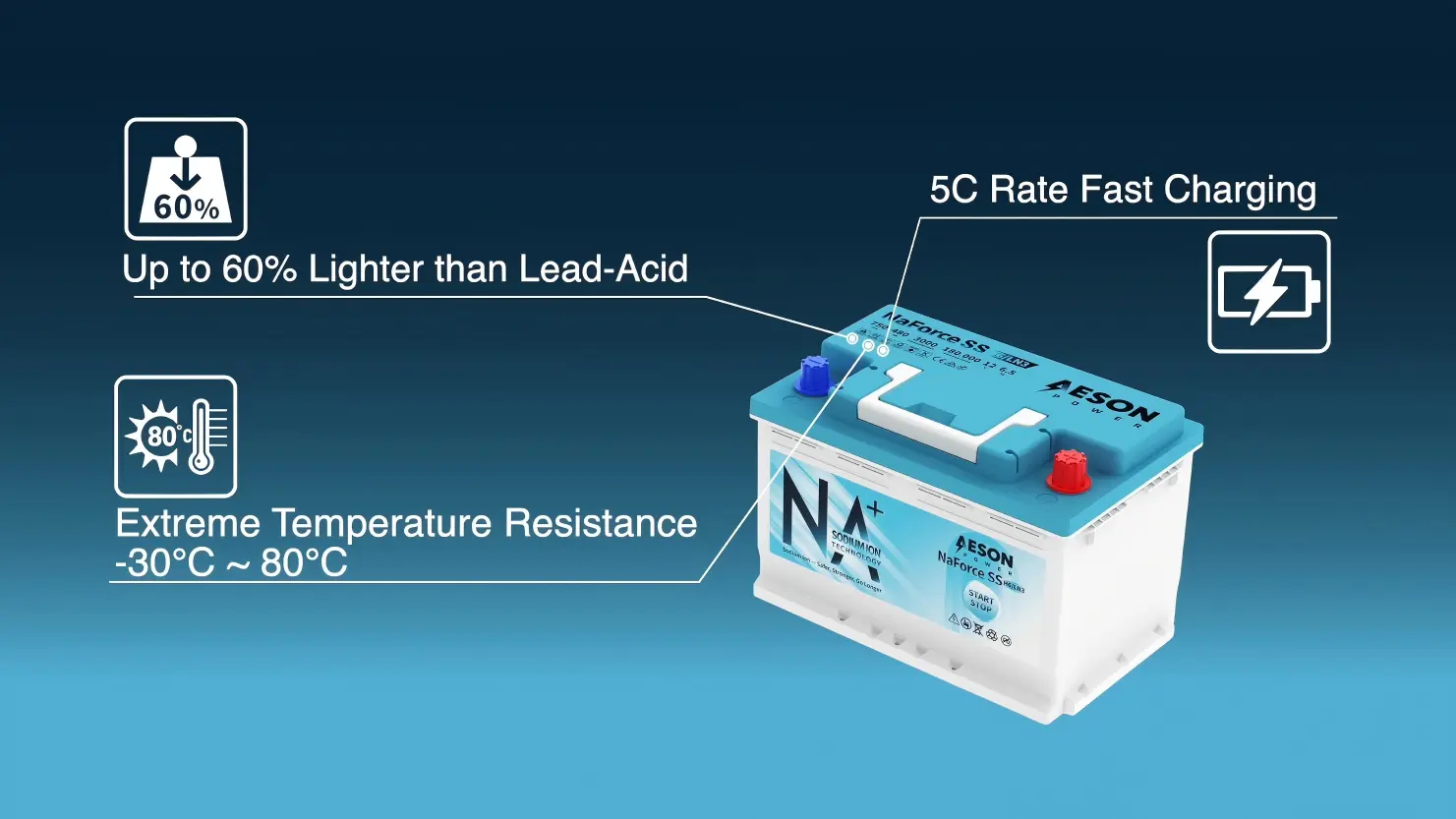
Our portfolio spans sodium-ion, lead-acid, and lithium-ion batteries. Sodium-ion solutions cover automotive starting, start-stop, commercial vehicle, EV auxiliary, racing, and UPS applications, while energy solutions serve residential, commercial, industrial, and utility-scale needs.
For us, production scale is not simply about producing more units. It is about building repeatable processes that support safe, high-quality products while maintaining secure supply chains. This matters as customers require dependable supply.
What Scale Means for Business Buyers
Production scale can influence more than factory cost. It can affect lead-time management, purchasing efficiency, production flexibility, quality consistency, and the ability to support customers as demand grows. For procurement teams, these factors can meaningfully affect project planning and total cost of ownership.
We also believe scale should be matched with application-specific engineering. Customers may prioritize starting power, cycling performance, temperature tolerance, backup reliability, footprint, or integration requirements. A scalable manufacturer needs technical and production flexibility to meet these priorities without sacrificing consistency.
Why Scale Will Shape Sodium-Ion Costs
Sodium-ion batteries are entering a broader scale-up phase, but manufacturing capacity and supply-chain maturity still have room to develop. The IEA reports that current sodium-ion cell manufacturing capacity is only a small fraction of lithium-ion capacity. As production expands, manufacturing learning, supplier development, and process optimization can strengthen the technology's cost position.
We see this as an opportunity for manufacturers and business buyers alike. The long-term economics of sodium-ion batteries will depend not on one material advantage, but on how effectively the manufacturing ecosystem converts technology improvements into reliable, repeatable, and cost-efficient products.
Building a Scalable Battery Supply With Aeson Power
Aeson Power is an Australian battery technology company and a partner with XuPai Group, providing factory-direct supply of sodium-ion, lead-acid, and lithium-ion batteries. Our sodium-ion innovation focuses on sustainable, lower-cost solutions for multiple scenarios, supported by seven manufacturing centers and rigorous quality control.
If you are evaluating sodium-ion batteries for automotive, UPS, energy storage, or another commercial application, we invite you to discuss your requirements with Aeson Power. Contact us to explore suitable battery solutions, production capabilities, and factory-direct supply options for your next project.