






Passenger-car battery design is moving beyond a simple question of chemistry. Charging strategy, voltage limits, temperature control, state estimation, communication, and protection logic determine whether a sodium-ion battery can operate reliably inside a vehicle. At Aeson Power, we focus on these requirements because a battery that fits mechanically but does not match the vehicle’s electrical architecture is not a suitable automotive solution.
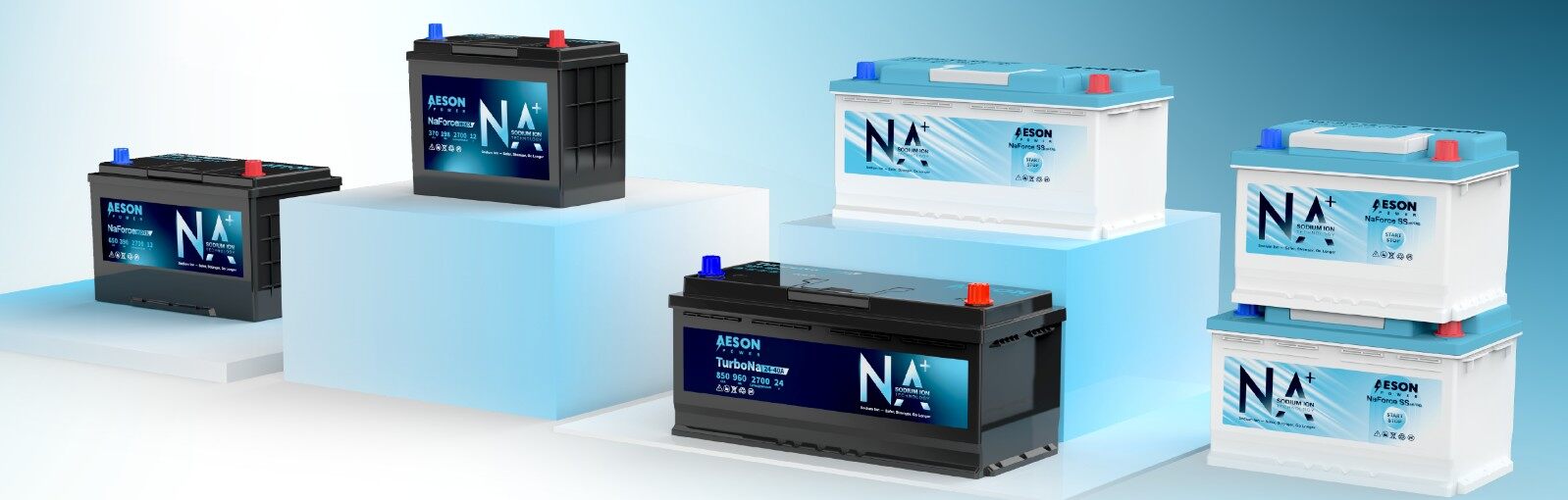
For passenger cars, the first distinction is application. A sodium-ion battery may serve as a 12 V starter or start-stop battery, or as a low-voltage auxiliary battery in an electric vehicle. NaForce EV Series is a customizable auxiliary battery for electric passenger cars. That distinction affects both charging design and BMS requirements.
Why Charging Limits Must Be Chemistry Specific
A sodium-ion system should not simply inherit charging settings from lead-acid or lithium-ion batteries. Cell chemistry, series configuration, voltage profile, internal resistance, temperature, and aging behavior influence the safe charging window. Research on sodium-ion cells commonly uses constant-current and constant-voltage charging, but exact voltage and current limits are cell-specific and should come from validated battery data.
As a sodium-ion battery manufacturer, we treat charger compatibility as an engineering parameter rather than a generic assumption. For our 12 V NaForce SS start-stop batteries, official charging guidance specifies CC-CV charging, a recommended maximum charge voltage of 14.6 V, and a maximum charge current of 2C. Once 14.6 V is reached, charging should stop within five to ten minutes.
This matters because the charging source may be an alternator, a DC-DC converter, or an external charger. The source must stay within approved voltage and current limits. For an EV auxiliary battery, the low-voltage battery also has to match the vehicle’s original system voltage. Our NaForce EV Series includes the 12 V 1215 auxiliary battery for electric passenger cars.
What a Sodium-Ion Battery Manufacturer Must Build Into the BMS
The BMS keeps the battery inside its allowable operating area. Core functions include monitoring voltage, current, and temperature, estimating state of charge and state of health, and reacting when operating limits are approached. These functions matter in vehicles because transient loads, charging events, long parking periods, and changing ambient temperatures can occur within one duty cycle.
Sodium-ion batteries also require chemistry-specific state estimation. Published research shows that lithium-ion SOC estimation methods cannot automatically be transferred to sodium-ion cells because their electrochemical behavior and voltage response differ. A useful BMS therefore needs models and calibration data developed for the actual sodium-ion chemistry rather than simply relabeling a lithium-ion algorithm.
Cell-level voltage supervision is equally important. Even when overall pack voltage appears acceptable, one cell can reach its upper or lower limit earlier than the others. The BMS must detect this condition and use appropriate balancing and protection logic so that operation does not push an individual cell outside its validated range.
Temperature Changes the Charging Decision
Temperature changes internal resistance, available power, charge acceptance, and the accuracy of state estimation. A vehicle BMS should therefore combine temperature sensing with current and voltage data when deciding whether charging or discharging should continue at the requested rate.
At Aeson Power, our automotive sodium-ion portfolio is designed for demanding temperature environments, but system controls still matter. Sodium-ion chemistry can offer useful low-temperature characteristics, yet safe charging limits must remain product-specific. A robust BMS should use the battery’s validated temperature map instead of assuming that improved cold-weather capability removes the need for thermal supervision.
Communication Matters in Modern Passenger Cars
An auxiliary battery in an EV is part of a networked electrical system. It helps power low-voltage electronics and supports activation of the high-voltage system. Communication between the battery, vehicle controller, and power-conversion system is therefore important for diagnostics, wake-up behavior, charging control, and fault handling.
Our NaForce EV solution incorporates a BMS with ASIL-B functional safety capability and supports CAN and CAN FD communication for vehicle data exchange. These features matter to OEM integration because the battery must do more than store energy; it must provide status information and respond predictably when the vehicle requests power or identifies an abnormal condition.
Protection Should Be Layered Rather Than Reactive
A well-designed BMS should not wait for a severe fault before acting. Overvoltage, undervoltage, excessive current, abnormal temperature, cell imbalance, and communication faults should be detected early enough for the system to limit charge, reduce load, isolate the battery, or report a fault according to the vehicle’s control strategy.
For buyers evaluating a sodium-ion battery manufacturer, the useful questions extend beyond nominal voltage and capacity. Charging limits, SOC accuracy, communication protocol, protection thresholds, validation conditions, and compatibility with the vehicle’s electrical architecture are all part of product selection. These details are important for OEMs, fleet operators, and distributors serving different climates.
Matching the Battery to the Vehicle
There is no single charging profile or BMS configuration for every sodium-ion passenger-car battery. A start-stop battery experiences repeated engine restarts and high current pulses, while an EV auxiliary battery supports control units, contactors, lighting, locks, communication systems, and other low-voltage loads. The control strategy should reflect the actual duty cycle.
At Aeson Power, we are an Australian sodium-ion technology company working in strategic partnership with Xupai Group. Our portfolio includes automotive starting and start-stop batteries, EV auxiliary batteries, commercial starting batteries, racing applications, UPS products, and customized sodium-ion systems.


