






A race car does not expose its battery to one stress at a time. Heat builds around the engine bay, acceleration and curb strikes transmit vibration through the chassis, and repeated starts demand short bursts of high current. At Aeson Power, we treat racing battery durability as the ability to keep these stresses from turning into electrical or mechanical instability during motorsport use.
A Lap Combines Thermal and Mechanical Stress
Track driving creates a different battery environment from ordinary road use. High engine loads can raise under-hood temperatures, while stiff suspension, kerbs, braking, and rapid directional changes transmit repeated movement through the battery mounting points.
These stresses can interact. Higher temperature can accelerate electrochemical degradation, while vibration challenges terminals, internal connections, cell restraints, and the enclosure. Recent sodium-ion research notes that high temperatures can accelerate degradation and introduce additional safety challenges, so a stated operating-temperature limit should not be interpreted as identical performance at every temperature.
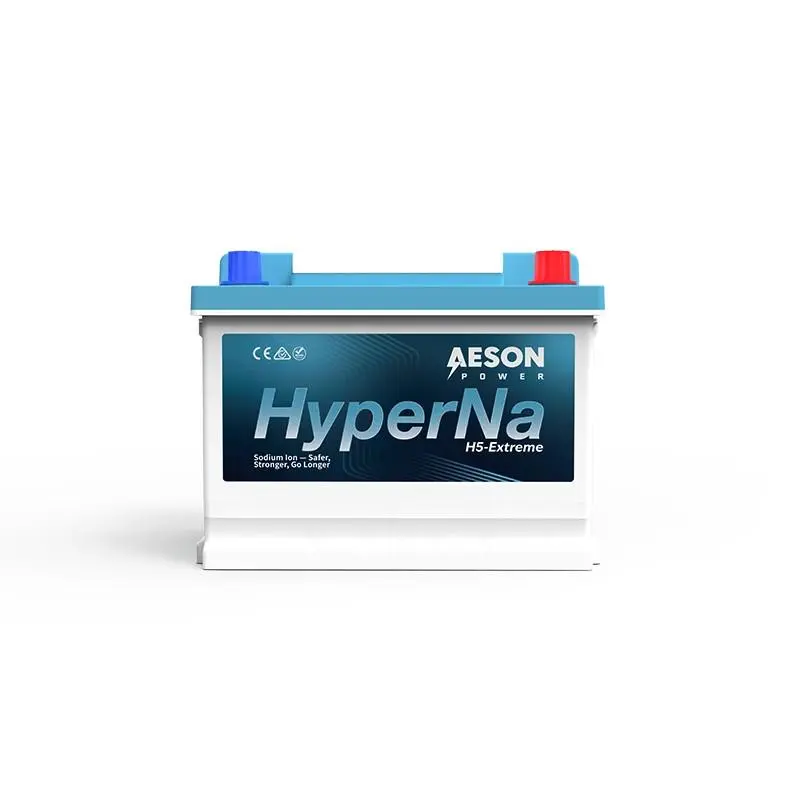
Our HyperNa series is specified for operation from -40°C to 80°C and is described with improved vibration resistance. They answer different questions: the temperature range defines the stated operating envelope, while vibration resistance concerns mechanical stability under movement.
Why a Racing Battery Mount Matters
Battery durability begins outside the cell. A pack that is not securely mounted can move relative to the chassis, increasing stress on terminals, cables, and the case. A strong chemistry cannot compensate for poor installation.
In motorsport applications, teams should confirm the battery's case dimensions, hold-down method, terminal orientation, cable strain, and surrounding clearance. Secure mounting helps limit movement under vibration and mechanical shock, reducing stress on the battery enclosure, terminals, and connections. Our HyperNa product guidance emphasizes using appropriate mounting hardware and regularly inspecting the battery, terminals, and cables to maintain installation integrity.
For a motorsport installation, teams should confirm the case dimensions, hold-down method, terminal orientation, cable strain, and clearance around the battery. Our product guidance also advises securing HyperNa with the correct mounting hardware and inspecting terminals, cables, and the case regularly.
Heat Changes More Than Safety
Temperature affects more than whether a battery remains physically safe. It can influence internal resistance, charge acceptance, electrochemical reaction rates, and aging. A 2025 review of sodium-ion batteries under extreme temperatures reports that high-temperature operation can accelerate degradation and increase safety challenges.
This is why an 80°C operating specification should be read as a boundary, not as a promise that repeated exposure near that temperature has no effect on life. HyperNa service life depends on temperature, starts, depth of discharge, charging method, vibration, electrical demand, and storage conditions.
Teams should also consider battery location. Moving a battery for weight distribution can change cable length, voltage drop, cooling conditions, and mounting loads. A relocation therefore needs an electrical and mechanical review rather than being treated only as a chassis-balance decision.
Starting Power Has to Survive the Environment
A racing starter battery earns its place when it can deliver the required cranking output after the car has been exposed to real track conditions. That is why PHCA, CCA, weight, reserve capacity, and charging behavior need to be read together.
Our HyperNa sodium-ion racing range offers different battery configurations to accommodate varying starting demands and installation constraints. Selecting between models involves more than comparing output figures. Teams should consider engine cranking requirements, electrical loads, available space, terminal layout, reserve capacity, and the vehicle's overall weight target.
Both models are part of the HyperNa sodium-ion racing range. The choice depends on cranking demand, electrical loads, available space, terminal layout, reserve capacity, and the vehicle builder’s mass target.
Charging Between Sessions Can Affect Durability
Between-session charging is another factor in battery care. HyperNa supports fast charging, but the appropriate charging procedure still depends on the battery model and its approved operating conditions. Charger compatibility, voltage settings, temperature, and charging control should be checked before use. Repeatedly charging outside the specified limits may affect battery performance and service life.
Fast-charge capability should not be treated as permission to use any charger at any setting. Correct voltage, current control, temperature, and charger compatibility still matter. A battery that is repeatedly pushed outside its approved charging conditions may experience a very different life from one used within them.
Durability Claims Need a Boundary
Descriptions such as “vibration resistant” and “high-temperature operation” need to be understood within their stated limits. HyperNa racing batteries feature improved vibration resistance and support operation at temperatures up to 80°C. These characteristics are relevant to demanding motorsport environments, but they should not be interpreted as guarantees of performance under every track condition or as a specific number of racing seasons.
The same caution applies to service life. Our official guidance specifically states that HyperNa life varies with starts, depth of discharge, charging method, temperature, vibration, onboard electrical demand, and storage. That is more useful for a race team than a universal calendar-life promise.
Durability Is a Car Level Result
A durable racing battery is part of a system. Battery chemistry, enclosure, internal construction, mounting, cables, alternator behavior, charger settings, heat exposure, and electrical loads all influence what happens during a season.
At Aeson Power, we develop the HyperNa series for racing and high-performance vehicle starting. Our two current models combine low mass with published PHCA, CCA, reserve-capacity, temperature, and charging data so teams can evaluate the product against a defined installation rather than a generic performance claim.
When selecting a racing battery, contact our team with the engine, available case space, terminal layout, electrical loads, charging system, mounting arrangement, and expected track environment so the battery can be assessed in the context in which it will actually operate.


