










Electric vehicles do not rely on the high-voltage traction battery alone. They also need a low-voltage electrical network to operate control electronics, safety systems, communications, and everyday vehicle functions. For business buyers, understanding what a car auxiliary battery powers helps us specify the right chemistry, voltage, capacity, and packaging. As companies making sodium-ion batteries develop new low-voltage solutions, auxiliary power is becoming an important application for this technology.
What Does a Car Auxiliary Battery Actually Power?
An auxiliary battery supplies low-voltage electricity to systems that do not directly use the vehicle’s high-voltage traction circuit. In an EV, it can support the vehicle’s low-voltage “house” systems and help control the high-voltage contactors that connect or disconnect the main battery. If the auxiliary battery is depleted, the vehicle may fail to start or wake up even when the traction battery is fully charged.
We therefore need to view the auxiliary battery as more than a backup power source. It supports the electrical architecture that allows the vehicle to boot, communicate, monitor conditions, and operate essential equipment. This makes auxiliary-battery reliability important for passenger EVs, commercial electric vehicles, and fleet platforms.
Key Systems Supported by an Auxiliary Battery
The exact electrical loads vary by vehicle design, but auxiliary systems commonly include control units, lighting, communication equipment, safety electronics, instrumentation, and other low-voltage loads. EV thermal-management components can also involve auxiliary electrical systems, including battery heating and cooling, HVAC equipment, and related pumps or actuators.
For commercial vehicles, the load profile can be more demanding. Electric buses, delivery vehicles, work trucks, and specialty vehicles may need low-voltage power for more equipment and longer operating periods. We should therefore evaluate the auxiliary battery according to the vehicle’s complete electrical load profile rather than choosing a battery only by nominal voltage.
Why Voltage and Energy Capacity Matter
Voltage must match the vehicle’s low-voltage architecture. While 12V systems are common, commercial electric vehicles can use higher low-voltage architectures, including 24V. Capacity and energy also matter because the auxiliary battery must supply loads during periods when the traction system is unavailable or when electrical demand continues after the vehicle is stationary.
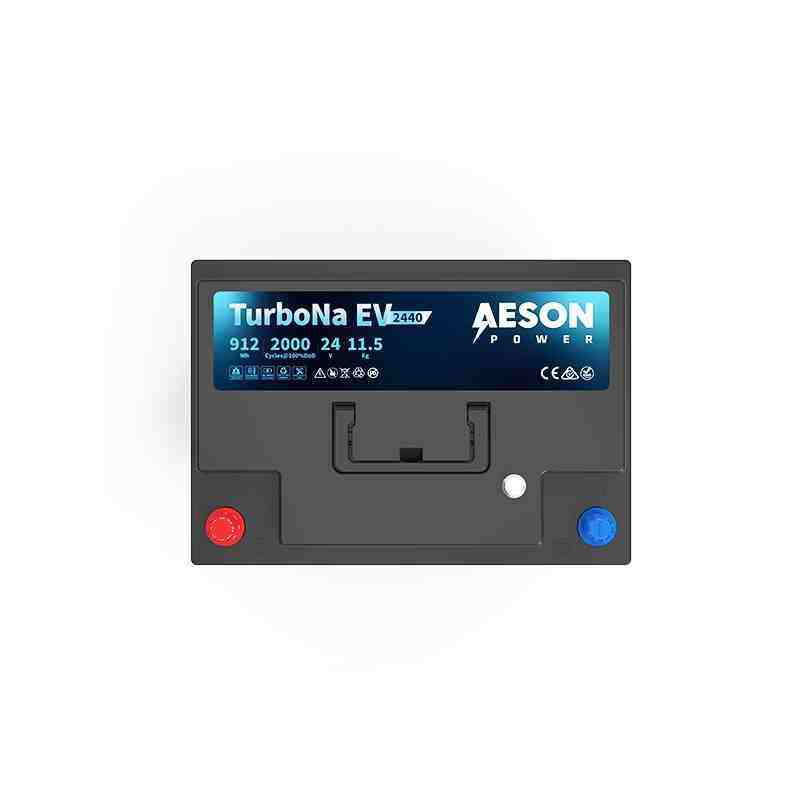
Aeson Power’s 2440 is designed as a 24V auxiliary battery for electric commercial vehicles. Its specification is 24V voltage and 912Wh energy, with dimensions of 343 × 238 × 200 mm and a total height of 202 mm. The listed weight is 11.5 kg. These specifications give business buyers concrete parameters for evaluating installation space and energy requirements. Aeson Power lists the 2440 within its 12V and 24V sodium-ion EV auxiliary battery range.
Why Sodium-Ion Is Interesting for Auxiliary Power
Sodium-ion technology is attracting attention in low-voltage EV applications because it can offer useful performance characteristics without depending on lithium-based chemistry. Aeson Power’s sodium-ion auxiliary battery platform emphasizes high-temperature operation, fast charging, and reduced weight. These features can be particularly relevant for commercial vehicles that operate for long hours or encounter demanding environmental conditions.
The 2440 supports operation at temperatures up to 80°C and 5C fast charging. It is also specified as approximately 60% lighter than a traditional lead battery. For fleet operators and vehicle manufacturers, lower mass can simplify battery handling and contribute to broader vehicle-weight optimization, while fast charging can help shorten recovery periods between operating cycles.
How Companies Making Sodium-Ion Batteries Can Add Value
As companies making sodium-ion batteries move from cell development toward application-specific products, the focus needs to shift from chemistry alone to system requirements. We need to consider voltage architecture, energy demand, installation dimensions, temperature range, charging characteristics, communication requirements, and the vehicle’s duty cycle together.
This is particularly important for commercial EVs. A battery that performs well at cell level may still be unsuitable if its pack dimensions, voltage, thermal behavior, or charging profile do not match the vehicle. Application engineering therefore becomes a critical part of selecting and integrating sodium-ion auxiliary power.
Aeson Power Develops Auxiliary Power for Commercial EVs
At Aeson Power, we are a sodium-ion battery manufacturer developing solutions for automotive and commercial transportation applications. Our product portfolio includes sodium-ion automotive starting and start-stop batteries, commercial starting batteries, EV auxiliary batteries, racing-car starting batteries, and UPS batteries. We also supply lead-acid and lithium-ion battery solutions for different application requirements.
Designed specifically for electric commercial vehicles, our 2440 auxiliary battery combines a robust 24V system architecture with high-rate sodium-ion technology to support heavy-duty operating cycles.
For businesses evaluating a car auxiliary battery for electric commercial vehicles, we can support the selection process from application requirements through product matching. Contact Aeson Power today to discuss your vehicle platform, electrical loads, and operating conditions, and let us develop a suitable sodium-ion auxiliary battery solution for your project.