









Products
You can find everything you want here
24 V Commercial Starting Batteries
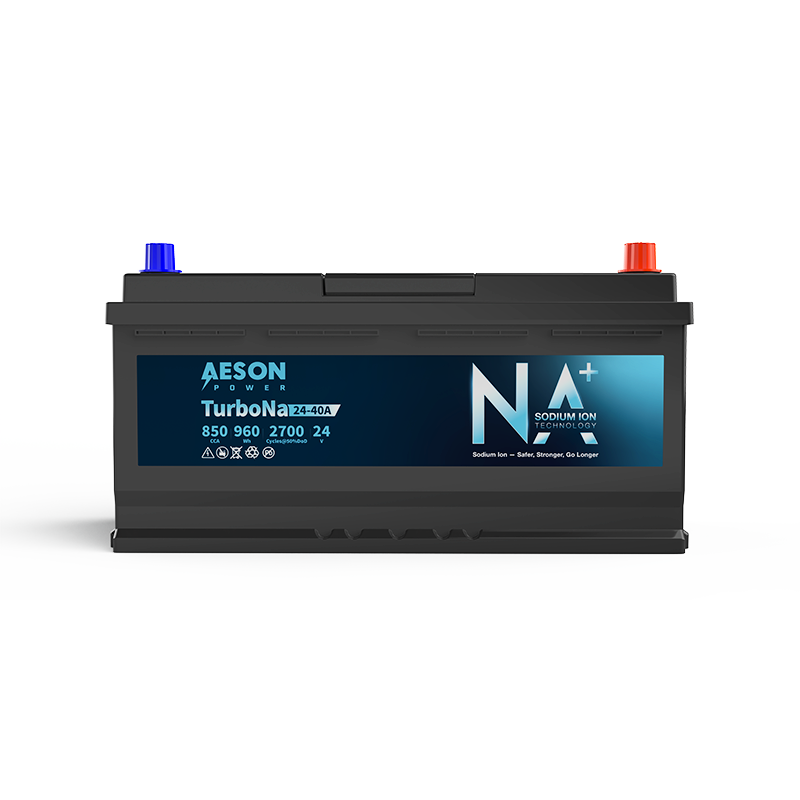
As a commercial battery manufacturer, Aeson Power offers 24 V sodium-ion starting batteries designed for commercial vehicles and diesel-powered equipment. Delivering high CCA, 5C fast charging, maintenance-free operation, and reliable performance across a wide temperature range of -40°C to 80°C, the TurboNa range replaces two traditional 12 V lead-acid batteries with a single lightweight, all-in-one 24 V solution.
Frequently Asked Questions
-
Why does Aeson Power only require one battery when traditional heavy-duty trucks and commercial vehicles use two 12V lead-acid batteries connected in series?
Due to the cell voltage limitation of traditional 12V lead-acid batteries (about 2V), 6 cells must be connected in series. To achieve the 24V system required by commercial vehicles, two 12V batteries must be physically connected in series outside the vehicle using thick, heavy cables. In contrast, the Aeson Power 24V sodium-ion battery performs highly efficient cell-level series connection directly inside a single battery pack (with modular BMS management), serving as a single battery with high CCA that directly outputs a 24V voltage.
-
In which specific equipment and business scenarios can the Aeson Power 24V sodium-ion starting battery be applied?
Diesel engines (construction machinery / generator sets), light trucks (high-frequency start-stop / urban distribution transport), and air compressors (high vibration / harsh outdoor environments).
-
What is the charging voltage? What is the full charging voltage?
Charging voltage range: 14.4~14.8 V. Recommended maximum charging voltage is 14.6V (12V).
Usually the open circuit voltage is between 13~14.5V after fully charged and rest for about 30min.
-
What Is a Commercial Battery?
A commercial battery is designed to deliver the high current required to start larger engines and support the electrical systems of commercial transport vehicles and diesel-powered industrial equipment. These applications typically require strong cranking performance, high durability, and reliable operation under demanding working conditions.
As a professional commercial battery manufacturer, Aeson Power offers TurboNa—an all-in-one 24 V sodium-ion commercial starting battery engineered for buses, coaches, light trucks, and diesel-powered equipment, including construction machinery, generator sets, and air compressors.
-
What Are the Main Applications for TurboNa Commercial Batteries?
TurboNa commercial batteries serve two main application categories:
Commercial Transport Vehicles: Buses, coaches, and light trucks used for frequent stop-and-go operation or urban distribution.
Diesel-Powered Industrial Equipment: Construction machinery, generator sets, and air compressors operating in high-vibration or harsh outdoor environments.
The correct model depends on the equipment’s voltage, required CCA, engine specifications, case size, terminal configuration, charging system, and operating environment.
-
What Are the Key Advantages of TurboNa Commercial Starting Batteries Over Lead-Acid Batteries?
TurboNa sodium-ion commercial starting batteries provide several practical advantages over conventional lead-acid battery systems:
All-in-One 24 V Design: One TurboNa battery can replace two externally connected 12 V lead-acid batteries, simplifying installation and reducing the number of cables and connections.
Strong Cranking Performance: The TurboNa range delivers up to 850 A CCA for demanding engine-starting applications.
Lower System Weight: Lightweight sodium-ion construction reduces the overall weight of the starting system.
Rapid Charge Acceptance: Up to 5C fast charging supports efficient energy recovery and shorter charging times.
High-Temperature Performance: Selected models are designed to operate at temperatures up to 80°C.
Maintenance-Free Operation: The sealed design does not require electrolyte refilling.
These benefits can help commercial operators reduce installation complexity, maintenance requirements, replacement labor, and vehicle downtime.
-
How Do TurboNa Batteries Perform in Demanding Commercial Environments?
TurboNa batteries combine high-rate discharge capability, integrated battery protection, and high-temperature operation up to 80°C to provide dependable starting power under demanding commercial conditions.
They are suitable for frequent-use vehicles, diesel-powered equipment, generator sets, and air compressors operating in high-vibration or challenging outdoor environments. For applications involving continuous vibration, dust, moisture, or extreme exposure, confirm the mounting method, enclosure protection, and charging requirements with Aeson Power before installation.
-
Do Aeson Power 24 V Sodium-Ion Commercial Batteries Require Maintenance?
Aeson Power 24 V sodium-ion commercial batteries use a sealed, maintenance-free design and do not require electrolyte refilling. However, periodic inspection is still recommended to maintain reliable performance.
Operators should inspect the battery case, terminals, cables, mounting hardware, and charging system regularly. During extended storage, keep the battery in a cool, dry environment, monitor its voltage, and recharge it using the approved 24 V charging profile before returning it to service.
-
Can Aeson Power Customize Commercial Starting Batteries?
Yes. As a commercial battery manufacturer, Aeson Power can evaluate customized starting-battery solutions for specific commercial vehicles, diesel-powered equipment, and market requirements.
Customization may include voltage, energy capacity, CCA, case dimensions, terminal configuration, battery protection functions, branding, packaging, and technical documentation. Available options depend on technical feasibility, certification requirements, and order volume.
Contact us to discuss your application and receive a tailored commercial battery solution.
-
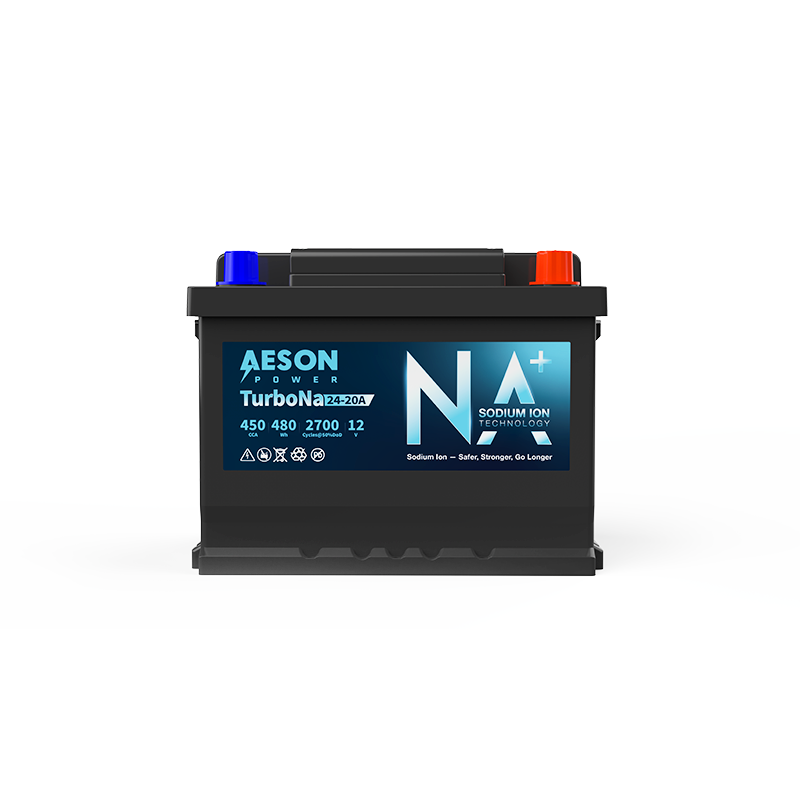
What are the main functions of the Aeson Power 12V sodium-ion automotive start-stop battery?
Start-stop batteries possess all the functions of a starting battery within the vehicle. Additionally, when the vehicle is stationary and the engine is not running, they supply energy to various electrical appliances on board; when the engine stops, they must ensure that the complete electronic system functions normally, including the power required for the next start.
-
Sodium battery charging time?
The charging time is related to the charging voltage and the charging current. For example, with 0.2C current and 14.6V voltage, the full charge time is about 5.5h; while with 1C high current, it isabout 1.1h. Normally, the charge voltage reach the limit value and last for 6-10min means it fully charged.
-
What is the discharge voltage (working voltage, i.e., closed circuit voltage in work) of sodium battery?
The discharge voltage is related to the size of the load and the SoC state of the battery. Thesmaller the load, the higher the voltage; the higher the SoC, the higher the voltage.
The closed-circuit voltage range of a new battery for start-stop use is between 9 and 12V, and thevoltage will gradually drop during usage.
-
Do sodium batteries require maintenance?
Sodium-ion starter batteries are a fully sealed & maintenance-free design, so these are similar to those of lead-acid AGM battery types. The original meaning of the English term MF(Maintenance Free) in the lead-acid battery terminology is that it does not require regular topping.
-
How are sodium batteries recycled?
Since sodium-ion starting batteries are a new technology and still in the stage of continuousimprovement, there is no comprehensive recycling standards and regulations yet, the relevantrecycling specifications are basically still referred to lithium-ion batteries, and it is recommended to consult the local professional organizations at present.
-
Are sodium batteries considered dangerous goods in transportation?
Yes, now basically refer to lithium-ion products regulation.
-
How to operate the sodium battery after over-discharged?
It is recommended to place it in 5~35℃ environment, and then recharge it according to therecommended method. In order to better protect the battery and avoid the damage caused byover-discharge, please recharge it if the battery voltage is less than 1ov.
-
How do I maintenance a sodium-ion battery during long time storage?
Short-term storage (1-3 months): generally no special maintenance is needed. Regularvoltage checks are recommended in higher temperatures (>35°C) to prevent excessiveself-discharge.
Medium-term storage (3-6 months): Possible 5%~20% capacity loss; check voltage every 3months. Recharge if the voltage drops to 10V per 12V.
Long-term storage (6 months or more): Possible 20%~40% capacity loss; recommendingCharge to 40%~60%soC to prevent irreversible damage for long time storage management..