






Stationary storage changes the usual battery comparison. In a car, every kilogram and litre can affect range. In a building, telecom site, or commercial energy system, footprint still matters, but safety, lifetime, temperature tolerance, efficiency, supply risk, and installed cost can matter just as much. That is why an ESS battery should be judged by the duty it performs rather than by chemistry reputation alone.
Stationary Storage Changes the Ranking
Lithium-ion, especially lithium iron phosphate, already has a mature supply chain, broad commercial adoption, and extensive field experience. Our LIBLFP APS5000 illustrates that maturity: it uses LiFePO4 chemistry, is rated at 51.2V and 100Ah, and is specified for at least 6,000 cycles under the stated 25°C and 80% DoD test conditions.
Our storage portfolio at Aeson Power includes both lithium-ion and sodium-ion products, which keeps the comparison grounded in actual stationary systems rather than chemistry labels. Sodium-ion is earlier in commercial development, yet the International Energy Agency identifies stationary storage as one of the applications where it can already be competitive in some conditions, especially cold climates.
Energy Density Is Not the Only Space Question
Lithium-ion still holds an energy-density advantage at cell level. The IEA reports current sodium-ion cells reaching up to about 175 Wh/kg, below leading LFP and NMC cells. For tightly constrained installations, that difference can influence cabinet size, floor loading, and usable energy per rack.
Yet system design can change the practical comparison. A stationary installation also contains enclosures, power electronics, cooling, fire protection, cabling, and service clearances. Buyers should compare complete-system dimensions and capacity instead of assuming cell-level energy density automatically determines the final site footprint.
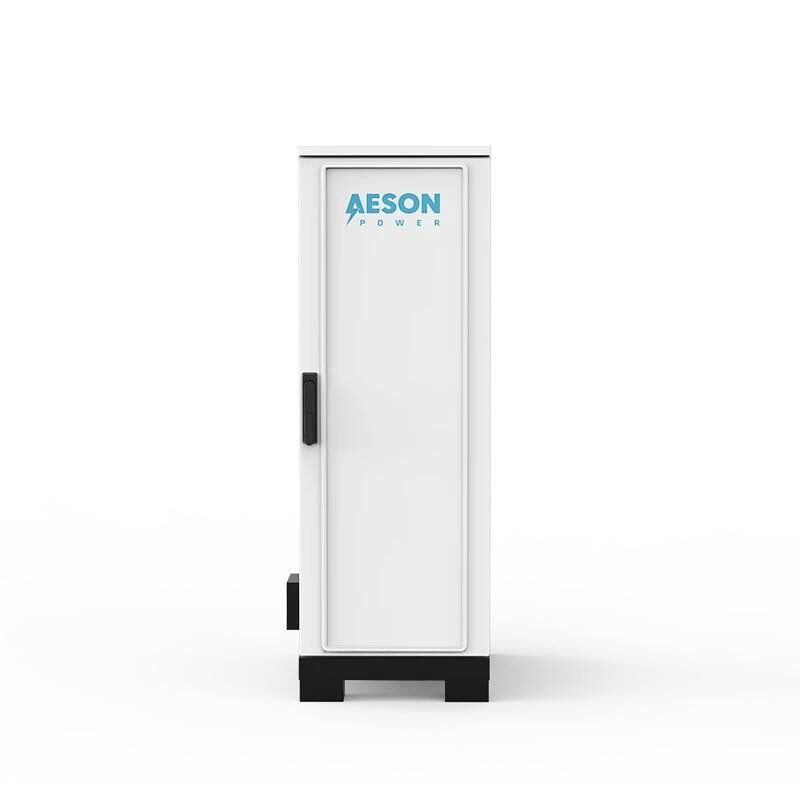
At system level, our SIBPOM 75/150 and 125/150 cabinets show how chemistry becomes only one design input. Both use 180Ah, 2.85V sodium-ion cells and a 1P294S configuration; the systems add air-conditioning cooling, aerosol fire protection, Modbus TCP communication, and IP54-or-higher protection. Those elements influence installation as much as cell chemistry.
Temperature Can Shift the Economics
Thermal management consumes equipment, space, electricity, and maintenance effort. Sodium-ion research continues to examine high- and low-temperature behaviour, and thermal safety remains chemistry- and design-dependent rather than automatic.
Operating temperature requirements vary across battery chemistries and product designs, so thermal performance should be evaluated against the conditions of the actual installation. In sites exposed to sustained heat or cold, the battery's approved charging and discharging conditions can influence cooling, heating, enclosure design, and ultimately the operating cost of the storage system.
For an outdoor telecom site or an unconditioned equipment room, those differences may affect system design. In a climate-controlled residential installation, they may matter far less. The operating environment should determine how much value is assigned to temperature range.
Safety Has to Be Evaluated at System Level
Safety is one reason sodium-ion attracts attention for stationary storage. A 2025 review in the Journal of Energy Chemistry notes that sodium-ion chemistry has promising thermal-safety characteristics while also emphasizing that cathodes, anodes, and electrolytes can still influence thermal-runaway behaviour. Sodium-ion therefore still requires system-level protection and thermal design.
Our NFPP-based sodium products use a polyanion cathode pathway selected for structural and thermal stability. At EES Europe 2025, our C&I sodium-ion cabinet was reported as having undergone third-party testing based on IEC 62619 and IEC 62933. For a stationary storage system, that type of evidence is more useful than treating chemistry alone as a safety guarantee.
Cycle Life Needs the Test Conditions Beside It
A cycle number without depth of discharge, temperature, end-of-life threshold, and charge-discharge rate can mislead buyers. Lithium-ion has extensive field data and standardized performance expectations, while sodium-ion products are still building a larger commercial evidence base.
This is one area where buyers should compare the exact product, not generic chemistry claims. Our APS5000 LFP module publishes at least 6,000 cycles under stated conditions. At EES Europe 2025, we reported more than 15,000 cycles for the sodium-ion products displayed there, but that event-level figure should not be transferred automatically to every current module or cabinet.
Supply Chains Tell a Different Story
Lithium-ion benefits from manufacturing scale that sodium-ion has not yet matched. The IEA reports that sodium-ion production remained below 1% of lithium-ion output in 2025 and that its supply chains are much less developed. That maturity supports current availability and standardization for many lithium-ion projects.
Sodium-ion, however, does not rely on lithium and can diversify battery supply chains. The IEA also notes that sodium-ion materials can be more geographically diversified upstream, although current sodium-ion manufacturing is itself highly concentrated. For long-lived stationary assets, supply diversification is a strategic consideration rather than a simple claim of lower risk.
The Better ESS Battery Depends on the Site
There is no universal winner. Lithium-ion is often the stronger choice when compactness, established field history, mature procurement channels, and proven system ecosystems dominate. Sodium-ion becomes more compelling when cold-climate operation, thermal stability, material availability, or application-specific system design carry greater weight.
Our storage work at Aeson Power spans LFP and sodium-ion products for residential, backup, telecom, data-centre, and C&I applications. The SIBPOM-4850 Pro provides one sodium-ion option, while APS5000 provides an LFP reference point; our larger sodium-ion portfolio also includes integrated C&I cabinet systems.
Selecting an ess battery should begin with the load profile, installation environment, required capacity, available space, operating temperature, safety requirements, and project economics. Share those project conditions with our storage team to compare configurations that fit the site rather than choosing chemistry by label alone.


