






In motorsport, unexpected mechanical failures can quickly bring a competition run to an end. But having sufficient battery capacity can make a difference when things don't go according to plan.
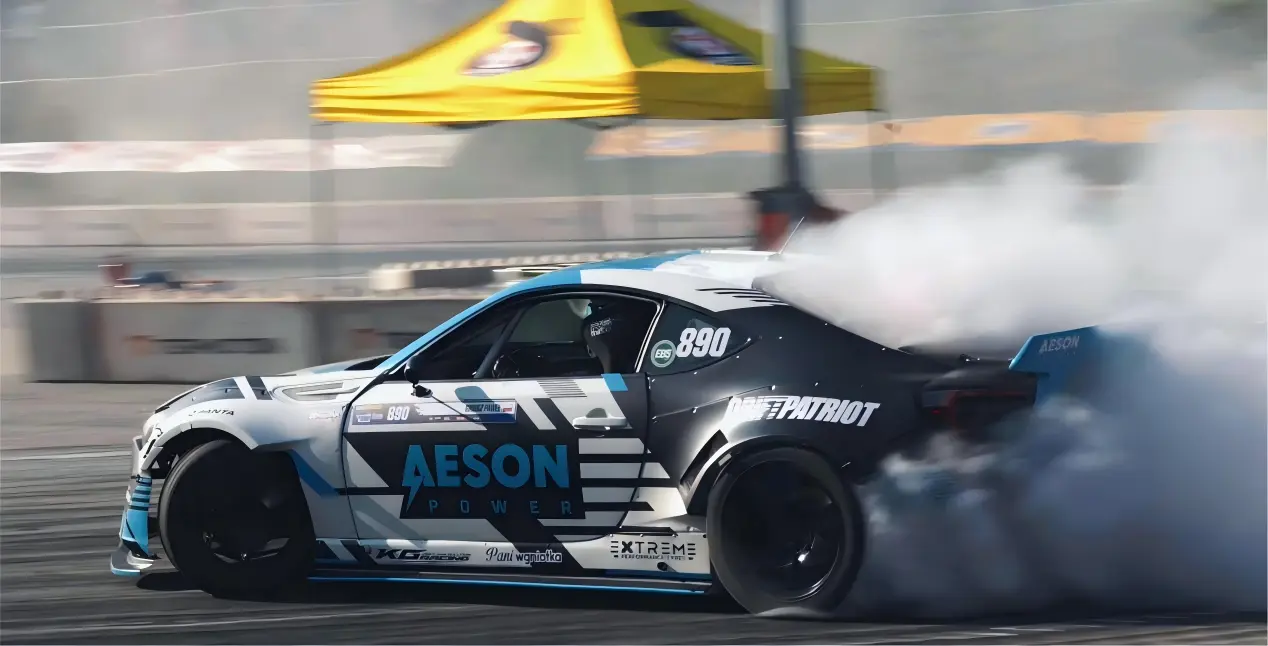
During the Polish Drift Championship, drifter Pawel Grosz encountered an unexpected mechanical failure when the alternator drive belt on his drift car suddenly snapped.
Without the alternator charging the battery, the vehicle had to rely entirely on its battery to power its electrical systems. Under normal circumstances, this type of failure would typically mean ending the competition and arranging for the car to be recovered for repairs.
However, after an inspection by the Mechanical Team, the Aeson Power Q85 sodium-ion battery voltage was measured at 13V. Following the team's assessment, Pawel decided to continue competing.
The car successfully completed four additional drift runs before returning to the pits. By then, the battery voltage had dropped to 11.5V.
This real-world experience highlights the importance of battery capacity and energy reserves in demanding motorsport applications, particularly when the vehicle's charging system is no longer operational.
Why Battery Capacity Matters in Motorsport
Weight is a critical consideration in racing. To minimise vehicle weight, racing teams often choose the smallest practical lead-acid starter batteries.
For example, a 16Ah lead-acid battery may be sufficient to start an engine in warm weather. In colder conditions, an external power source may be needed to assist with starting.
While this approach helps reduce weight, it also means working with a relatively limited energy reserve.
Aeson Power sodium-ion batteries offer a different balance between weight and capacity.
Compared with the 16Ah lead-acid battery used as a reference, Aeson Power's sodium-ion alternatives provide approximately two to two-and-a-half times the nominal capacity while weighing less.
Specification | Aeson Power H5 | Aeson Power H6 | Aeson Power Q85 | Normal Lead-Acid for drifting |
Weight (kg) | 6.1 | 6.5 | 5.5 | 7.0 |
Capacity (Ah) | 33 | 40 | 33 | 16 |
Energy (Wh) | 396 | 528 | 396 | 192 |
CCA (A) | 650 | 750 | 650 | 170 |
Internal Resistance (mΩ) | ≤3.5 | ≤3.5 | ≤3.5 | 7 |
Note: Specifications are based on the compared battery models. Pawel's vehicle was equipped with the Q85 sodium-ion battery, while H5 and H6 are also used in some motorsport applications.
More Energy Reserve, Without the Extra Weight
The comparison highlights several advantages of Aeson Power sodium-ion batteries:
Lighter weight: The Q85 weighs just 5.5kg, compared with 7kg for the reference lead-acid battery.
More than twice the capacity: At 33Ah, the Q85 offers over twice the nominal capacity of the 16Ah lead-acid battery.
Higher starting performance: With a CCA rating of 650A, the Q85 offers substantially greater starting power than the 170A lead-acid reference.
This additional energy reserve can be particularly valuable in motorsport, where unexpected mechanical failures can put additional demands on the battery.
Power That Keeps You Moving
Pawel Grosz's experience demonstrates how battery performance can make a practical difference in demanding motorsport applications.
When the alternator drive belt snapped, the sodium-ion battery measured 13V during the initial inspection and continued supporting the vehicle through four additional drift runs, with its voltage measuring 11.5V when the car returned to the pits.
For racing teams looking to reduce vehicle weight without compromising on battery capacity and starting performance, Aeson Power sodium-ion batteries offer a compelling choice to conventional lead-acid technology. Designed for demanding automotive and motorsport applications, these lightweight sodium-ion batteries combine high energy density, powerful starting performance and greater energy reserves in a compact package. Whether used in drift cars, performance vehicles or other high-demand automotive applications, Aeson Power delivers advanced sodium-ion battery solutions that help racing teams achieve an effective balance between weight reduction, reliable starting power and battery performance.
