






A battery buyer rarely has a chemistry problem in isolation. The real question is whether the chemistry, pack design, operating limits, and supplier support fit the application.
An NFPP battery can look attractive because of the characteristics associated with its polyanion cathode, but the label alone does not determine suitability. As a sodium-ion battery manufacturer, we treat NFPP as one part of a complete system rather than a substitute for application matching.
Start With the Duty Rather Than the Chemistry Name
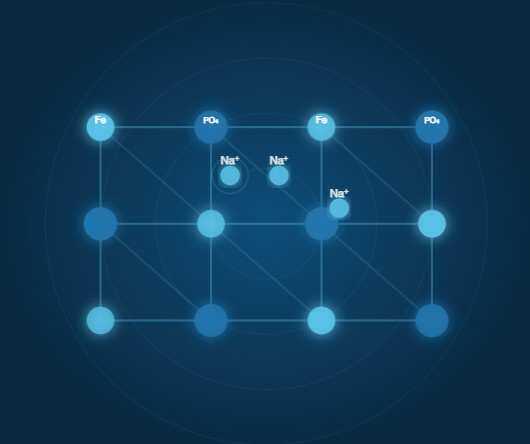
NFPP refers to Na4Fe3(PO4)2(P2O7), an iron-based polyanion cathode material used in sodium-ion batteries. Recent reviews describe its rigid framework, cycling stability, safety characteristics, and relatively low raw-material cost, while also identifying limitations such as low electronic conductivity, slower sodium-ion kinetics, and energy-density constraints that continue to be addressed through material and electrode engineering.
That balance matters. A chemistry can have useful intrinsic characteristics and still need evaluation against a defined load profile. Starting an engine, supporting a start-stop vehicle, providing UPS backup, and supplying a commercial energy-storage system place different demands on voltage, current, runtime, thermal behavior, and control.
At Aeson Power, our NFPP-based sodium-ion portfolio spans automotive starting and start-stop products, UPS batteries, and other application-specific systems. We therefore begin with the duty cycle and electrical architecture before narrowing the product choice.
Check Whether the Published Data Matches the Application
A buyer should separate headline chemistry claims from model-level data. Nominal voltage, capacity, maximum current, dimensions, weight, charge limits, discharge limits, and temperature range need to come from the actual product page or datasheet.
Our SIBPOM-12100 UPS battery illustrates why. It is specified at 11.4 V nominal voltage and 100 Ah rated capacity. Its charging cut-off voltage is 13.2 V, standard charging is listed at 100 A continuous current to that cut-off, and the same 100 A figure is stated for standard discharge to a 6 V cut-off.
Those figures belong to that model. They should not be copied onto another NFPP battery simply because the cathode chemistry is similar. Buyers comparing suppliers should ask for model-specific documentation rather than rely on chemistry-level descriptions.
A Sodium Battery Manufacturer Should Explain the Operating Window
Temperature deserves attention because one broad “operating range” can hide different charge and discharge limits. Charging at low temperature and delivering power at low temperature are not the same task. A product page that separates those conditions gives buyers more useful information for system design.
Current requirements differ too. An automotive starter needs short bursts of high cranking current. A UPS battery may need sustained discharge during an outage. An energy-storage system is assessed around different power and duration requirements. We match current capability to the intended duty rather than assume that a single rate figure describes every use case.
The charging source should also be checked. Voltage window, cut-off logic, current limit, and any BMS or control requirements need to align with the charger, alternator, DC-DC converter, or power-conversion equipment used in the application.
Look Beyond the Cell to Protection and Integration
The positive electrode is only one layer of the finished battery. Our sodium-ion technical information identifies hard carbon as the negative electrode and NaPF6 as the electrolyte used in our system, alongside the NFPP positive electrode. Pack architecture, sensing, protection, mechanical design, terminals, communication, and thermal conditions then shape how that chemistry operates in practice.
For custom projects, we support structural and electrical integration and BMS co-customization. Buyers should therefore clarify whether they need a standard battery, a modified enclosure or interface, or a more deeply integrated system. That distinction affects engineering work, validation, and the information required before production.
A buyer should also ask how abnormal conditions are handled. Overcharge, over-discharge, excessive current, temperature excursions, and communication faults cannot be judged from the cathode name. Protection requirements belong to the complete battery and the equipment around it.
Ask What Has Actually Been Validated
NFPP research has advanced from laboratory cells toward practical pouch-cell and commercial development, but recent reviews still discuss challenges around phase purity, conductivity, energy density, electrolyte optimization, and industrialization. That makes validation evidence important when evaluating a supplier.
For us, useful validation begins with a defined product and application. Buyers should ask which specifications have been tested, under what conditions, and whether the data applies to the exact model being quoted. Certification, transport documentation, installation requirements, and market-specific compliance may also matter depending on destination and application.
Manufacturing capability is relevant, but it should not replace technical evidence. Production scale tells a buyer whether supply can be supported; it does not prove that every model suits every duty.
Compare the Whole System Before Comparing Quotes
When evaluating an NFPP battery, we treat the cathode chemistry as the beginning of the conversation. As a sodium battery manufacturer, Aeson Power develops sodium-ion products for automotive, commercial, EV auxiliary, UPS, energy-storage, and customized applications in strategic partnership with Xupai Group.
Our work combines application matching, product documentation, engineering integration, and manufacturing support rather than relying on chemistry claims alone. Contact our team with your voltage, load, temperature, dimensions, charging conditions, and duty cycle so we can assess the NFPP solution against the actual application.


