






A finished car battery hides most of the work that determines whether it will perform consistently. Before reaching a vehicle, active materials are processed into electrodes, which are then assembled with separators and other components into cells before formation, grading, and testing. As a car battery manufacturer, we view manufacturing as a chain of controlled transformations rather than a single assembly step.
For our sodium-ion automotive products, that chain begins with the chemistry. Aeson Power identifies NFPP as the positive-electrode material, hard carbon as the negative electrode, NaPF6 as the electrolyte, and PP/PE as the separator in its sodium-ion system. Those materials define what the production process must control before a starter battery is complete.
Materials First Enter a Controlled Process
Battery manufacturing begins before anything resembles a battery. Active powders, conductive additives, binders, current collectors, electrolyte components, separators, and other inputs need to meet the specifications established for the cell design. Industrial sodium-ion production follows many process principles already used in lithium-ion manufacturing.
Reviews of sodium-ion electrode processing describe electrode preparation as slurry formulation and mixing, followed by coating, drying, calendaring, and cutting. Process parameters require optimization for each material system because particle properties, slurry composition, moisture sensitivity, and electrode chemistry can affect manufacturability and cell performance.
For a sodium-ion batteries manufacturer, this stage matters because variations in slurry composition or electrode loading can carry into later cell performance. Manufacturing control therefore begins with material consistency and process settings, not with final inspection.
What a Car Battery Manufacturer Controls on the Electrode Line
Cathode and anode materials are mixed with conductive and binding components to create processable electrode mixtures. These are coated onto current collectors and dried so that the active layer remains attached while solvent or moisture is removed.
The dried electrodes are pressed to control thickness and density, then slit or cut to the required dimensions. U.S. Department of Energy descriptions of battery manufacturing identify mixing, coating, drying, roll pressing, and slitting as core electrode-production operations. Sodium-ion industrialization literature describes essentially the same front-end sequence.
Coating uniformity, electrode thickness, density, and residual moisture can influence resistance, capacity, and repeatability. A modern line therefore has to hold these variables within defined manufacturing windows rather than depend on a final test to correct earlier variation.
Cell Assembly Changes the Environment
Once electrodes are prepared, they are combined with separator material so the positive and negative electrodes remain electrically isolated while ions can move through the cell.
Depending on cell format, electrodes may be stacked or wound, connected to tabs, placed into a housing, dried where required, filled with electrolyte, and sealed. Reviews of sodium-ion industrialization divide production into electrode manufacturing, cell assembly, and formation-and-sorting stages, showing that assembly is only one part of the process.
Mechanical alignment, electrical connections, sealing, and contamination control all affect whether the cell can proceed reliably into electrochemical activation.
Formation Gives the Cell Its Initial Electrochemical State
A newly assembled rechargeable cell is not ready for automotive service immediately after electrolyte filling. It undergoes formation: controlled initial charging and discharging that activates the electrochemical system and helps establish interfacial layers important to later cycling.
For sodium-ion cells using hard-carbon anodes, interphase formation is relevant to cycling stability. Formation conditions therefore belong to manufacturing engineering rather than ordinary customer charging.
After formation, cells can be measured and sorted according to defined electrical characteristics. This helps reduce variation when cells are combined into a battery. For a sodium-ion battery manufacturer, formation and grading connect cell chemistry with pack-level consistency.
From Cells to an Automotive Product
A car battery must satisfy a vehicle, not just a laboratory tester. Selected cells are combined into the required electrical configuration, then integrated with the enclosure, terminals, internal connections, protection functions where applicable, and other product-specific hardware.
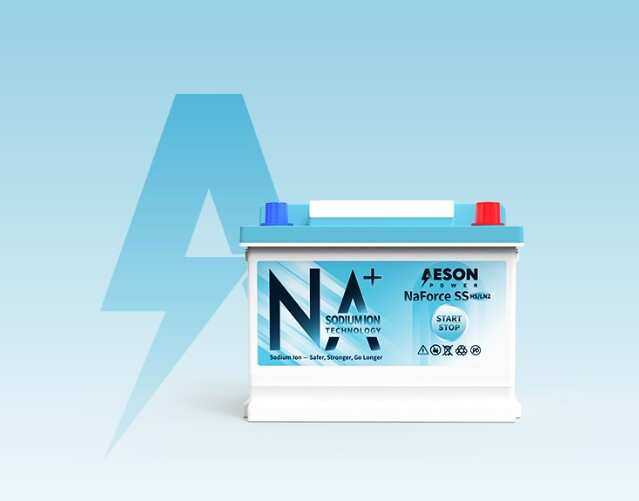
The design depends on the application. Our NaForce range serves 12 V automotive starting applications, while the start-stop line is designed for start-stop vehicles. Our commercial sodium-ion line also includes 24 V starting products, so system architecture is not identical across every automotive battery we manufacture.
Case dimensions, terminal positions, voltage, and cranking requirements must correspond to the intended vehicle. Manufacturing therefore has to preserve mechanical specifications alongside electrical ones.
Testing Is a Gate, Not a Substitute for Process Control
End-of-line checks can confirm whether a finished battery meets defined requirements, but testing cannot compensate for uncontrolled coating, weak connections, or inconsistent cell formation earlier in production.
We also separate routine production control from engineering validation. Aeson Power has publicly documented overcharge validation on NaForce NS40L, NaForce SS H7/LN4, and S95L batteries at 60°C, monitoring voltage, temperature, internal resistance, battery appearance, and safety status. Such validation examines behavior under severe conditions; it does not mean every production battery receives the same abuse test.
Manufacturing Scale Still Depends on Repeatability
Our wider manufacturing network includes seven manufacturing centers, 90 production lines, more than 1.1 million square metres of covered area, and 30 GWh of annual production capacity across our battery activities. Those figures describe the broader manufacturing platform, not sodium-ion-only capacity.
As a sodium-ion battery manufacturer, we combine that manufacturing base with sodium-ion development for automotive starting, start-stop, commercial starting, EV auxiliary, UPS, energy storage, and customized applications. The value of a modern factory lies not only in output, but in keeping materials, processes, testing, and application requirements connected across production.
Through its strategic partnership with Xupai Group, Aeson Power operates as an Australian battery technology company. We support international customers with factory-direct supply, product matching, technical documentation, and application-specific development.
Contact our team to discuss automotive battery specifications, fitment, and supply requirements for your market.


