






A race car battery is judged at several moments: when the engine is cranked, when electrical loads continue between runs, when the chassis vibrates on track, and when the car returns to the paddock for charging. For us, choosing racing car batteries means balancing those moments rather than chasing one headline number.
What Racing Car Batteries Need at Ignition
The first task is simple to describe but demanding to execute: the battery must provide enough current to turn the engine quickly and consistently. Pulse Hot Cranking Amps (PHCA) and Cold Cranking Amps (CCA) help describe starting capability, but neither figure should be considered without the engine's actual cranking requirement.
Our HyperNa racing batteries are designed to deliver the high-current output required for demanding starting applications. Model selection should still reflect the engine's cranking demand, available installation space, terminal arrangement, and onboard electrical requirements. A higher-output battery is not automatically the better choice when another configuration provides sufficient starting performance with a better fit for the vehicle.
Low Mass Matters Only When the Electrical Job Is Still Covered
Weight is valuable in motorsport because every component contributes to total vehicle mass. Yet the lightest battery can become the wrong battery if it leaves too little reserve capacity or cannot meet the engine's starting demand.
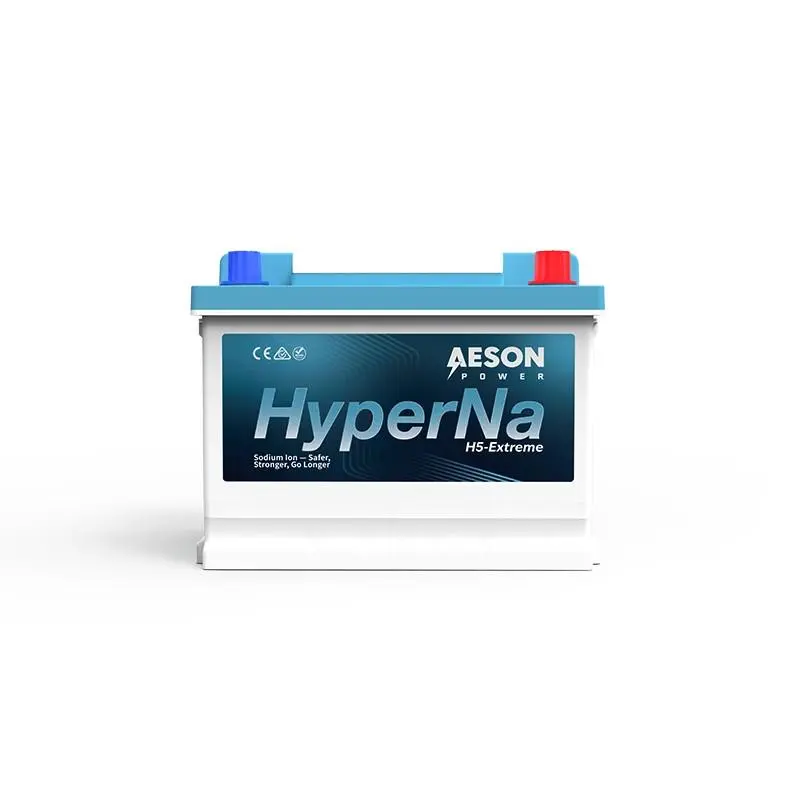
The NS40-Extreme weighs 5.0 kg and provides 312 Wh with a 55-minute reserve-capacity rating. The H5-Extreme weighs 5.5 kg, provides 396 Wh, and is listed with 82 minutes of reserve capacity. Those figures show why battery selection is a trade-off rather than a search for the lowest scale reading.
For us as a sodium-ion battery manufacturer, the useful comparison is power-to-weight performance. A race team should know what mass is being removed, but it should also confirm what cranking output, stored energy, and reserve capability remain after the change.
Track Conditions Test the Installation as Well as the Chemistry
A race battery works inside a moving, hot mechanical system. Kerb strikes, stiff suspension, engine vibration, and chassis movement can transmit loads into the battery mount, terminals, and internal connections. Heat from the engine bay adds another layer of stress.
HyperNa racing batteries feature improved vibration resistance and support operation at temperatures up to 80°C. These characteristics help address demanding racing environments, while secure mounting, correct terminal orientation, protected cables, and adequate clearance remain essential to a durable installation.
Poor mounting can damage even a suitable battery by increasing mechanical stress on the case, terminals, and connections. Mounting method and cable routing should therefore be considered during battery selection and installation, rather than addressed only after the battery arrives.
Between Sessions, the Battery Has a Different Job
Once the car is back in the paddock, charging speed and compatibility become more important than cranking output. HyperNa is listed with 5C fast-charge capability, while our published 12 V guidance specifies a 14.4 to 14.8 V charging range and a recommended maximum charging voltage of 14.6 V.
That capability can shorten recovery time between sessions when the charging equipment is appropriate. It does not mean any high-current charger can be connected without checking voltage control, current limits, battery temperature, and the required charging profile.
For racing car batteries, this matters because race weekends often involve repeated starts, data collection, electrical loads, and short service windows. Fast charge acceptance is useful only when it works inside the electrical system fitted to the car.
Reserve Capacity Becomes Visible When the Engine Is Off
Starting performance gets most of the attention, but onboard electrical demand can continue when the engine is not running. Data loggers, pumps, communication equipment, fans, control systems, and other loads can make reserve capacity relevant between runs.
This is why the H5-Extreme's 82-minute reserve-capacity rating may matter more than its extra 0.5 kg in a car with higher off-engine demand. In a simpler build with tighter packaging, the 55-minute NS40-Extreme may be enough. The correct choice depends on the car's electrical architecture.
A sodium-ion battery manufacturer should therefore publish model-level data rather than rely on broad chemistry claims. We provide separate PHCA, CCA, energy, reserve-capacity, weight, and case-size figures for both HyperNa models so teams can compare the actual products.
Compatibility Comes Before Individual Battery Traits
There is no single "best" characteristic that can replace proper fitment. High PHCA cannot solve a battery that does not fit the tray. Low weight does not correct insufficient reserve capacity. Fast charging is not useful if the vehicle or charger operates outside the approved charging window.
Our selection guidance asks teams to confirm case size, dimensions, terminal configuration, PHCA, CCA, reserve capacity, charging requirements, onboard loads, and weight. That list is more valuable than choosing a battery because one number is larger.
We can also evaluate customized racing battery solutions covering voltage, energy capacity, cranking output, case dimensions, terminal configuration, protection functions, branding, packaging, and technical documentation, subject to technical feasibility, certification requirements, and order volume.
A Trait Becomes Valuable Only in the Right Car
The best battery traits for racing cars are not independent advantages. Strong pulse cranking, low mass, adequate reserve capacity, rapid charge acceptance, vibration resistance, temperature capability, and compact packaging have to support the same installation.
At Aeson Power, we develop HyperNa for racing and high-performance starting applications. As a sodium-ion battery manufacturer, we combine published model-level specifications with application matching rather than treating one performance figure as a universal answer.
When comparing racing car batteries, contact our team with the engine, existing battery, case space, electrical loads, charging system, and target weight so the traits that matter most can be assessed against the actual car.


