






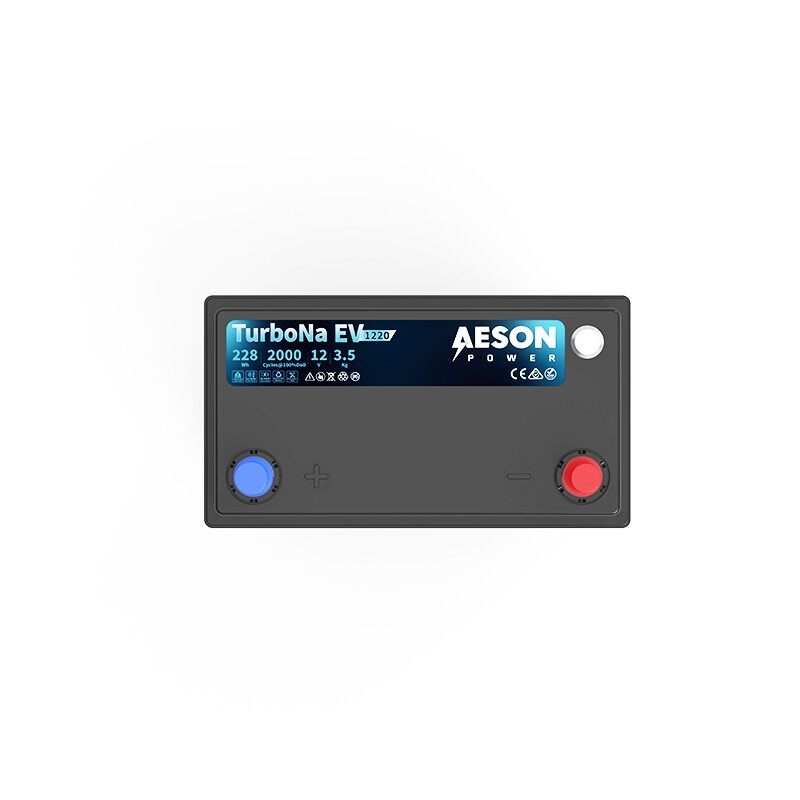
An electric vehicle can have a fully charged traction battery and still refuse to wake up. The reason may be the small low-voltage battery that powers the vehicle before the high-voltage system comes online. We think of an aux car battery as the bridge between a parked EV and an active one: it supplies low-voltage power so the car’s electronics can begin their work.
What Does the Auxiliary Battery Actually Do
The large traction battery stores the energy used to move the vehicle. The auxiliary battery has a different job. In most electric passenger cars, it supplies 12 V power to control units, locks, lighting, displays, safety equipment, communication systems, and other low-voltage electronics.
The U.S. Department of Energy explains that an EV auxiliary battery powers accessories, while the DC/DC converter uses energy from the traction battery to supply the lower-voltage system and recharge the auxiliary battery. The two batteries therefore work together, but they are not interchangeable.
For us as a sodium battery manufacturer, that distinction is fundamental. The low-voltage battery is designed around vehicle electronics, wake-up functions, and control requirements rather than propulsion energy.
Why an EV Can Be Full Yet Still Seem Dead
Before the traction battery can send high voltage through the vehicle, contactors have to close. These are electrically controlled switches that connect the high-voltage pack to the rest of the powertrain. The low-voltage electrical system helps operate that process.
If the auxiliary battery is discharged, the car may be unable to energize its control systems and close the contactors. That is why a vehicle can have energy remaining in the traction battery yet fail to start normally. Difficulty waking the vehicle, low-voltage warnings, repeated boosting, or intermittent electronic faults can justify checking the auxiliary battery.
An Aux Car Battery Is Not a Smaller Traction Battery
The easiest way to understand the difference is by purpose. The traction battery is sized to deliver propulsion energy. The auxiliary battery is sized around low-voltage electronics, control functions, standby loads, wake-up requirements, and communication with the vehicle.
That distinction also changes how a replacement should be chosen. Voltage has to match the original low-voltage architecture. Dimensions, connections, communication requirements, charging profile, protection logic, and vehicle integration may matter as much as nominal energy.
Our NaForce EV range is designed for low-voltage auxiliary applications in electric passenger cars. It supports the vehicle’s electronics, control functions, and communication requirements rather than providing propulsion energy. Battery selection therefore needs to account for the vehicle’s low-voltage architecture, electrical interfaces, and integration requirements.
How Does It Get Recharged
Drivers do not normally charge the auxiliary battery from the same external connector used for the traction pack. Once the high-voltage system is active, a DC/DC converter can reduce traction-battery voltage to the level required by the vehicle’s low-voltage system and recharge the auxiliary battery.
For our NaForce EV Series, published charging guidance gives a 14.4 to 14.8 V range for the 12 V battery, with 14.6 V as the recommended maximum charging voltage. External charging, when required, should follow the approved profile for the specific battery rather than assuming every lead-acid or lithium-ion charger is compatible.
What a Sodium Battery Manufacturer Has to Match
An EV auxiliary battery is part of the vehicle’s electrical architecture, not an isolated box. We therefore look at the original system voltage, available installation space, communication protocol, charging strategy, expected standby loads, environmental conditions, and the functions that remain active while the car is parked.
This becomes especially important when moving beyond a standard product. Our NaForce EV series is customizable for electric passenger cars, while our EV auxiliary portfolio also includes solutions for commercial vehicles. We support 12 V and 24 V low-voltage applications according to vehicle requirements rather than treating one battery as universal.
Cold Weather Can Expose Low Voltage Weakness
Cold conditions can make low-voltage battery weakness more noticeable because electrochemical behavior changes with temperature. For an EV, that matters before propulsion begins because its control systems still require dependable low-voltage power to wake the vehicle.
Our NaForce EV information specifies an operating range from -40°C to 80°C. We treat that figure as an operating envelope rather than a claim that performance remains identical at every temperature. Vehicle load, state of charge, charging conditions, and the battery’s condition still influence real-world operation.
Why Communication Matters More Than Many Drivers Expect
Older auxiliary batteries could often be understood mainly through voltage, capacity, and physical fit. Modern EVs can require closer coordination between the battery and vehicle electronics.
Our 1215 supports CAN and CAN FD communication. The broader NaForce EV platform also incorporates a BMS with ASIL-B functional-safety capability for monitoring, protection, and power management. These are published characteristics of the NaForce EV system rather than features we assume for every auxiliary battery on the market.
For an aux car battery, this is one reason replacement decisions should follow the vehicle specification rather than case size and voltage alone. Communication and control requirements can be part of compatibility.
The Simple Way to Think About It
The traction battery moves the car. The auxiliary battery helps the car become electrically alive. If the low-voltage battery cannot perform that role, energy may still remain in the traction pack while the systems required to activate it are unavailable.
We are Aeson Power, an Australian sodium battery manufacturer working in strategic partnership with Xupai Group. We develop sodium-ion solutions across automotive starting, start-stop, commercial starting, EV auxiliary, UPS, energy storage, and customized applications, with NaForce EV focused specifically on low-voltage auxiliary power for electric vehicles.
For an EV auxiliary project or replacement program, contact our team with the vehicle model, original battery specification, system voltage, dimensions, communication requirements, and charging information so the low-voltage solution can be matched to the actual vehicle.


