






An electric car may carry a traction battery far larger than its low-voltage battery, yet that small battery still has a critical job. The easiest way to understand an EV auxiliary battery is to follow what happens from parking to high-voltage readiness. The 12V system supplies the low-voltage power needed for that sequence.
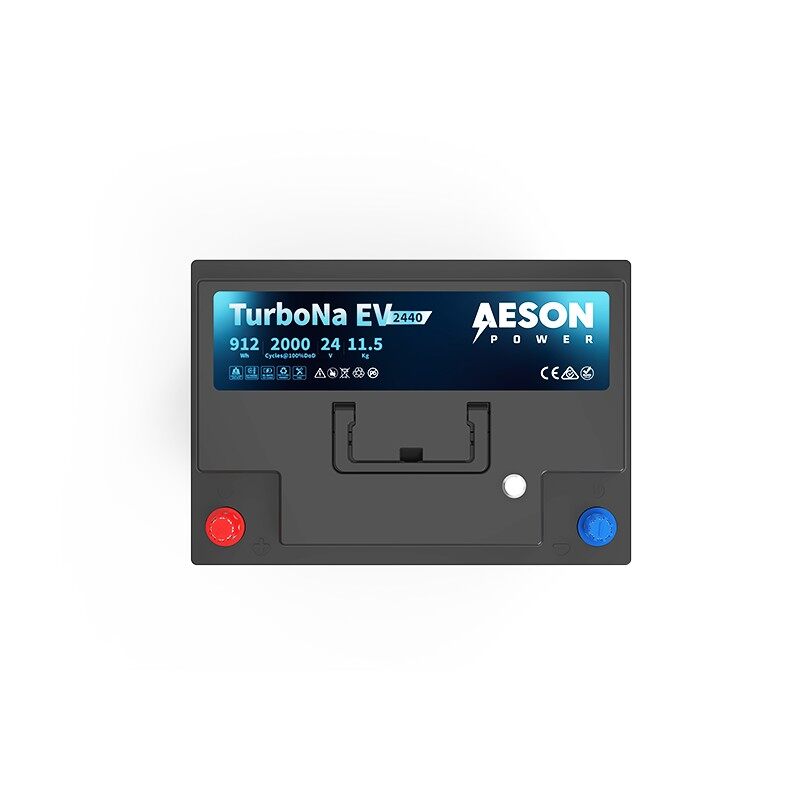
Before the High Voltage Pack Joins the Circuit
When an EV is parked, the high-voltage traction battery is not simply left connected to every vehicle circuit. High-voltage contactors control when the pack is connected to the propulsion system. Low-voltage power is used by control electronics and can operate those contactors during vehicle start-up.
This creates a separation of roles. The traction battery stores propulsion energy, while the low-voltage system supports accessories, controllers, communication and the process that brings the high-voltage system online. Aeson Power's NaForce EV information likewise states that its auxiliary battery powers low-voltage electronics and control units and helps power the contactors that connect the traction battery.
Why the EV Auxiliary Battery Still Matters at 12V
Twelve volts remains useful because many automotive control systems and accessories are designed around established low-voltage architectures. The U.S. Department of Energy describes the auxiliary battery as the source for vehicle accessories, while a DC/DC converter steps high voltage down to the lower voltage required by those systems and recharges the auxiliary battery.
This arrangement keeps low-voltage electronics on a separate supply before the high-voltage circuit is enabled. Most electric passenger cars still use a 12V auxiliary system, while some commercial EVs use 24V low-voltage architectures. Aeson Power likewise lists 12V auxiliary products for passenger cars and 12V and 24V options for commercial EVs.
What Happens Between Unlock and Ready
A useful way to picture the sequence is as a chain. The vehicle is unlocked or awakened. Low-voltage controllers come online. Networks begin communicating. Safety checks run. The contactors can then connect the traction battery when the vehicle determines that conditions are correct.
If the auxiliary battery is too weak to support that chain, a charged traction pack does not automatically solve the problem. The vehicle may have propulsion energy available but still be unable to complete the low-voltage start-up process. Aeson Power's EV auxiliary guidance specifically notes that a vehicle may fail to start properly when the auxiliary battery is dead even if the high-voltage battery remains charged.
The 12V Battery Also Works After Start-Up
Once the high-voltage system is active, the auxiliary battery does not become irrelevant. The DC/DC converter supplies the low-voltage network and can recharge the battery from the traction pack. The low-voltage architecture continues to serve controllers, lighting, locks, displays, communication systems and other electronics.
It is important not to overstate this role. Not every electrical function in an EV is powered directly from the 12V battery. High-power systems may use high-voltage energy, while their controllers still belong to the low-voltage network. The distinction prevents a simple explanation from turning into an inaccurate claim about the entire vehicle.
Where Sodium-Ion Fits Into the Low Voltage Role
For companies making sodium-ion batteries, the auxiliary application is different from building a high-voltage traction pack. Energy density is not the only design priority. Low-voltage compatibility, wake-up reliability, communication, temperature behaviour, protection and packaging all influence whether the battery can integrate with the vehicle.
Our NaForce EV Series is designed as a customizable auxiliary-battery platform for electric passenger cars. The 1215 model uses a 12V architecture, provides 180Wh of nominal energy, weighs 3.2kg, measures 265 × 180 × 75mm, and supports CAN and CAN FD communication. We present it as an auxiliary product rather than a traction-battery replacement.
Communication Makes the Battery Part of the Vehicle Network
A modern auxiliary battery can do more than supply voltage. Vehicle integration may require battery data to be exchanged with other controllers so that status, protection and power-management decisions can be coordinated.
Our NaForce EV platform incorporates a BMS with ASIL-B functional-safety capability and supports CAN and CAN FD communication. Those published characteristics apply to the NaForce EV system. They should not be assumed for every 12V battery or every product offered by other companies making sodium-ion batteries.
For OEM and replacement projects, dimensions and nominal voltage are only part of compatibility. Communication, charging, protection logic and the original low-voltage architecture also need to match. Our EV auxiliary solutions are developed around vehicle-specific requirements rather than treated as universal replacements.
Why a Bigger Traction Battery Does Not Remove the Need
The continued use of a separate low-voltage battery can look redundant until the power-up sequence is considered. A high-voltage pack is optimized for propulsion and controlled through safety switching. The 12V system provides the independent low-voltage layer needed to control the vehicle before and during high-voltage operation.
That architecture explains why simply increasing traction-battery capacity would not eliminate the low-voltage function. The issue is not a shortage of stored energy. It is how that energy is safely connected, converted and controlled inside the vehicle.
Matching the Auxiliary System to the Car
An EV auxiliary battery should therefore be evaluated as part of the vehicle architecture. System voltage, installation space, connectors, communication, charging behaviour, standby loads and environmental conditions all influence the final choice.
We are Aeson Power, an Australian battery technology company working in strategic partnership with Xupai Group. Among companies making sodium-ion batteries, our work includes automotive starting, start-stop, commercial starting, EV auxiliary, racing, UPS, energy-storage and customized sodium-ion applications. For EV auxiliary projects, we focus on low-voltage integration rather than treating the product as a smaller traction battery.
Contact our team with the vehicle platform, original auxiliary-battery specification, available space, communication requirements and charging architecture to discuss a compatible low-voltage solution.


