






A parked electric vehicle may look inactive, but its low-voltage systems still need dependable power. Locks, lighting, control units, displays, safety equipment, and communication electronics rely on that network. For drivers asking what is the auxiliary battery, the useful answer is not simply "a small 12 V battery." It is the power source behind many everyday functions before and while the high-voltage system is available.
What Is the Auxiliary Battery Supplying Before the Car Moves
The traction battery stores the energy used for propulsion. The auxiliary battery has a different role. The U.S. Department of Energy states that an electric vehicle's auxiliary battery powers vehicle accessories, while the DC/DC converter steps high voltage down to the level required by low-voltage equipment and recharges the auxiliary battery.
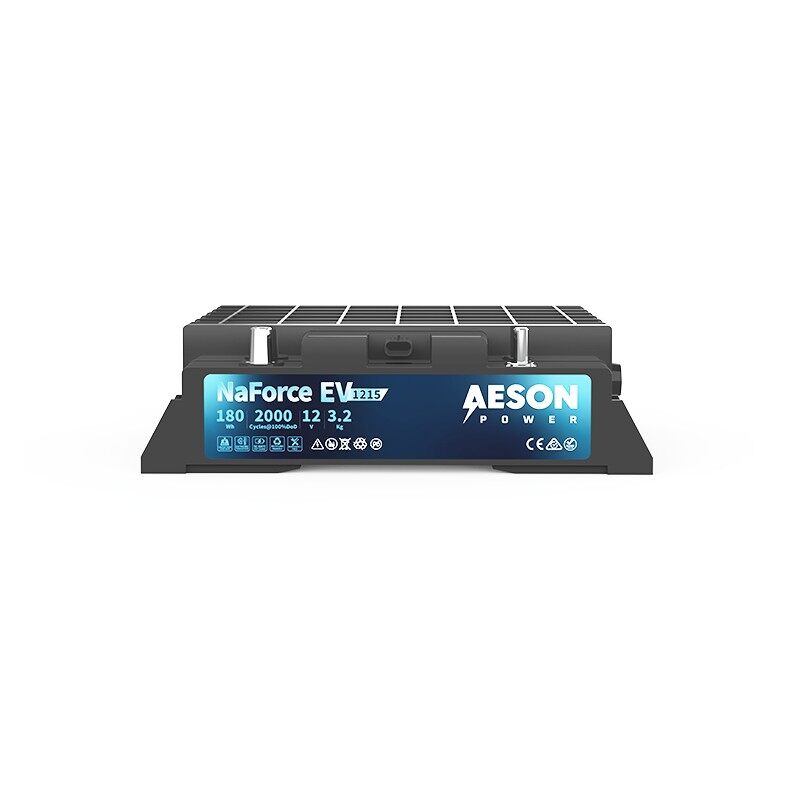
Our NaForce EV series serves this low-voltage role. We describe it as supporting vehicle wake-up and supplying power to control units, locks, lights, safety equipment, communication systems, and other essential electronics. These are systems a driver interacts with before thinking about propulsion.
That is why a discharged auxiliary battery can create a problem that feels larger than the battery itself. Low-voltage functions may become unavailable, and the vehicle may be unable to enter its normal ready state even when the traction battery still contains energy.
Comfort Features Depend on More Than the Traction Battery
Many comfort functions begin with low-voltage electronics. A display has to wake up. Door modules have to respond. Interior and exterior lighting need a stable supply. Communication modules may remain active while the vehicle is parked.
This does not mean every comfort load is powered directly by the auxiliary battery. Some high-power functions may draw energy from the high-voltage system, while their controls and supporting electronics still depend on the low-voltage architecture. We therefore avoid describing the auxiliary battery as the source of every electrical load.
For a sodium-ion design, this distinction also shapes how the auxiliary battery is specified and integrated into the vehicle. A low-voltage automotive battery is not judged only by stored energy. It has to support stable delivery, integration with the vehicle's control architecture, and the conditions under which those electronics wake, communicate, and remain protected.
Safety Functions Make Low Voltage More Important
The low-voltage system also participates in the vehicle's safety chain. NHTSA technical information for electric vehicles shows that the 12 V system can control the high-voltage contactors that connect the traction battery to the high-voltage circuit. If low-voltage power is unavailable, the vehicle may be unable to enable high-voltage flow.
This provides another way to understand the role of the auxiliary battery. It is not only a convenience battery. It can supply the control power that allows safety-related switching and vehicle initialization to occur in the correct sequence.
Our NaForce EV series incorporates a BMS with ASIL-B functional safety capability for real-time monitoring, protection, and power management. It also supports CAN and CAN FD communication, allowing battery information to be exchanged with the vehicle. These are published characteristics of NaForce EV, not features we assume for every auxiliary battery on the market.
A Battery Can Matter Most When the Vehicle Is Parked
Low-voltage demand does not disappear when the driver leaves. Some electronic systems remain available for security, locking, communication, and vehicle monitoring. Manufacturer service bulletins also show that prolonged accessory use, repeated door operation, lighting, or extended accessory mode can contribute to 12 V auxiliary-battery discharge.
That makes standby behavior relevant to comfort and reliability. The low-voltage battery has to remain ready for the next wake-up event.
For our NaForce EV 1215, the published product configuration is a 12 V sodium-ion auxiliary solution for electric passenger cars. We keep model-level information separate from broad chemistry claims because the correct battery still depends on the vehicle's voltage architecture, packaging, communication requirements, and charging strategy.
Why Sodium-Ion Battery Manufacturing Matters to Low Voltage Reliability
Sodium-ion battery manufacturing matters to low-voltage reliability because consistent production helps ensure that each battery meets the electrical and control requirements of the vehicle. Low-voltage functions operate repeatedly throughout daily use: locks may activate thousands of times, control units wake whenever the vehicle is accessed, and communication systems handle numerous short events. Reliable performance therefore depends not only on battery chemistry but also on manufacturing consistency across these repeated demands.
Our broader sodium-ion battery manufacturing work connects battery development with system integration. For customized sodium-ion projects, we support structural and electrical integration, BMS co-customization, and end-to-end control from R&D through mass production.
For EV auxiliary applications, that means the finished battery cannot be viewed only as a collection of cells. BMS behavior, communication interfaces, enclosure design, electrical integration, and the vehicle-specific requirements defined for the project all contribute to the finished low-voltage system.
Manufacturing scale alone does not prove that a battery will suit a vehicle. The more relevant question is whether the supplied product matches the approved specification and continues to communicate and operate within its intended electrical architecture.
The Auxiliary Battery Is Part of the User Experience
Drivers rarely notice a healthy auxiliary battery because the functions it supports feel automatic. The car unlocks, the displays wake, the control units communicate, and the vehicle becomes ready. When low-voltage power is weak, those ordinary interactions can become the first visible sign that something in the supporting electrical system needs attention.
That is why understanding the auxiliary battery ultimately requires looking at its role in vehicle behavior, not only its chemistry. Its role sits behind both convenience and the low-voltage control functions that help the EV transition safely from parked to active.
We are Aeson Power, an Australian battery technology company working in strategic partnership with Xupai Group. Through our sodium-ion battery manufacturing work, we develop NaForce EV auxiliary solutions alongside sodium-ion products for automotive, commercial, UPS, energy-storage, and customized applications, combining application matching with system-level development.
Contact our team with your vehicle platform, low-voltage architecture, packaging limits, communication requirements, and operating conditions to discuss an auxiliary battery solution matched to the system.


