










Battery durability depends on more than its initial capacity or power output. The materials inside a cell must withstand repeated electrochemical reactions without losing their structural integrity, particularly in applications that demand frequent charging and discharging. Sodium-ion technology has attracted growing attention in this area, with polyanion cathodes offering an interesting approach to material stability.
An NFPP battery uses a distinctive phosphate-based chemical structure that helps limit electrode volume changes during cycling. Understanding this material design reveals why polyanion chemistry is being investigated for long-life energy storage and other demanding battery applications. At Aeson Power, we focus on developing sodium-ion solutions built around this promising material technology.
The Structural Advantages of Polyanion Cathode Materials
Cathode materials play a central role in rechargeable battery performance because they provide the sites through which ions are stored and released. Their crystal structures must accommodate repeated ion movement while maintaining chemical and mechanical stability. Excessive structural distortion can increase internal resistance, weaken electrode integrity, and contribute to capacity degradation over time.
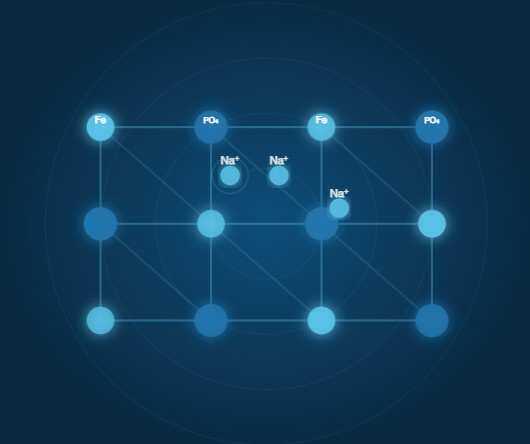
Polyanion chemistry addresses this challenge through strongly bonded anionic groups. Phosphate and related oxygen-containing groups form rigid structural units within the cathode framework. Their strong covalent bonding helps resist structural disruption during electrochemical reactions, creating a material architecture with favorable stability characteristics.
Another important consideration is the interaction between the cathode structure and mobile sodium ions. Ion transport depends on available migration pathways, lattice characteristics, and the energy required for diffusion. A carefully designed polyanionic framework can facilitate sodium-ion movement while limiting unwanted structural expansion, balancing transport properties with mechanical durability.
How NFPP Chemistry Influences Cycling Durability
The chemical formula Na₄Fe₃(PO₄)₂(P₂O₇) represents a compound containing phosphate and pyrophosphate groups within a hybrid polyanionic framework. This arrangement distinguishes NFPP from cathode materials based on different structural chemistries. Strongly bonded anionic groups contribute to framework rigidity, helping the electrode accommodate repeated sodium insertion and extraction.
Volume variation during cycling deserves particular attention because repeated expansion and contraction can gradually affect electrode particles. Significant mechanical stress may cause particle cracking, disrupt electrical contact, and expose additional surfaces to electrolyte reactions. By suppressing volume expansion, the NFPP structure offers a material-level approach to reducing these degradation mechanisms.
Ion migration also contributes to the overall electrochemical behavior. Sodium ions need to move through the cathode during charging and discharging, while the host structure remains sufficiently stable to support repeated reactions. This balance between ion mobility and structural retention makes NFPP battery chemistry relevant to research into long-cycle energy storage systems.
Cycling durability, however, is not determined by cathode composition alone. Electrolyte compatibility, electrode porosity, particle size, conductive additives, and manufacturing consistency all influence full-cell performance. Testing under different current rates and temperature conditions provides a more realistic picture of how these factors interact throughout the battery's service life.
Applications That Benefit From Structural Stability
Long-term cycling capability matters particularly in energy storage installations where batteries undergo regular charge-discharge cycles. Commercial and industrial systems may operate according to daily electricity consumption patterns, renewable energy generation, or peak-demand management requirements. Material degradation can gradually reduce usable capacity, affecting the amount of energy available to the system.
Telecommunications infrastructure and backup power installations present another set of requirements. Batteries in these environments may remain on standby for extended periods before supplying power during an outage. Their performance depends on storage stability, discharge characteristics, environmental conditions, and the reliability of supporting electronic systems. Routine testing and monitoring help confirm that standby batteries remain ready to deliver the required power when an outage occurs.
Industrial equipment introduces additional operating demands, including variable loads and frequent power fluctuations. Battery chemistry must accommodate the intended discharge profile without experiencing excessive degradation. A stable cathode framework can contribute to durability, although system sizing, thermal management, and battery management strategies remain equally important.
For manufacturers and energy storage integrators, the appeal of an NFPP battery lies in its potential combination of structural stability and sodium-ion transport characteristics. Application suitability still needs to be assessed through measurable parameters such as cycle retention, energy density, discharge rate, temperature response, and calendar aging rather than cathode chemistry alone.
Conclusion
Long-life battery development requires careful attention to the relationship between material structure and electrochemical behavior. NFPP polyanion chemistry offers a distinctive solution through its strongly bonded phosphate and pyrophosphate framework, which supports structural integrity and limits volume changes during repeated cycling. These characteristics provide a valuable foundation for investigating durable sodium-ion energy storage technologies.
At Aeson Power, we incorporate NFPP technology into our sodium-ion battery development, drawing on the properties of Na₄Fe₃(PO₄)₂(P₂O₇) cathode chemistry. Our focus is on structural stability, efficient sodium-ion migration, and long-cycle application potential. With our experience in battery technology and manufacturing, we welcome distributors, industrial customers, and energy storage partners to explore our solutions and discuss opportunities for collaboration. Contact Aeson Power to learn more about our sodium-ion battery technologies and their potential applications.