










Battery technology becomes easier to understand once its internal chemical processes are connected to the electricity we use every day. From vehicle starting systems to industrial backup power, rechargeable batteries rely on controlled interactions between materials, ions, and electrons. Sodium ion technology follows an electrochemical principle similar to lithium-ion systems, but uses sodium ions as the charge carriers.
Its growing commercial relevance comes from a combination of accessible raw materials, distinctive cathode chemistry, and potential advantages in temperature adaptability and charging performance. At Aeson Power, we develop sodium-ion battery solutions and believe that understanding how these systems operate is essential for evaluating their practical applications.
The Internal Components That Make a Battery Work
A rechargeable sodium-ion cell contains four essential components: a positive electrode (cathode), a negative electrode (anode), an electrolyte, and a separator. Each performs a different function, but their interaction determines how electrical energy is stored and released. The electrodes host the electrochemical reactions, while the electrolyte provides a medium for ion movement between them.
The separator sits between the positive and negative electrodes. Its porous structure allows sodium ions to pass through while preventing direct physical contact between the electrodes. Without this insulating barrier, an internal short circuit could occur, potentially causing excessive heat and cell damage. Current collectors also play an important role by carrying electrons between the electrodes and the external electrical circuit.
Material selection has a considerable influence on battery characteristics. Cathode composition affects operating voltage, structural stability, and sodium storage capacity. Anode materials determine how effectively sodium can be accommodated during charging. Electrolyte composition, meanwhile, influences ionic conductivity and interfacial compatibility. These factors explain why two batteries based on the same general chemistry can deliver different performance in practical applications.
Following Sodium Ions Through Charge and Discharge
The operating principle becomes clearer by examining what happens during a charging cycle. An external charger applies an electrical potential that drives sodium ions out of the positive electrode. These ions travel through the electrolyte and cross the separator before entering the negative electrode, where they are stored within its structure. Electrons move through the external charging circuit to maintain electrical balance.
Discharging reverses this process. Sodium ions leave the negative electrode and migrate through the electrolyte toward the positive electrode. Meanwhile, electrons travel through the external circuit, supplying electrical energy to connected equipment. The simultaneous movement of ions inside the cell and electrons outside it creates the current that powers electrical devices.
This reversible movement is fundamental to sodium ion technology. Unlike a conventional primary battery that undergoes largely irreversible chemical reactions, rechargeable cells are designed to support repeated ion transfer between their electrodes. Actual performance depends on reaction kinetics, internal resistance, electrode architecture, and operating conditions. Voltage also changes throughout the process as the chemical states of the electrodes evolve.
How NFPP Chemistry Shapes Practical Battery Performance
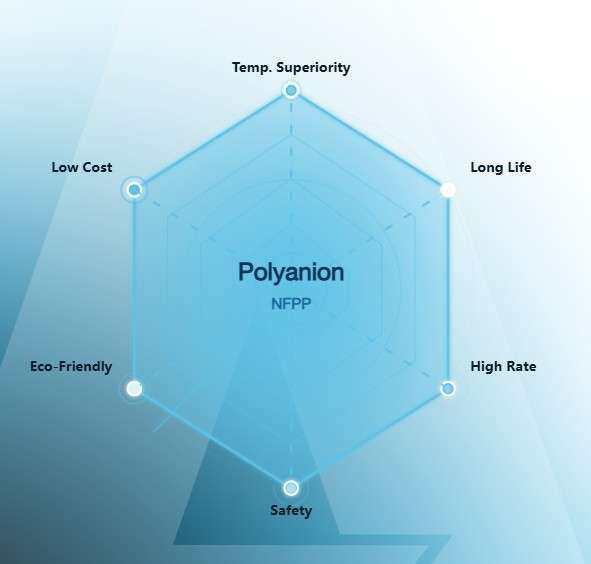
Cathode chemistry is one of the most important factors influencing the behavior of sodium-ion cells. Different cathode materials offer different combinations of energy density, power capability, thermal stability, and cycle durability. Polyanion compounds attract attention because their strongly bonded anionic groups can create a relatively rigid structural framework.
NFPP, with the chemical formula Na₄Fe₃(PO₄)₂(P₂O₇), combines phosphate and pyrophosphate groups within a hybrid polyanionic structure. This arrangement supports structural integrity during repeated sodium insertion and extraction while facilitating ion migration. Suppressed volume expansion can help reduce mechanical stress within the electrode, an important consideration for batteries expected to undergo frequent cycling.
A practical cell developed around this chemistry combines an NFPP positive electrode with a hard-carbon negative electrode, NaPF₆ electrolyte, and a PP/PE separator. These components work together to support sodium-ion transport, charge storage, and electrical isolation. At Aeson Power, our sodium-ion battery portfolio incorporates this material approach, with applications covering automotive starting, start-stop systems, UPS backup, and energy storage. Our product development also emphasizes high-rate discharge, temperature adaptability, structural stability, and safety-oriented material design.
The benefits of this chemistry extend beyond its electrode structure. Sodium is widely available in nature, which offers an alternative raw-material supply pathway compared with battery systems that depend on scarcer resources. However, overall manufacturing costs also depend on processing methods, production scale, material purity, and quality control. The availability of sodium alone does not automatically make every finished battery less expensive.
Conclusion
Understanding a battery requires looking beyond its external terminals. Ion migration, electron flow, electrode composition, and internal material interactions collectively determine how a rechargeable cell performs. The relationship between these processes explains why cathode innovation and cell engineering remain important areas of development across the energy storage industry.
A capable sodium ion battery factory must translate material research into consistent cell production through controlled electrode preparation, assembly, formation, and quality inspection. Manufacturing scale matters, but process consistency and application-specific testing are equally significant when assessing a supplier.
At Aeson Power, we combine sodium-ion technology development with substantial manufacturing resources, including seven manufacturing centers, 90 production lines, and an annual production capacity of 30 GWh. Our focus extends from automotive batteries to industrial backup and energy storage applications. We welcome distributors, OEM partners, and energy storage businesses to explore our manufacturing capabilities and discuss suitable battery solutions. Contact our team to discover how we can support your next sodium-ion battery project.