






A truck battery can start an engine perfectly in the workshop and still fail to meet a fleet’s expectations months later. Reliability testing exists to close that gap. At Aeson Power, testing a commercial battery means checking more than whether it delivers voltage once. We need evidence that electrical output, safety, mechanical integrity, and repeatability remain acceptable when the battery faces conditions that resemble real service and defined abuse cases.
Reliability Starts With a Failure Definition
A test only becomes useful when the failure criterion is clear. For a starter battery, that may involve cranking ability, voltage retention, charge acceptance, internal resistance, physical damage, or abnormal heating. Different applications need different thresholds.
International starter-battery standards illustrate this principle. IEC 60095-1, which applies to lead-acid starter batteries, separates functions such as cranking performance, charge acceptance, charge retention, and endurance into defined tests. We do not treat that lead-acid standard as proof of sodium-ion compliance; it shows why reliability has to be broken into measurable functions rather than described by one broad claim.
The Commercial Battery Duty Cycle Shapes the Test Plan
Commercial vehicles place unusual demands on a battery. Delivery trucks may restart frequently. Construction equipment may encounter vibration, dust, heat, and long idle periods. Generator sets can remain inactive before being asked to start immediately. A test plan should reflect the actual duty rather than copy a passenger-car profile.
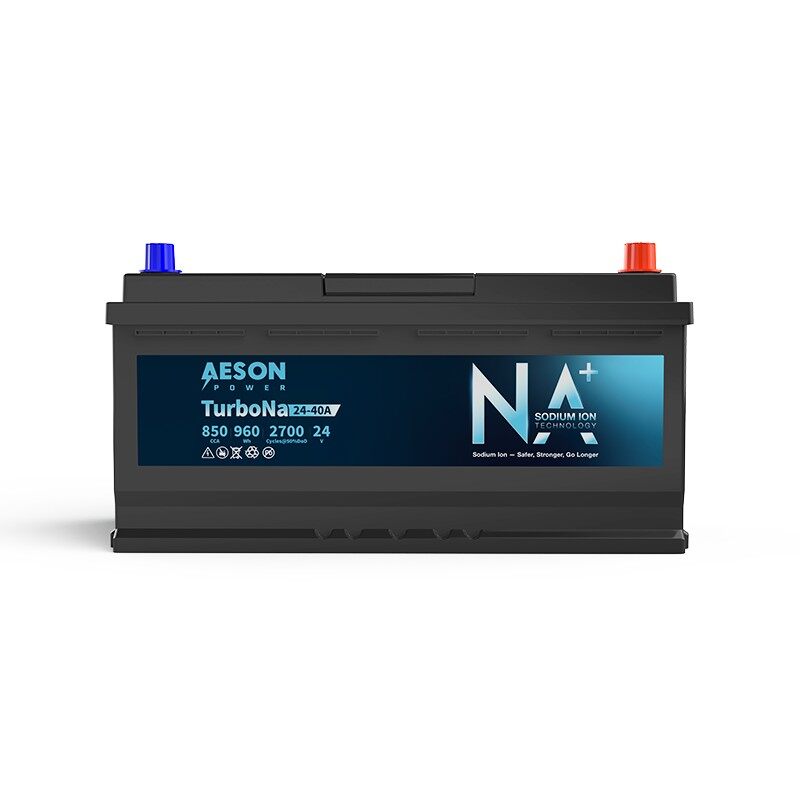
Our TurboNa sodium-ion starting battery range is developed for commercial vehicles and diesel-powered equipment. Its applications include vehicles and machinery exposed to frequent starting, extended idle periods, and demanding operating environments. These conditions make it important to evaluate starting performance, electrical compatibility, and durability against the actual duty cycle rather than relying on specifications alone.
Electrical Stress Shows More Than Normal Operation
Routine performance testing asks whether a battery works inside its intended range. Abuse testing asks what happens when something goes wrong. Both matter, but they answer different questions.
At Aeson Power, we have publicly documented an overcharge test on NaForce NS40L, NaForce SS H7/LN4, and S95L sodium-ion starting batteries. The batteries were held in a 60°C chamber, continuously charged to 16 V and 17 V for more than six hours, and monitored for voltage, temperature, internal resistance, appearance, and safety condition.
During that reported test, none of the three batteries showed thermal runaway, fire, smoke, case melting, or deformation. Those results apply to the stated samples and conditions. We do not present one laboratory event as proof that every battery will behave identically under every possible fault.
Measurements Before and After Tell the Story
Visual inspection alone is not enough. Reliability testing is stronger when it records measurable changes before, during, and after stress. Voltage can show electrical behavior, internal resistance can reveal changes in current path or cell condition, and temperature can identify unusual heat generation.
For a commercial battery, the useful question is often not simply “Did it survive?” but “What changed because of the test?” A battery that remains intact yet shows a large electrical shift may require further investigation. This is why monitored parameters and acceptance limits matter as much as the stress itself.
Validation and Production Control Have Different Jobs
Engineering validation explores whether a design can tolerate intended use and selected abnormal conditions. Production quality control checks whether manufactured units continue to meet the approved specification. Confusing the two can create misleading claims.
An extreme-temperature overcharge test, for example, is a design-validation exercise. It should not be described as a procedure performed on every finished battery unless the production process actually requires that test. Routine manufacturing may instead use inspections and electrical checks appropriate to the product and process.
We publish model-specific data for our automotive and commercial starting ranges, which helps keep evaluation tied to the product being supplied rather than to a family-wide average. For buyers, that distinction is important when comparing samples, batches, or revisions.
Mechanical Reliability Cannot Be Assumed From Chemistry
A starter battery lives in a mechanical environment as well as an electrical one. Terminal connections, cell restraints, enclosure integrity, internal conductors, and mounting all matter when the vehicle vibrates or experiences repeated shocks.
Mechanical testing should reflect the conditions a battery encounters in service. Vibration and mechanical shock requirements vary depending on the vehicle, equipment, mounting position, and operating environment. A battery installed in an air compressor or construction machine may experience different mechanical stresses from one used in an urban delivery vehicle. Testing should therefore account for the intended application, mounting arrangement, and expected operating conditions.
What Buyers Should Ask About the Test Evidence
A useful reliability discussion should identify the exact model, sample configuration, test temperature, voltage or current, duration, monitored parameters, and pass criteria. It should also separate internal validation from certification or standardized testing.
We prefer that level of specificity because it prevents a test result from becoming a vague marketing statement. A buyer can then decide whether the evidence resembles the intended fleet environment and whether additional application-specific validation is needed.
Matching Commercial Batteries to Fleet and Equipment Requirements
At Aeson Power, we develop sodium-ion solutions for automotive starting, start-stop, commercial starting, racing, EV auxiliary, UPS, energy storage, and customized applications. Our commercial range includes 24 V TurboNa products designed for vehicle and diesel-equipment starting, supported by model-specific technical data and application matching.
When evaluating a commercial battery for a fleet or equipment program, contact our team with the engine type, electrical system, cranking requirement, operating environment, and expected duty cycle so the relevant test evidence can be reviewed in context.


