






Industrial storage is moving closer to production equipment, substations, warehouses, data centers, and site-level power systems. That puts the battery beside real operating constraints: heat, dust, limited floor space, maintenance windows, communication networks, and costly downtime. Industrial energy storage solutions built around sodium-ion technology could change how those constraints are balanced, especially where compactness is not the only design priority.
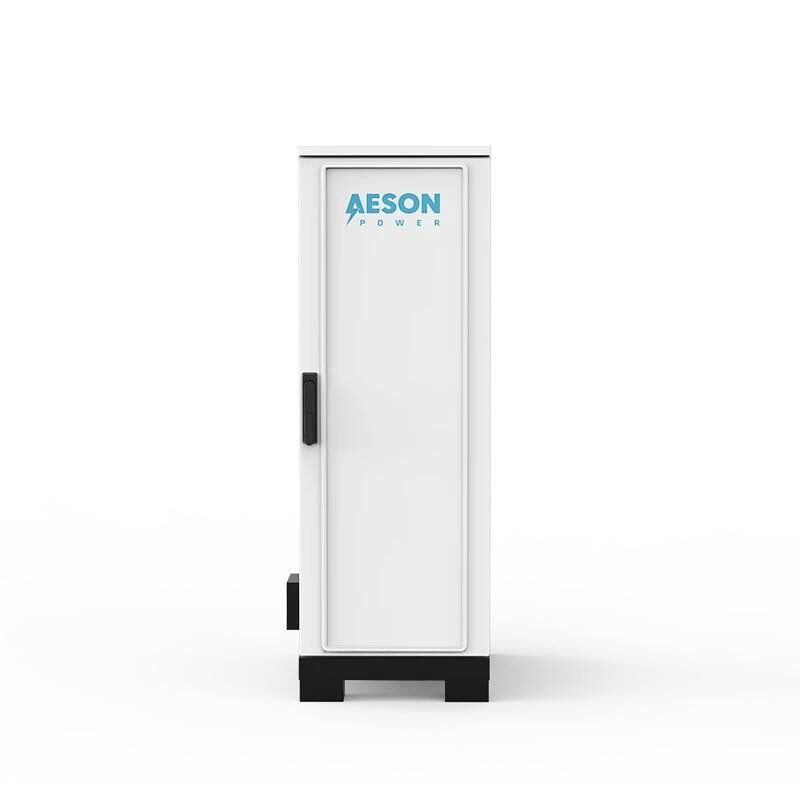
Industrial Energy Storage Solutions at Facility Scale
An industrial battery is part of a larger electrical system. Power rating determines how quickly it can respond, energy capacity sets how long it can support a load, and the enclosure, cooling, fire protection, controls, and communications decide how easily it fits into a site.
Our SIBPOM 75/150 and 125/150 cabinets use sodium-ion cells and have a rated AC voltage of 400 V. Published specifications list 75 kW and 125 kW rated-power versions, air-conditioning cooling, aerosol fire protection, Modbus TCP communication, protection of at least IP54, and C4H corrosion resistance.
Factories and industrial parks rarely resemble clean laboratories. Equipment may sit near process heat, airborne contaminants, outdoor service areas, or existing switchgear. Cabinet design and interfaces can influence engineering work as much as the cell chemistry inside.
Beyond Watt Hours per Kilogram
Sodium-ion currently carries an energy-density disadvantage compared with leading lithium-ion chemistries. The International Energy Agency reports recent sodium-ion cells reaching about 175 Wh/kg, versus up to 205 Wh/kg for newer LFP cells. In vehicles, that gap can affect range directly.
Industrial sites frame the problem differently. A stationary cabinet does not move with the stored energy, so footprint, structural loading, access, and installation cost can be weighed against safety, temperature capability, serviceability, and supply considerations. Space still matters, but it is one engineering constraint among several.
The IEA identifies battery stationary storage as one application where sodium-ion is expected to be particularly relevant. Its manufacturing base remains much smaller than lithium-ion, making gradual, application-specific adoption more realistic than an immediate market-wide replacement.
Heat Dust and the Cabinet Boundary
Factories can expose storage equipment to wide temperature swings, especially in semi-outdoor electrical areas, mines, logistics facilities, and sites where HVAC is limited. Sodium-ion research reports promising thermal characteristics, although cell chemistry, state of charge, current, and system design still influence performance.
Our NFPP pathway uses a polyanion cathode chemistry selected for structural stability. In the C&I cabinet, the battery is paired with air-conditioning cooling. The published system design also includes aerosol fire protection and environmental protection at IP54 or higher.
A sodium battery manufacturer serving industrial projects has to engineer beyond the cell. Thermal control, cabinet construction, protection, power conversion, and site integration determine how chemistry becomes an operating asset.
The Control Layer Coordinates Industrial Energy Storage Operations
Industrial storage gains value through timing and coordination. A plant may need the battery to charge, discharge, hold reserve, respond to a site controller, or coordinate with onsite generation and production loads.
The SIBPOM C&I platform supports Modbus TCP communication, providing a route for exchanging operating data with higher-level controls. Its published maximum system efficiency is 90%. Those specifications give project engineers concrete modelling inputs for this cabinet family.
A manufacturing plant may prioritize production continuity, a warehouse may coordinate storage with rooftop solar, and a data center may reserve energy for critical loads. Different facilities can therefore use similar battery hardware under very different dispatch logic.
The U.S. Department of Energy's Onsite Energy Program treats storage as part of a wider industrial energy strategy, alongside onsite generation and flexible loads. Its guidance emphasizes reliability and operational flexibility for manufacturers and other large energy users, which is closer to the way industrial storage is actually planned than a battery-only procurement exercise.
Procurement Beyond the First Delivery
Industrial battery projects are purchased for years of service, so sourcing extends beyond the initial shipment. Cell availability, replacement parts, technical support, documentation, and manufacturing continuity all enter the procurement discussion.
Sodium-ion can diversify battery chemistries and reduce exclusive dependence on lithium-based supply chains. The IEA notes that sodium resources are widely available, but global sodium-ion production in 2025 was still below 1% of lithium-ion output. Resource diversity and present manufacturing maturity both belong in procurement decisions.
Our work as a sodium battery manufacturer includes energy-storage products alongside automotive, UPS, and custom sodium-ion systems. A broader manufacturing network supports delivery, while project specifications and quality control still have to remain aligned with the industrial application.
A Gradual Industrial Shift
Sodium-ion adoption in industrial storage is likely to develop around applications where its characteristics address specific engineering needs, such as stationary deployment, operating conditions, safety-focused design, or supply diversification. Aeson Power develops sodium-ion energy storage solutions for commercial and industrial applications, combining battery technology with system integration and project support.
As a sodium battery manufacturer, we assess solutions against actual plant and project requirements. Share your site load profile, installation environment, power and energy requirements, control architecture, and operational priorities with our ESS team to discuss a suitable storage solution.


