










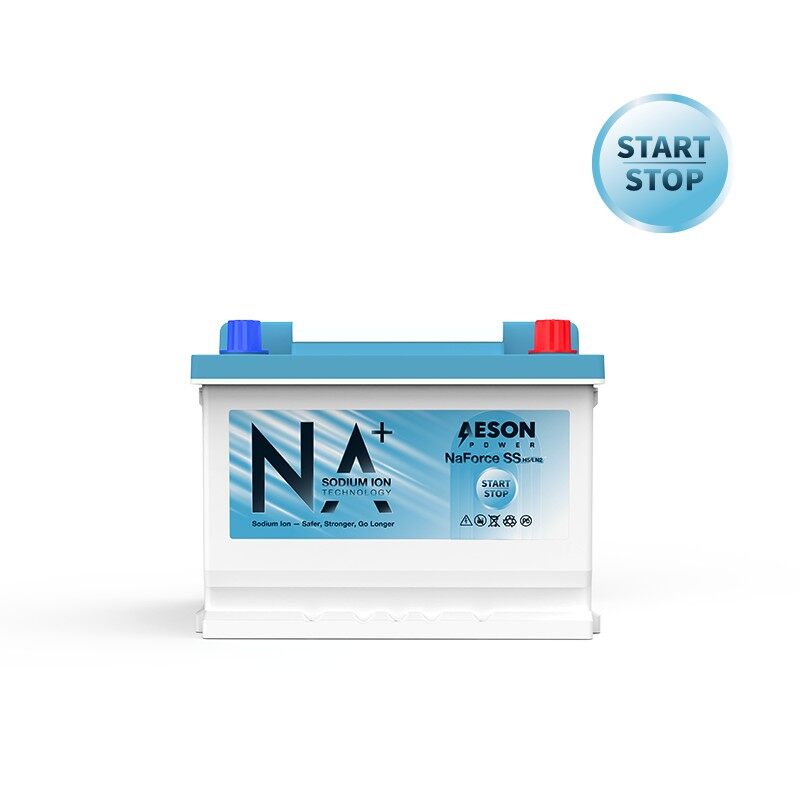
A vehicle starter motor draws a substantial amount of current within a short period, making battery discharge capability a critical factor in automotive applications. Beyond nominal voltage and stored energy, the ability to deliver power quickly influences engine starting, electrical responsiveness, and overall operating reliability.
A sodium ion 12V car battery brings a different electrochemical approach to these requirements, combining sodium-based electrode materials with cell designs intended for practical automotive use. Understanding high-rate performance involves examining current delivery, internal resistance, ion transport, and thermal behavior rather than relying on a single specification. At Aeson Power, we develop sodium-ion battery solutions with particular attention to these performance requirements.
What Determines High-Rate Battery Performance?
High-rate discharge describes a battery's ability to release stored energy at a relatively high current over a short period. In automotive starting applications, the starter motor requires considerable electrical power to overcome engine resistance and initiate combustion. The battery must respond quickly while maintaining sufficient terminal voltage throughout the starting process.
Internal resistance has a direct influence on this behavior. As current passes through a battery, resistance produces a voltage drop and generates heat. A simplified relationship can be expressed as ΔV = I × R, where voltage drop increases with current and internal resistance. Lower resistance can help maintain terminal voltage during demanding discharge events, although electrode design, temperature, and battery condition also affect the result.
Electrochemical reaction rates are equally important. During discharge, sodium ions move through the electrolyte and participate in reactions at the electrodes, while electrons travel through the external circuit to power the starter motor. If ion transport or interfacial reactions become too slow, polarization increases and the battery may struggle to deliver its rated power.
How Sodium-Ion Chemistry Supports Rapid Power Delivery
The ability to deliver high current depends partly on the structure and composition of electrode materials. Cathodes must accommodate sodium-ion movement without experiencing excessive structural disruption, while anodes need to support reversible sodium storage. The electrolyte must also provide sufficient ionic conductivity to facilitate transport throughout the cell.
NFPP polyanion chemistry is particularly relevant to this discussion. Its Na₄Fe₃(PO₄)₂(P₂O₇) composition contains strongly bonded phosphate and pyrophosphate groups that contribute to a stable cathode framework. This hybrid structure facilitates sodium-ion migration while limiting volume expansion during repeated electrochemical cycling. Such characteristics provide a useful material foundation for balancing power capability and structural durability.
Temperature introduces another variable. Cold environments generally slow electrochemical reactions and increase internal resistance, potentially reducing available starting current. Elevated temperatures may improve reaction kinetics initially, but prolonged exposure can accelerate electrolyte degradation and unwanted side reactions. High-rate performance must consequently be evaluated across the intended operating temperature range rather than under a single laboratory condition.
Cell engineering translates these material properties into practical electrical output. Electrode thickness, particle size, conductive additives, electrolyte formulation, and current collector design all influence how efficiently a cell handles rapid discharge. A well-balanced design must consider both immediate power delivery and the heat generated during high-current operation.
Key Specifications for Evaluating 12V Starting Batteries
Cold cranking amps (CCA) provide an important reference when comparing automotive starting batteries. This rating measures the current a battery can deliver under specified low-temperature testing conditions while maintaining a defined minimum voltage. Higher CCA values generally indicate greater cold-starting current capability, although the actual starting result also depends on engine size, vehicle condition, and environmental factors.
Energy capacity describes a different performance characteristic. Expressed in watt-hours, it represents the electrical energy stored under specified conditions. A battery can have substantial energy capacity without necessarily delivering the highest starting current. For this reason, automotive buyers should assess CCA and energy ratings together rather than treating them as interchangeable measurements.
Voltage compatibility, charging requirements, and physical dimensions also deserve attention. Most conventional passenger vehicles use 12V electrical systems, but battery chemistry can influence charging behavior and voltage characteristics. The vehicle's charging system must be compatible with the replacement battery, and installation dimensions, terminal positions, and mounting arrangements must match the available space.
For a practical reference, our Aeson Power S95L start-stop battery has a nominal voltage of 12V, a CCA rating of 720A, and an energy capacity of 480Wh. These specifications illustrate how starting-current capability and stored energy can be evaluated together when assessing an automotive battery. Its ratings should still be considered alongside vehicle compatibility and the manufacturer's operating instructions.
Conclusion
High-rate discharge is the result of several interconnected factors rather than one impressive specification. Electrode chemistry influences sodium-ion movement, internal resistance affects voltage stability, and thermal conditions determine how efficiently electrochemical reactions proceed. For automotive applications, these elements must work together to support dependable engine starting and repeated operation.
At Aeson Power, we develop sodium-ion automotive batteries using NFPP polyanion technology, with a focus on structural stability, high-rate discharge, temperature adaptability, and extended cycling performance. Our manufacturing resources include seven manufacturing centers, more than 90 production lines, and an annual production capacity of 30 GWh. We welcome automotive distributors, OEMs, and industry partners to explore our battery technologies and technical capabilities. Explore Aeson Power's 12V sodium-ion solutions and discover new possibilities for automotive starting applications.