










A vehicle that switches its engine off at traffic lights may appear to put less demand on its battery, but the opposite is often true. Each automatic shutdown and restart creates another electrical cycle, while lights, displays, climate control and other systems may continue drawing power.
Understanding what is a start stop battery helps explain why an ordinary starting battery may struggle in this driving environment. At Aeson Power, we believe that understanding the technology behind these systems is just as important as comparing specifications.
How Start-Stop Technology Changes Battery Demands
In conventional vehicles, the engine generally remains running during short stops, so the battery is not repeatedly responsible for restarting it throughout a journey. Start-stop vehicles operate differently: the engine shuts down when the car is stationary under suitable conditions and restarts when the driver is ready to move. This reduces unnecessary idling, but it also increases the frequency of battery-assisted engine starts.
The electrical load does not necessarily disappear when the engine stops. Air conditioning, dashboard displays, audio equipment, control modules and safety-related electronics may continue operating, depending on the vehicle design. The battery must supply these systems while retaining enough energy for the next restart. Frequent short trips can make the task more demanding because the charging system may have limited time to replenish the energy used.
This operating pattern explains why what is a start stop battery is more than a question about battery size or starting power. It refers to a battery designed around repeated engine restarts, changing electrical loads and regular charge-and-discharge activity. Its suitability depends on how well it handles the vehicle's actual operating conditions, rather than on one specification in isolation.
Why Ordinary Starting Batteries May Fall Short
A standard starting battery is generally designed to deliver a strong burst of current to start an engine, followed by relatively limited cycling during normal driving. In a start-stop vehicle, the number of starting events can rise considerably. Repeated cycling places additional demands on the battery's internal materials and can contribute to capacity loss over time if the battery is not designed for this duty.
Another important distinction is charge acceptance. During a journey, the vehicle's charging system may have to restore energy within relatively short periods between stops. A battery that cannot accept charge efficiently under the system's operating conditions may struggle to recover its state of charge. The result can be reduced availability of the start-stop function or additional strain on the battery.
Temperature, driving habits and electrical accessories also influence service life. Heavy traffic, frequent short journeys, extreme heat or cold, and high accessory use can all affect battery performance. This is why a replacement should match the vehicle manufacturer's requirements, including the specified battery technology, dimensions, terminal layout and charging-system compatibility.
What Battery Engineering and Manufacturing Need to Address
A suitable battery for start-stop use must balance several characteristics: starting current, usable energy, cycle durability, charging behaviour, thermal performance and physical dimensions. These factors interact. For example, a high cold-cranking ampere (CCA) rating indicates strong starting-current capability under standardized test conditions, but it does not independently describe how well a battery withstands repeated cycling. Energy capacity, measured in watt-hours, provides a different piece of information.
Material selection and production control also matter. In sodium ion battery manufacturing, engineers must consider electrode composition, electrolyte compatibility, cell design and the consistency of assembly. Cathode structure affects how sodium ions move during charge and discharge, while electrode interfaces and cell construction influence resistance, capacity retention and operating stability. These characteristics need to be evaluated at the cell level and then validated in the finished battery.
Manufacturing quality is not simply a matter of selecting suitable raw materials. Electrode preparation, coating uniformity, moisture control, cell assembly, formation and final testing all contribute to product consistency. For automotive applications, validation should also consider vibration, temperature exposure, charging behaviour and repeated starting cycles. Battery management and vehicle integration add another layer: the charging strategy must be compatible with the battery's chemistry and operating limits.
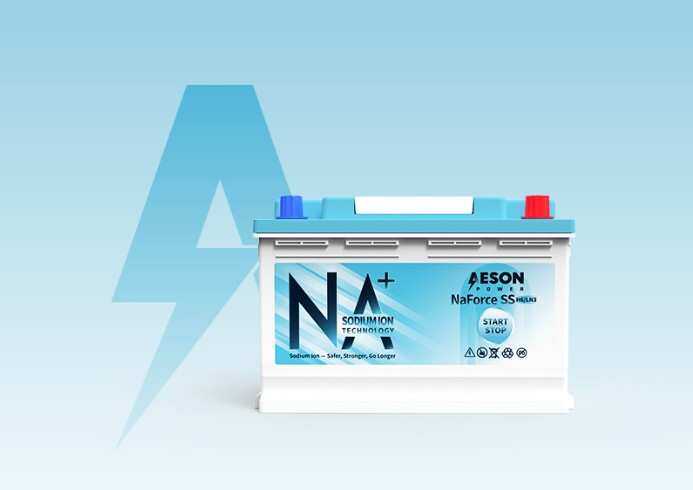
A practical example from our automotive range is the H6/LN3-Pro. This 12V model is specified at 850A CCA and 594Wh, weighs 7.7kg and measures 278 × 175 × 185mm. Its published specification also lists 180,000 start-stop cycles. These figures illustrate how starting output, energy capacity, physical size and cycle capability describe different aspects of a battery; actual suitability still depends on the vehicle's required case size and electrical system.
Sodium-Ion - Aeson Power
Conclusion
Frequent engine restarts change the role a vehicle battery must perform. It needs to provide starting power repeatedly, support electrical loads during engine-off periods and recover energy as driving conditions allow. A useful answer to what is a start stop battery therefore involves more than identifying a battery labelled for this application: drivers should also consider vehicle compatibility, charging requirements and the conditions in which the car is used. Progress in sodium ion battery manufacturing is expanding the range of battery technologies being developed for automotive and other applications, while careful engineering and testing remain essential.
At Aeson Power, we develop sodium-ion battery solutions for automotive starting, start-stop and other energy applications, drawing on our experience in battery technology and manufacturing. Our work focuses on combining application-specific design with practical performance requirements, so customers can assess solutions against their real operating needs. Explore our automotive battery range and speak with our team to find out more about the technology and specifications available.