










A commercial vehicle's electrical system has to match its engine, onboard equipment and working conditions. Trucks, buses and heavy-duty machinery often carry greater electrical loads than passenger cars, making voltage selection an important part of battery planning.
A commercial battery is not simply a larger version of a car battery: its voltage, starting output and energy capacity must suit the vehicle's electrical architecture. At Aeson Power, we work with battery technologies for different automotive applications, and understanding the distinction between 12V and 24V systems is a useful starting point.
How 12V and 24V Starting Systems Differ
Voltage describes the electrical potential supplied by a battery system. Many passenger vehicles use 12V electrical architectures, while larger commercial vehicles commonly use 24V systems to support their starting requirements and electrical equipment. The correct configuration is determined by the vehicle manufacturer and its electrical design, not simply by engine size or the driver's preference.
A 24V system can deliver the same power at a lower current than a 12V system. Since electrical power is calculated by multiplying voltage by current, doubling the voltage can reduce the current needed for a given power demand. Lower current can help limit resistive losses and cable heating, provided the wiring and components are appropriately specified. A practical benefit is that 24V systems can use smaller-gauge wiring and more compact starter components for the same power demand.
However, higher voltage does not automatically mean stronger starting performance. Starter motor design, engine displacement, compression, ambient temperature, cable condition and battery capability all influence engine cranking. A properly matched 12V system can perform reliably in a vehicle designed for it, just as a 24V configuration is appropriate for vehicles engineered around that architecture.
Which Voltage Does Your Commercial Vehicle Require?
The vehicle's original electrical specifications should always be the first reference. Check the owner's manual, battery compartment labels or manufacturer documentation to confirm the required voltage and battery arrangement. Some vehicles use two 12V batteries connected in series to form a 24V system, while others use batteries configured differently to meet their electrical requirements.
Operating conditions provide additional context, but they do not determine voltage by themselves. A delivery van making frequent stops, a long-haul truck travelling extended distances and a bus carrying substantial auxiliary equipment may have very different power demands. Their battery capacity, starting-current requirements and charging strategies need to reflect those individual duty cycles.
Replacing a battery with a different voltage can damage electrical components or prevent the starter and charging systems from operating correctly. Even within the same voltage category, physical dimensions, terminal positions, polarity, capacity and CCA ratings must be checked. CCA, or cold-cranking amps, measures a battery's ability to provide starting current under standardized low-temperature test conditions; it should not be confused with energy capacity.
A practical next step is to compare the candidate battery's specification sheet against the vehicle's charging-system output and any auxiliary loads added after factory delivery. Accessories such as refrigeration units, lifts, or telematics can change the current draw and recharge balance, so the selected battery should still match the alternator's capability and the vehicle's actual electrical architecture.
Battery Ratings and Engineering for Heavy-Duty Starting
Three specifications are particularly useful when comparing starting batteries. Voltage identifies the system's electrical configuration, CCA indicates its standardized cold-starting capability, and watt-hours (Wh) express stored energy. These figures describe different characteristics, so a higher number in one category cannot automatically compensate for an unsuitable value in another.
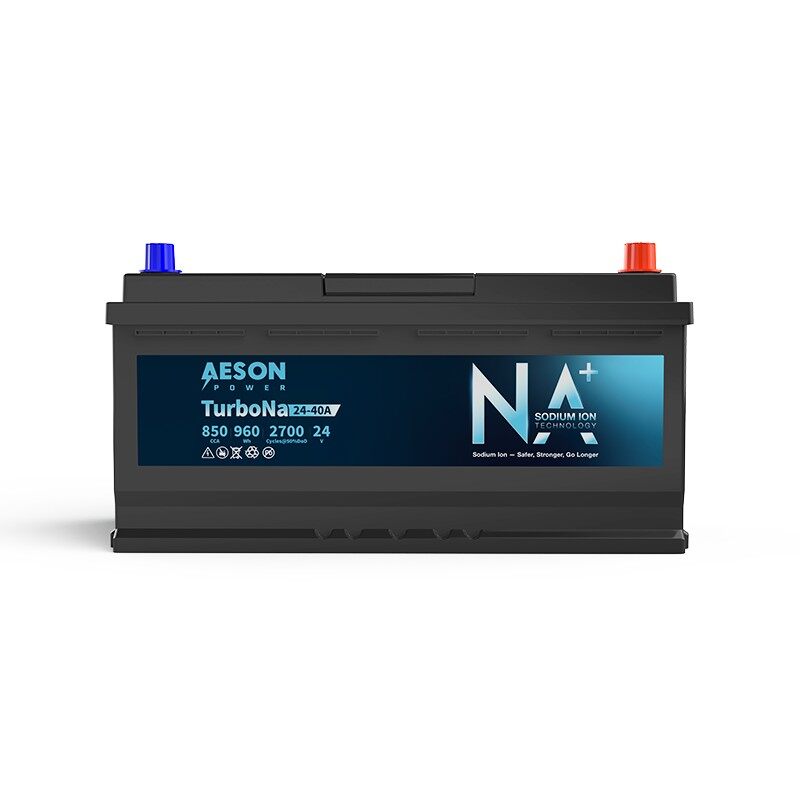
For instance, our 24--40A commercial starting battery is rated at 24V, with 850A CCA and 960Wh of energy capacity. The combination illustrates the distinct roles of system voltage, starting-current capability and stored energy in a commercial application. Before installation, operators should still verify the vehicle's specified battery arrangement, dimensions, terminal configuration and charging compatibility.
Battery construction also affects how well a unit handles demanding service. Electrode materials, internal resistance, cell design and connection quality influence current delivery and energy transfer. In commercial applications, vibration resistance and temperature tolerance deserve attention as well, since vehicles may operate for long hours across changing road and weather conditions. Regular inspection of terminals, cables and charging-system output can help identify problems before they cause starting difficulties.
Conclusion
The choice between 12V and 24V is ultimately an electrical-system decision, not a simple comparison of which number is larger. A vehicle designed for 12V needs a compatible 12V replacement, while a 24V commercial platform requires a battery arrangement that meets its specified starting and operating demands. Understanding the relationship between voltage, CCA and energy capacity makes it easier to evaluate a commercial battery without relying on a single headline rating.
At Aeson Power, we develop battery solutions for automotive starting and other energy applications, with a focus on sodium-ion technology, application-specific engineering and manufacturing capabilities. Our range addresses different voltage and operating requirements, helping customers assess battery options against their vehicle specifications. Visit our website to learn more about our commercial starting battery solutions and discuss the requirements of your application.