










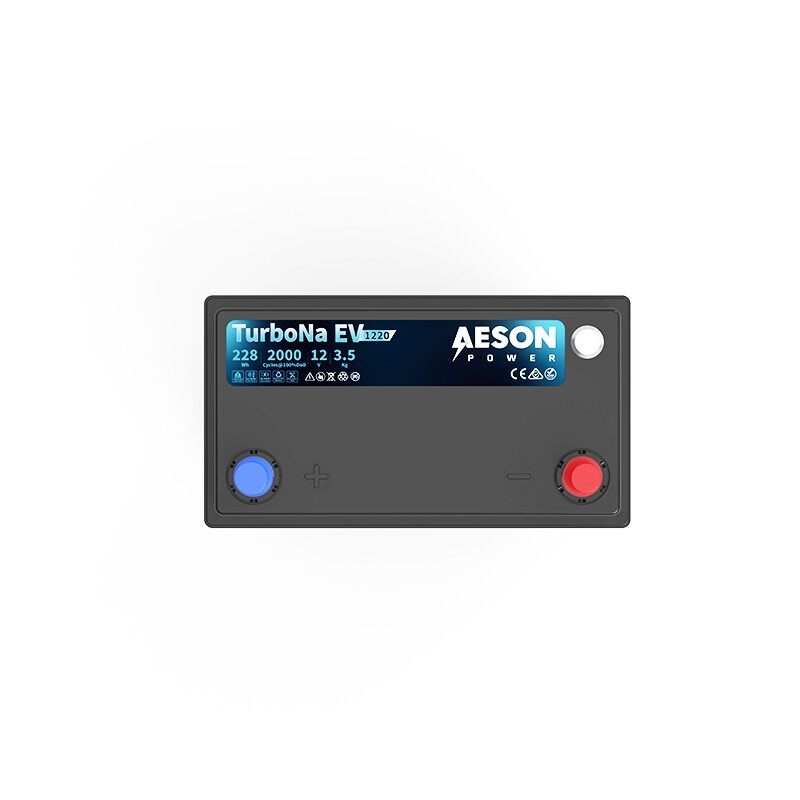
Commercial vehicle operators sometimes face a choice between installing one 24V battery or connecting two 12V units in series. Although both arrangements can supply a 24V electrical system, their installation requirements, maintenance considerations and failure characteristics are not identical.
Selecting an industrial vehicle battery involves more than matching voltage: equipment layout, available space, operating temperature and service conditions all influence the decision. At Aeson Power, we develop battery solutions for demanding applications, and understanding these system differences is an important part of making an informed selection.
How One 24V Battery and Two 12V Batteries Work
A single 24V battery provides the required system voltage within one battery assembly. Its internal cell configuration is designed to deliver the specified voltage and electrical output, reducing the number of separate battery units that need to be installed and connected. This arrangement may simplify external wiring, although the battery still needs suitable mounting, protection and electrical connections.
Two 12V batteries connected in series work differently. The positive terminal of one battery connects to the negative terminal of the other, allowing their voltages to add together: 12V plus 12V produces a nominal 24V system. The total available amp-hour capacity, however, remains equivalent to that of one battery in the series string, assuming both batteries have the same rated capacity.
Series connection also means that the two batteries operate as a combined system. If one unit becomes weak or develops a fault, the performance of the entire arrangement can be affected. Differences in age, capacity, internal resistance or state of charge may create imbalance, making battery matching and maintenance particularly important.
Installation, Maintenance and System Reliability
Space is often the first practical consideration. A single 24V assembly may fit installations designed around one battery enclosure, while two 12V units require room for separate cases, mounting points and an interconnecting cable. In some vehicles, the existing battery tray and service access make one arrangement more convenient than the other.
Maintenance requirements differ as well. With two batteries in series, technicians should inspect both units rather than evaluating only the overall system voltage. Measuring each battery separately can reveal voltage differences that might otherwise remain hidden. Using batteries with matching chemistry, capacity, age and condition helps reduce imbalance during operation and charging.
A single 24V battery has fewer external battery-to-battery connections, which can reduce the number of connection points requiring inspection. Nevertheless, this does not make it immune to electrical faults or internal degradation. Terminal condition, cable sizing, mounting security, charging performance and temperature exposure remain relevant regardless of configuration.
Temperature and Battery Performance in Demanding Environments
Commercial vehicles may operate in engine compartments, industrial sites or regions where ambient temperatures rise substantially. Heat can accelerate chemical reactions inside a battery, but prolonged exposure may also increase degradation, affect electrolyte stability and shorten service life. The actual impact depends on battery chemistry, cell design, thermal management and operating conditions.
Temperature ratings need careful interpretation. A stated maximum operating temperature describes a specified limit under defined conditions; it does not mean that continuous operation at that temperature has no effect on service life. Battery selection should account for the temperature around the battery itself, which may differ considerably from the outdoor air temperature.
Our 24--40A commercial starting battery is specified for high-temperature operation up to 80℃. Its rated voltage is 24V, with 850A CCA and 960Wh of energy capacity. These specifications provide useful reference points for evaluating a commercial starting application, but installation compatibility and the manufacturer's operating conditions should still be checked before use.
Evaluating Battery Technology and Application Requirements
The configuration is only one part of the decision; battery chemistry also shapes performance, charging requirements and maintenance considerations. Lead-acid and lithium-based systems have different charging characteristics, energy densities and operating limitations. Sodium-ion technology offers another chemistry option, with its own requirements for cell design, battery management and system integration.
For an industrial vehicle battery, the most relevant comparison should include starting current, usable energy, cycle requirements, temperature range, physical dimensions and compatibility with the vehicle's charging system. A 24V rating alone does not establish whether a battery can meet the demands of a particular engine or accessory load. Operators should also confirm whether the vehicle manufacturer specifies a single battery assembly or a series-connected pair.
Manufacturing consistency matters because small variations between cells can affect the behaviour of the finished battery. A capable sodium ion battery manufacturer needs to manage material quality, electrode production, cell assembly, formation and product testing. For commercial use, validation should extend beyond individual cell measurements to include finished-battery performance under relevant vibration, temperature and electrical-load conditions.
Conclusion
One 24V battery and two 12V batteries in series can both serve a 24V commercial electrical system, but they are not automatically interchangeable. The better arrangement depends on the vehicle's original design, available installation space, maintenance practices, charging equipment and operating environment. Evaluating these factors together provides a more reliable basis for selecting an industrial vehicle battery than comparing voltage figures alone.
At Aeson Power, we develop sodium-ion battery solutions for automotive starting, commercial vehicles and energy applications, combining application-focused engineering with manufacturing experience. As a sodium ion batteries manufacturer, we focus on battery design, production consistency and practical requirements across different operating environments. Visit our website to learn more about our commercial battery technology and discuss the specifications suited to your application.